Can you back up with a weight distribution hitch?
Straight answerReading span: 3 minchecked November 28, 2026by the editorial desk
Can you back up with a weight distribution hitch? Yes. Equal-i-zer and Andersen both say you can reverse and turn with the hitch hooked up. Take the tension off first only where the grade changes sharply, such as a steep driveway, and check that a bolt-on friction sway bar clears in a full jackknife.
Read-out
Yes, you can back up with the spring bars hooked up. Equal-i-zer says its hitch is designed to back up and take tight turns hooked up, and Andersen says its hitch can stay connected while reversing. Disengage the bars before backing over a sharp change in grade, and test a bolt-on friction sway bar in a jackknife before you rely on it.
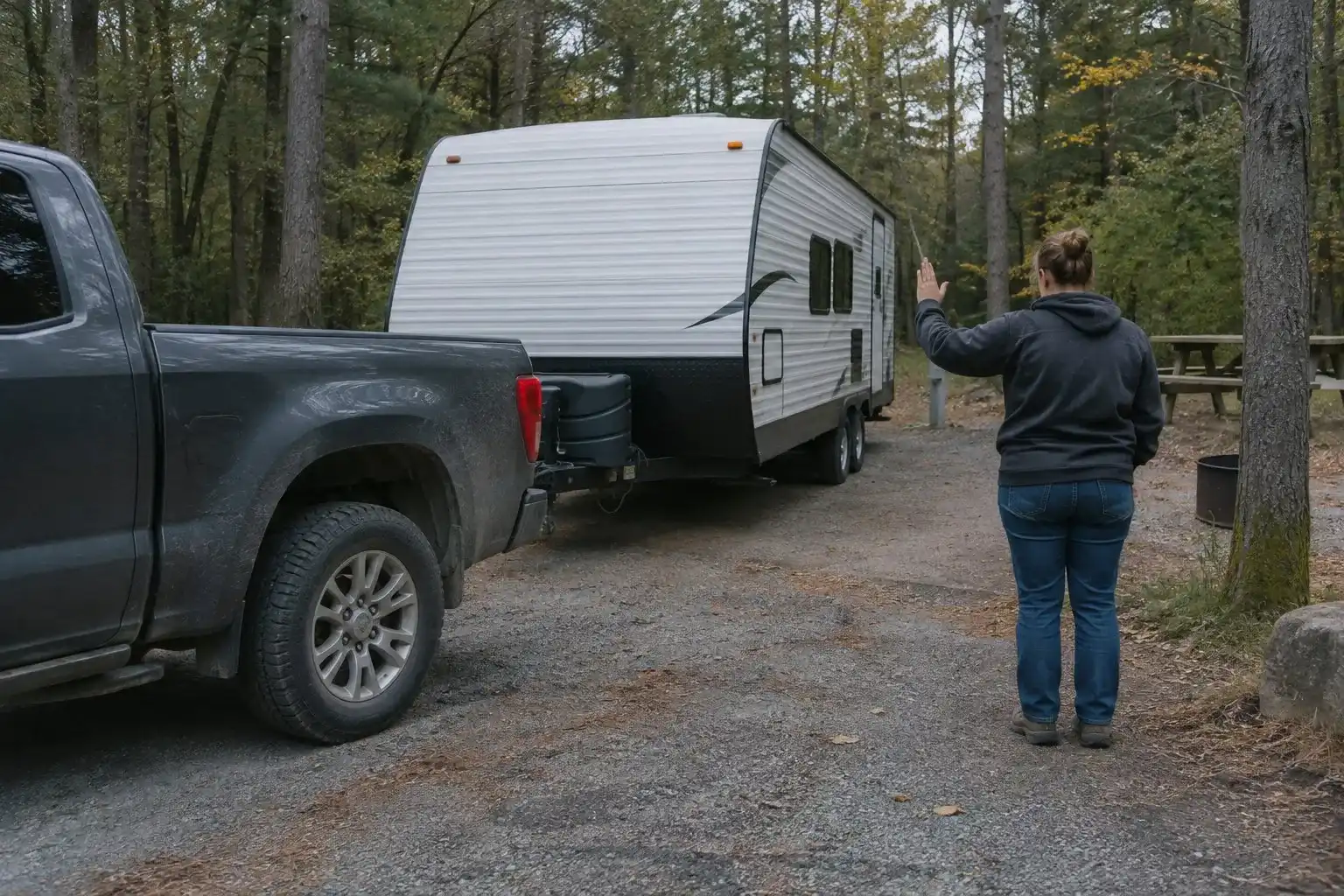
Yes, with the bars hooked up
Many first-time towers assume the spring bars must come off before every reverse. The makers say otherwise. Equal-i-zer says its hitch is designed to let you back up and take tight turns with the hitch hooked up. Andersen says its chain-free hitch can remain connected while backing up. On a level campsite or a flat driveway, you reverse the way you drove in.
The brackets have a lot to do with it. Equal-i-zer places its frame brackets 27 to 32 inches from the center of the coupler, which leaves the arms 2 to 3 inches of room past the bracket. If you set the brackets yourself, how to install a weight distribution hitch covers where they go.
Three times to take the tension off first
| Situation | What the maker says | What to do |
|---|---|---|
| Sharp change in grade | Equal-i-zer: disengage before towing or backing where the grade changes a lot, for example from a level street up a steep driveway | Jack the tongue, unhook the bars, back in, hook up again |
| Rough ground, ditches, boat ramps | Equal-i-zer: never tow with the hitch engaged on rough roads, through deep ditches and dips, or while launching a boat | Unhook the bars before you leave the pavement |
| Bolt-on friction sway bar | CURT: back slowly into a jackknife both ways; if the bar hits, bottoms out or comes apart, it must be removed while backing | Do the jackknife check once with a helper |
The grade rule is the one people miss. Equal-i-zer warns that failing to disengage there puts excessive strain on the trailer and the receiver hitch, and its rough-road rule names hitch fatigue or failure from excessive strain on the spring arms and head.
To unhook safely, take the load off with the tongue jack before you touch a pin. Equal-i-zer's manual says never to loosen or remove any part of the hitch while it is under load. The daily routine for hooking up and unhooking is on how to hook up a weight distribution hitch.
Friction sway bars are the one to check
A bolt-on friction bar is a separate telescoping part between the ball mount and the A-frame, so it has its own limit on how far the trailer can angle. CURT's 17200 sheet asks for one test: with a second person watching, back slowly into a jackknife in both directions. If the bar touches the bumper or trailer frame, compresses fully or pulls apart, take it off whenever you back up. If it clears, you can leave it on. Fitting and care for that kind of bar are on trailer sway bar.
Backing a trailer, in short
Ford's guide asks you to practice turning, stopping and backing in an area away from traffic before your first trip. Back slowly with a spotter at the rear of the trailer, keep one hand at the bottom of the steering wheel and move it the way you want the trailer to go. Small inputs do a lot at the trailer.
Backing into a campsite with a slope is a camper question as much as a hitch one; camper weight distribution hitch covers it. If you are still picking a hitch and want one that stays connected without fuss, Andersen's chain-free design is on the Andersen brand page.
Questions at the scale house
Q01What if the truck's bumper hits the trailer in tight turns?
Equal-i-zer's manual names extended bumper guards, truck campers and rear-mounted spare tires as things that limit your turning radius. If you cannot turn tightly with its standard 12 inch shank, it suggests asking your dealer about the longer 18 inch Equal-i-zer shank. Check the safety chains and trailer parts first, since they can also eat into the clearance.
Q02Can I back up with an Andersen hitch hooked up?
Yes. Andersen's weight distribution FAQ says the hitch can remain connected while backing up. Its chain-free design has no steel spring bars to swing on brackets; it uses chains with urethane springs and a friction cone at the ball. Andersen also says the hitch cannot be used with surge brakes, so check that before you buy.
Q03How do I steer when backing a trailer?
Ford's towing guide gives a simple rule: put one hand at the bottom of the steering wheel and move it in the direction you want the trailer to go. Make small inputs, because a slight movement of the wheel moves the rear of the trailer much more. Back slowly, with someone spotting near the rear of the trailer.
Weighed against
Next stop
- Hook-up routineShop stepsHow to use a weight distribution hitch on every trip: couple, lift with the jack, hook the bars, lower, connect chains and wiring. Unhooking too.
- InstallationShop stepsWeight distribution hitch installation in order: coupler height, ball, head on the shank, bars, A-frame brackets, then the torque values.
- AndersenMaker fileAndersen weight distribution hitch: how the chain-free cone design works, its 14,000 lb rating, set-up and care, and why surge brakes rule it out.
- Trailer sway barsBuying sheetTrailer sway bar guide: how a friction sway control bar works, the CURT 17200 we pick, where it mounts, when to take it off, and what it cannot fix.
- For campersBuying sheetWeight distribution hitch for a camper or travel trailer: size it on the packed tongue, not the brochure, and pick a kit that comes ready to tow.
Who weighs it up
weightdistributionhitch.com Editorial Desk
Towing set-up & hitch picks
We are the editorial desk at weightdistributionhitch.com. For every hitch we pull the tongue weight and trailer weight ratings, the shank and ball size, the bracket spacing and the torque values out of the maker's install sheet, then set them against the receiver label and the tow vehicle's own towing guide.
- — Ratings copied from the install sheet or part page, with document name
- — Set-up targets taken from the truck maker's towing guide, not a rule of thumb
- — "Not stated by maker" wherever a rating, surge-brake note or warranty term is missing