Do I need a weight distribution hitch?
Straight answerReading span: 3 minchecked November 28, 2026by the editorial desk
Do I need a weight distribution hitch? You need one when your vehicle guide or the receiver label says so, and the line differs by vehicle. Ford's 2026 guide sets it at 5,000 lb of trailer for the F-150. The receiver label adds a tongue weight limit, and Equal-i-zer notes that most owners reach the tongue limit before the trailer limit.
Paid links on this sheet: Links with a * go to Amazon, and a purchase through them pays this site a commission; your price stays the same. As an Amazon Associate I earn from qualifying purchases. How the links pay
Read-out
Yes, if your loaded trailer or tongue goes past the weight-carrying limit in your vehicle guide or on the receiver label. For the 2026 F-150 that is 5,000 lb of trailer and 500 lb on the tongue. Check the tongue first: most tongues weigh 10 to 15 % of the trailer, so that limit often comes first. Below the line, it is optional.
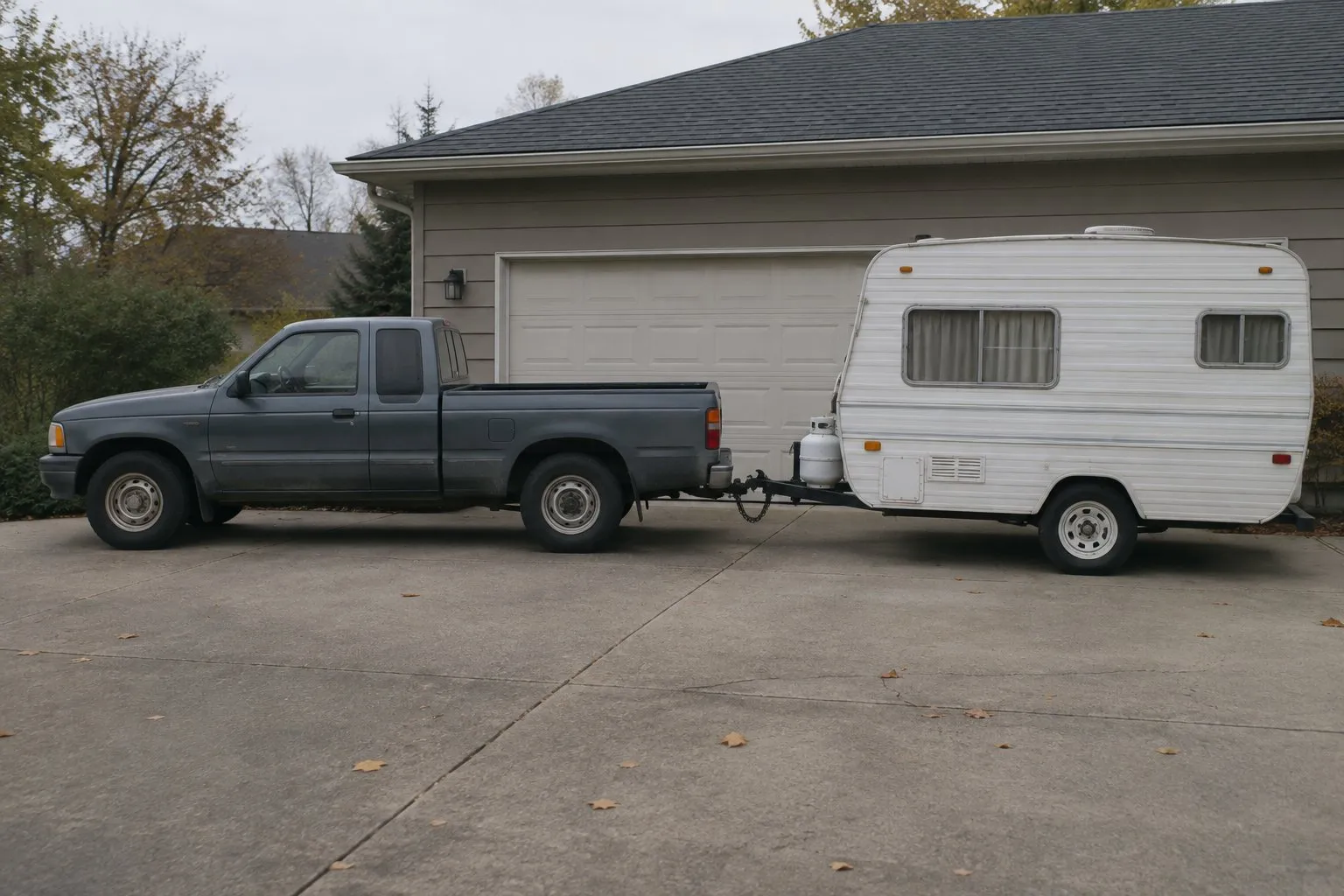
Two labels answer the question
There is no single weight above which every truck needs a weight distribution hitch. The answer sits in two places, and both are free to read:
- Your vehicle's towing guide or owner's manual. It names the trailer weight, or sometimes the tongue weight, above which a weight-distributing system is required.
- The label on your receiver hitch. Ford's guide notes that this label shows both a weight-carrying and a weight-distributing capacity. Past the first pair, you need the hitch to use the second.
Whichever line you reach first decides it. What the two hitch types are, side by side, is on weight-carrying vs weight-distributing hitch, and how to read the label is on hitch tongue weight rating.
What two vehicle makers actually say
| Vehicle | The line in the guide | Source |
|---|---|---|
| 2026 Ford F-150 | Do not exceed 5,000 lb of trailer without a weight-distribution system. Receiver: 5,000 lb / 500 lb weight-carrying, 13,500 lb / 1,400 lb weight-distributing | Ford 2026 RV & Trailer Towing Guide |
| 2026 Ram 1500 | No trailer or tongue weight named above which weight distribution is required. Factory Class IV hitch: 11,550 lb / 1,155 lb | Ram 2026 Ram 1500 Owner Handbook |
| Ford, all vehicles (class table) | Class III, 3,501 to 5,000 lb: not required unless specified for a particular vehicle. Class IV, over 5,000 lb: most applications require a weight-distributing or 5th-wheel hitch | Ford 2026 RV & Trailer Towing Guide |
The tongue line is the one people miss. Most trailer tongues weigh 10 to 15 % of the trailer, and Equal-i-zer points out that this is why you are more likely to pass a tongue weight limit before the trailer weight limit. Where a guide names no line at all, as Ram's 1500 handbook does, the receiver label is the limit you work with; the Ram 1500 tongue weight capacity page has the numbers. Work out your own range on tongue weight percentage.
No state or federal law was part of what we read, so this page does not answer the legal side. The vehicle guide is the document your truck's maker stands behind.
Below the line: optional, not pointless
Under the weight-carrying limit, a plain ball mount is allowed. That does not make the seesaw effect go away. Ford's guide warns that too much tongue load can press the vehicle down in back until the front wheels lose traction, steering response and braking. Equal-i-zer adds that cargo behind the truck's rear axle works the same way. If the nose of your truck rises visibly when the tongue drops on the ball, part of your steering grip went with it.
If the answer is yes
Size the hitch by loaded tongue weight, then set it to your vehicle maker's target. For the most common case, a travel trailer with 800 to 1,000 lb on the tongue, this is the kit we pick:
CURT 17062 Round Bar
Round-bar hitch, friction sway unit and a pre-torqued 2-5/16" ball in one box, for 800 to 1,000 lb of tongue weight.
Why it's on this ticket: CURT states 800 to 1,000 lb tongue weight and 8,000 to 10,000 lb trailers, with ball and friction sway unit in the box.
Fits: Travel and utility trailers with a loaded tongue weight of 800 to 1,000 lb and a 2" receiver

- Tongue weight (decides it)
- 800–1,000 lb
- Max trailer weight
- 8,000–10,000 lb
- Spring bars
- Round bar
- Sway control
- Friction unit #17200 (included)
- Shank
- 2" (flips for drop or rise)
- Ball
- 2-5/16", pre-torqued, included
- Surge brakes
- No (listing)
- Hitch, sway control unit #17200 and a pre-torqued 2-5/16" ball come in the box
- Grease zerk in the head for the spring bar sockets
- 2" shank flips for drop or rise; the head also takes CURT's 2-1/2" shank
- Sway control is a bolt-on friction unit, not built into the head
- Tongue weight range stops at 1,000 lb
- Not for surge brakes (stated in the listing); the hitch needs no drilling, but the included sway unit's plate is drilled into the A-frame
Lighter or heavier tongue? The hitch size guide and the best weight distribution hitch page cover the other ranges. And one myth to drop before you buy: the hitch does not raise your truck's tow rating. Ford's guide says towing values are the same for both hitch types on its Super Duty pickups, as explained on does a weight distribution hitch increase towing capacity. Vehicle-specific limits for the Ford F-150 have their own page.
Questions at the scale house
Q01Does a 4000 pound trailer need a weight distribution hitch?
Not by Ford's general rule. Ford's guide groups 3,501 to 5,000 lb trailers as Class III and says a weight-distributing hitch is not required unless specified for a particular vehicle. Check your vehicle's own page or owner's manual, and the tongue weight: a tongue limit, such as the 500 lb weight-carrying rating of the F-150 receiver, can be reached before the trailer limit is.
Q02When do you need a weight distribution hitch?
When your loaded trailer weight or tongue weight goes past the weight-carrying limit that your vehicle guide or the receiver label gives. Ford's guide also says weight-distributing hitches are required for certain Class III and all Class IV applications, and Class IV in that guide means trailers over 5,000 lb.
Q03Is a weight distribution hitch worth it below the limit?
It can be. Ford's guide describes how too much tongue load can lift the front wheels until traction, steering response and braking drop. If the front of your truck rises noticeably when you hitch up, a weight distribution hitch puts part of that load back on the front axle. Set it to your vehicle's target, as Equal-i-zer's manual warns against under- and over-distribution.
Weighed against
Next stop
- Carrying vs distributingSide by sideWeight carrying hitch vs weight distribution hitch: where the tongue load goes, what the receiver label allows for each, and when Ford calls for it.
- Hitch tongue ratingHow it worksTrailer hitch tongue weight rating explained: the two limits on the receiver label, why the truck and the ball have their own, and which one wins.
- Does a weight distribution hitch increase towing capacity?Straight answerDoes a weight distribution hitch increase towing capacity? No. It unlocks the receiver's higher rating, while your truck's tow rating stays the same.
- What size weight distribution hitch do I need?Straight answerWhat size weight distribution hitch do I need? Size the bars by loaded tongue weight plus rear cargo, then check trailer GVWR and the receiver label.
- How much tongue weight should a trailer have?Straight answerHow much tongue weight should a trailer have? 10 to 15 % of its loaded weight, Ford plans with 10 %. What is acceptable and how to fix it.
Who weighs it up
weightdistributionhitch.com Editorial Desk
Towing set-up & hitch picks
We are the editorial desk at weightdistributionhitch.com. For every hitch we pull the tongue weight and trailer weight ratings, the shank and ball size, the bracket spacing and the torque values out of the maker's install sheet, then set them against the receiver label and the tow vehicle's own towing guide.
- — Ratings copied from the install sheet or part page, with document name
- — Set-up targets taken from the truck maker's towing guide, not a rule of thumb
- — "Not stated by maker" wherever a rating, surge-brake note or warranty term is missing