Weight distribution hitch parts: shanks, brackets, bars and sway
Buying sheetReading span: 5 minchecked November 28, 2026by the editorial desk
Weight distribution hitch parts are bought one at a time for three reasons: a new truck that needs a different shank, a new trailer that needs other brackets, or sway control the hitch never had. Each part has to match your hitch's maker and rating. The two parts most owners add are a friction sway bar and a drop shank.
On the ticket
Missing sway control on a WD hitch with sway tabs? The CURT 17200 friction bar fits most weight distribution hitches. A lifted truck on a 2-1/2 inch receiver with a CURT hitch? The CURT 17132 shank gives up to 8 inches of drop. Spring bars, heads and brackets come from your hitch's maker, sized to its rating.
Paid links on this sheet: Links with a * go to Amazon, and a purchase through them pays this site a commission; your price stays the same. As an Amazon Associate I earn from qualifying purchases. How the links pay
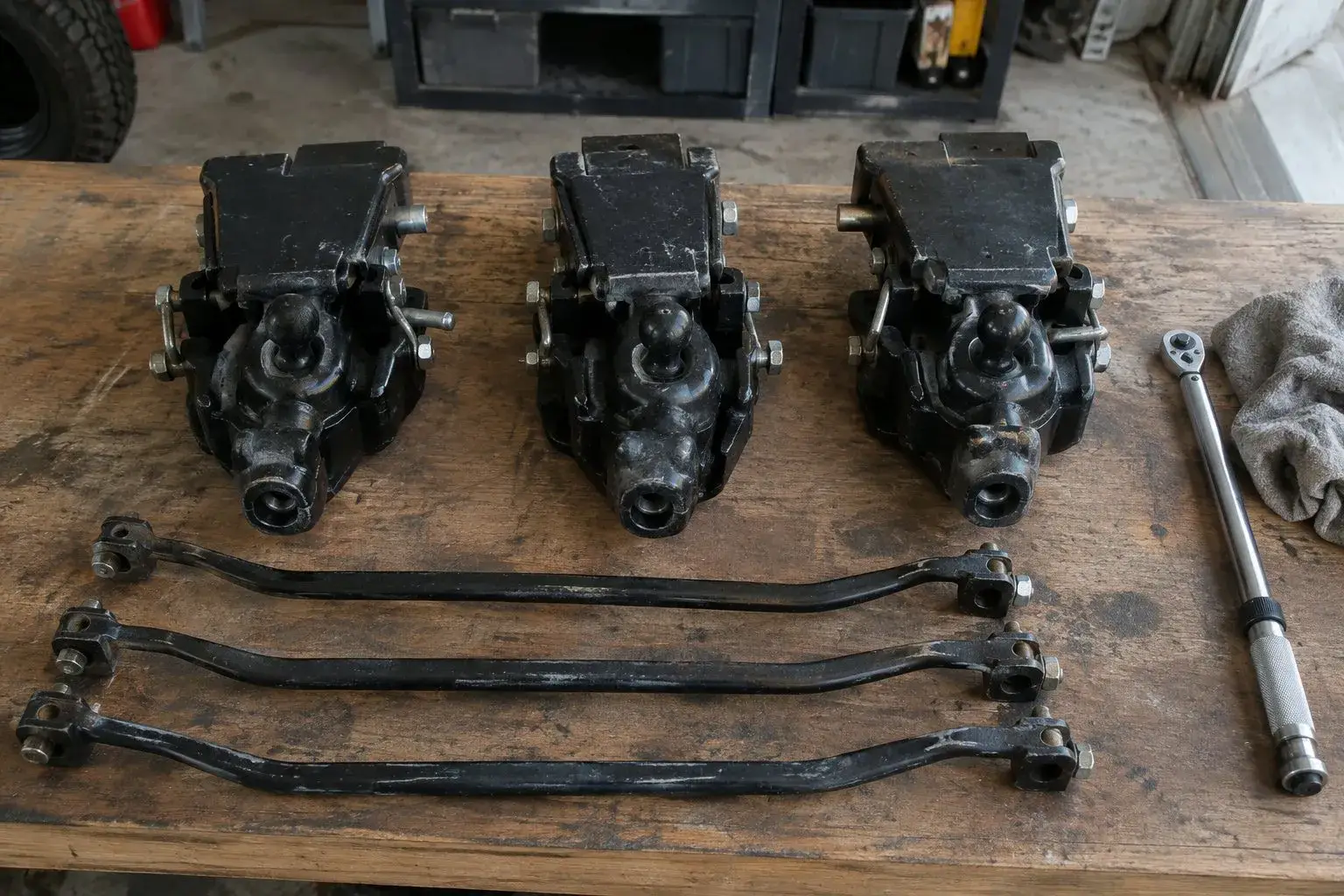
The parts, and which ones you can swap
A weight distribution hitch is a kit of parts that work as one. Some can be replaced freely, some only with the same maker's part in the same rating. What each part does is explained on parts of a weight distribution hitch; this page is about buying them.
| Part | What it does | Buy it from |
|---|---|---|
| Shank | Slides into the receiver and sets the head's height | The hitch maker; CURT shanks fit all CURT WD hitches |
| Head | Holds the ball and the spring bar sockets | The hitch maker, matched to the hitch type |
| Spring bars (arms) | Carry the load shift under tension | The hitch maker, same rating as the head |
| Hookup brackets / L-brackets | Hold the bars on the trailer's A-frame | The hitch maker; different versions for LP tanks and frame sizes |
| Spacer washers | Set the head tilt and so the bar tension | The hitch maker |
| Pins and clips | Lock shank, head and bars | The hitch maker |
| Friction sway bar | Adds sway control beside the hitch | Fits most WD hitches with sway tabs |
| Hitch ball | Couples the trailer | Any ball of the right size, thread and rating |
The rule behind the right-hand column comes from the makers. Equal-i-zer's manual says each hitch has two spring arms sized for a head of the same rating, and that they will not fit a head of a different rating. CURT says its heads are specific to TruTrack, trunnion or round bar hitches. Mixing load-carrying parts is not something any maker we read allows.
Sway control you can add
CURT 17200 Sway Control
Friction sway bar with an on/off handle and an adjustment bolt; fits most WD hitches or a weld-on tab.
Why it's on this ticket: CURT says it fits most weight distribution hitches or a sway tab mount, with both attachment balls and a weld-on tab in the kit.
Fits: Adding friction sway control to a WD hitch with sway tabs, or to a plain ball mount with the weld-on tab

- Sway control
- Friction, on/off handle
- Fits (decides it)
- Most WD hitches, or weld-on tab
- Included
- Unit, 2 attachment balls, tab, plate, clips
- On/off handle and adjustment bolt
- Fits most weight distribution hitches; weld-on tab included for plain ball mounts
- Both attachment balls included
- CURT recommends two units for larger trailers
- Some drilling on the trailer frame may be needed
- No load rating stated on the part page
The most common add-on is a friction sway bar. CURT's 17200 uses a brake-pad-like material to resist sideways movement, with an on/off handle and an adjustment bolt. The kit includes the sway unit, a trailer-mounted attachment ball and bolt, a hitch-mounted attachment ball, a weld-on tab for left-hand use or for a plain ball mount, a reinforcement plate and clips. Fitting it on most A-frame trailers needs some drilling.
Know its limits before you order. CURT's installation sheet says it cannot be used on trailers with surge brakes, and must be removed on wet, icy, gravel or snow-covered roads. Larger, heavier or broad-sided trailers may need two units. CURT's 17062 and 17422 hitches already include one, so check your box first. Fitting and care are on the trailer sway bar page, and the design question, bolt-on versus built in, is on integrated vs friction sway control.
Shanks: the part a new truck changes
The shank decides how high the head sits. A new truck with a taller or lower receiver often needs a different one, while the rest of the hitch stays.
CURT's replacement shanks are solid welded steel and come with maximum drops from about 7-1/2 to 19-3/4 inches, maximum rises from about 5-1/2 to 10-1/4 inches, and lengths of 8 to 14 inches. CURT says they are compatible with all CURT weight distribution hitches. For lifted trucks, the one we pick is the 17132:
CURT 17132 8" Drop Shank
Solid-steel 2-1/2" shank with up to 8" of drop for lifted trucks; works with all CURT WD hitches.
Why it's on this ticket: Up to 8 inches of drop on a 2-1/2 inch receiver, rated 15,000 lb and 1,500 lb but limited to your spring bars' rating.
Fits: Lifted trucks and tall receivers with a 2-1/2" receiver and a CURT WD hitch

- Shank
- 2-1/2" receiver
- Drop (decides it)
- Up to 8" (no rise)
- Rating
- 15,000 lb / 1,500 lb, limited to the bars
- Up to 8" of drop
- Works with all CURT weight distribution hitches
- Rated 15,000 lb / 1,500 lb, limited to the spring bar rating
- Not rated for use in the rise position
- Shank only, the hitch is sold separately
- Needs a 2-1/2" receiver
The 17132 is 14-1/2 inches high and 12-1/2 inches long, with 3/4 inch holes spaced 1-1/4 inches apart for head height. It is not rated for use in the rise position, and it is the shank only. How to work out the drop you need is on how to measure hitch drop, and the shank choices are compared on drop hitch for weight distribution.
Brackets: the part a new trailer changes
The brackets bolt to the trailer's A-frame and hold the spring bars. CURT notes that you may need replacement hookup brackets for a different trailer, and offers standard versions, versions for trailers with LP tanks, and TruTrack support brackets for different frame thicknesses. Its snap-up brackets can be levered into place with a lift handle.
Placement matters as much as the part. Equal-i-zer's FAQ puts its frame brackets 27 to 32 inches from the center of the coupler, and its manual asks for at least 3 inches between the end of each spring arm and the center of the L-bracket once the tongue weight is on the hitch. If there is less, the brackets move forward. Bracket work is part of how to install a weight distribution hitch.
Washers, pins and the ball
- Spacer washers set the head tilt. Equal-i-zer's manual says to add washers or raise the L-brackets when the set-up is under-distributed, and to remove washers or lower the brackets when it is over-distributed. Use the washers your maker specifies; the method is on weight distribution hitch adjustment.
- Pins and clips hold everything together under load. Equal-i-zer warns never to loosen or remove any part of the hitch while it is under load, and to take the tension off the spring arms with the tongue jack before you pull the L-pins.
- The ball must match the coupler, and Equal-i-zer asks for a ball rated at least as high as the trailer's gross weight. CURT's kits include a pre-torqued 2-5/16 inch ball. Sizes and threads are on hitch ball for a weight distribution hitch.
When a part is worn out
Equal-i-zer's manual asks you to check for damage or abnormal wear at the start of each trip and to replace worn parts. The friction surfaces of its head and sockets get cleaned and greased before each trip; CURT's 17062 has a grease zerk in the head instead. Never grease a friction sway bar's slide bar, CURT warns, because it works by friction. A routine for all of it is on weight distribution hitch maintenance.
If parts are failing one after another, compare the cost of the parts with a new hitch sized to your current tongue weight. The best weight distribution hitch page sorts complete kits by that number. CURT lists a limited lifetime warranty on its kits and shanks, with one year on parts and finish, so check that first.
CURT 17200 Sway Control: hitch it or leave it?
TKT 15+ Hitch it if …
- If your WD hitch has sway tabs but no sway control yet
- If you want sway control you can switch off, for example before backing into a site
− Leave it if …
- If your hitch already has integrated sway control
- If you don't want to drill the trailer A-frame
Numbers match? Check the CURT 17200 Sway Control listing for the exact rating and what is in the box.
Amazon price: View on Amazon(paid link to Amazon, opens in a new tab)Ad · paid link · check price & delivery on AmazonAd · paid link · price as of ·Questions at the scale house
Q01Can I mix parts from different weight distribution hitch brands?
Not for the load-carrying parts. Equal-i-zer's manual says its spring arms are sized for a hitch head of the same rating and will not fit a head of a different rating, even within its own range. CURT says its replacement shanks fit all CURT weight distribution hitches but does not say they fit other brands. A friction sway bar like CURT's 17200 is the exception: CURT says it fits most WD hitches.
Q02Do I need new brackets for a different trailer?
Often, yes. CURT notes that you may need replacement hookup brackets when you move the hitch to another trailer, and sells versions for trailers with LP tanks or other parts in the way. Whatever you fit, the hitch has to be set up again: Equal-i-zer warns never to move a hitch to a different tow vehicle or trailer without readjusting it.
Q03Where do I buy replacement parts for an Equal-i-zer hitch?
From Equal-i-zer directly. Its FAQ says it takes orders for replacement parts by phone, and that orders generally ship the next business day by UPS or USPS. Have the model number from the spring arm sticker ready, because arms and head must match in rating.
Weighed against
Next stop
- Parts explainedHow it worksParts of a weight distribution hitch, from shank and head to spring bars, brackets, pins and sway control: what each one does and where you adjust it.
- Drop shankBuying sheetA drop hitch for weight distribution is a taller shank under the hitch head. Measure the drop, match the receiver size, and keep every rating in mind.
- Trailer sway barsBuying sheetTrailer sway bar guide: how a friction sway control bar works, the CURT 17200 we pick, where it mounts, when to take it off, and what it cannot fix.
- AdjustmentShop stepsWeight distribution hitch adjustment: which washer, bracket or ball change adds or removes tension, and how to spot over- and under-distribution.
- Hitch ballHow it worksThe 2-5/16 hitch ball on a WD hitch: why the coupler sets the size, which shank fits the head, the ball rating you need and how tight the nut goes.
- MaintenanceShop stepsWeight distribution hitch maintenance in ten minutes: where the grease goes and where it never goes, which bolts to check and what wear to look for.
Who weighs it up
weightdistributionhitch.com Editorial Desk
Towing set-up & hitch picks
We are the editorial desk at weightdistributionhitch.com. For every hitch we pull the tongue weight and trailer weight ratings, the shank and ball size, the bracket spacing and the torque values out of the maker's install sheet, then set them against the receiver label and the tow vehicle's own towing guide.
- — Ratings copied from the install sheet or part page, with document name
- — Set-up targets taken from the truck maker's towing guide, not a rule of thumb
- — "Not stated by maker" wherever a rating, surge-brake note or warranty term is missing