Trailer sway bar: the friction kit we pick, and how to fit it
Buying sheetReading span: 7 minchecked November 29, 2026by the editorial desk
A trailer sway bar is a friction unit that bolts between your ball mount and the trailer's A-frame and resists side-to-side movement. The CURT 17200 is the usual answer: on/off handle, adjustment bolt, and it fits most weight distribution hitches. It does not move any weight, and it has to come off for slippery roads.
On the ticket
Take the CURT 17200 if your WD hitch has a sway tab and no sway control yet. It mounts 24 inches back from the coupler, switches on and off with a handle, and CURT recommends two for larger trailers. It is not for surge brakes, and CURT says to remove it on wet, icy, gravel or snowy roads.
Paid links on this sheet: Links with a * go to Amazon, and a purchase through them pays this site a commission; your price stays the same. As an Amazon Associate I earn from qualifying purchases. How the links pay
What a sway bar is, and what it is not
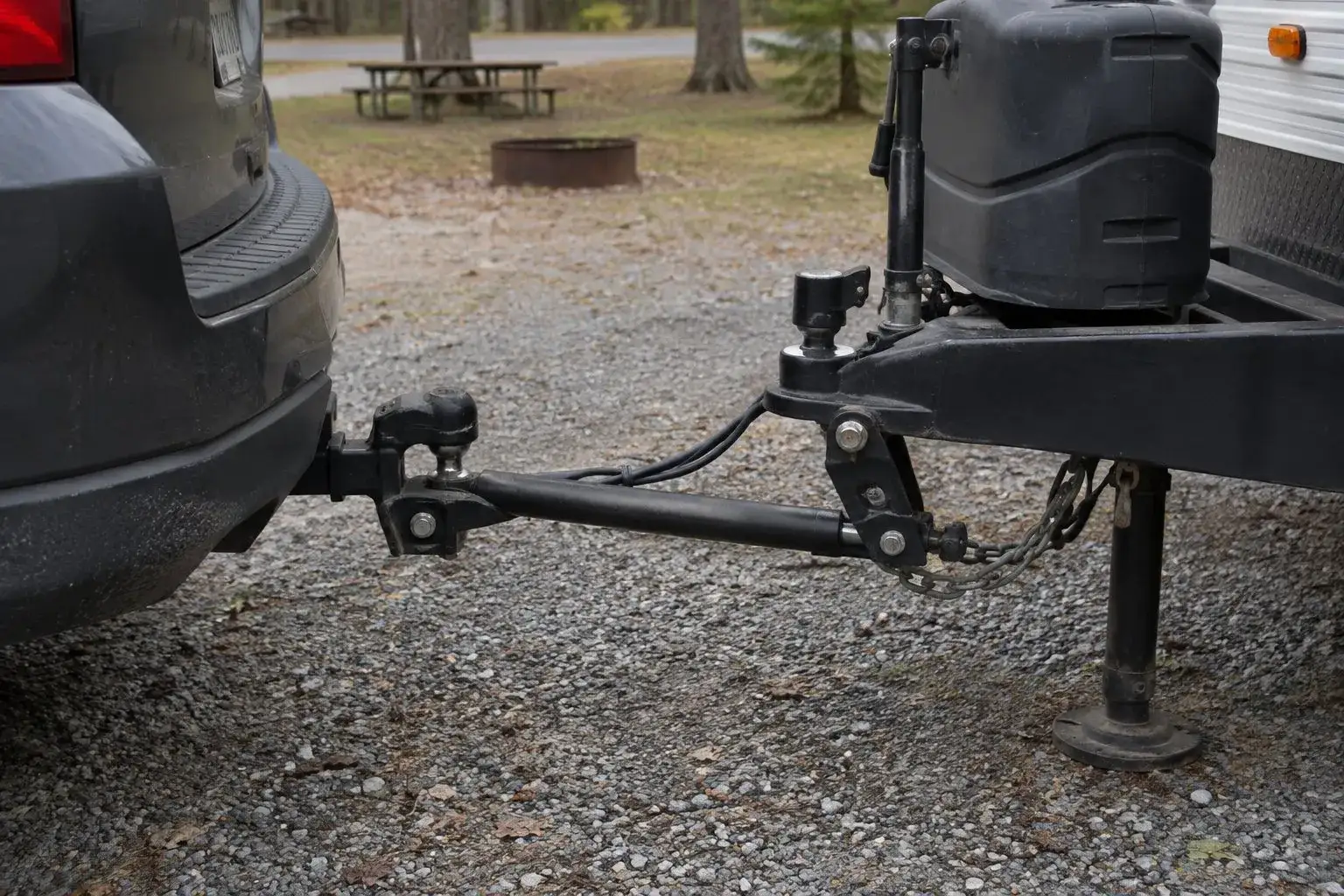
"Sway bar" means two different things around a truck. On the chassis it is an anti-roll bar. At the hitch it is a friction sway control bar: a telescoping bar in a friction housing, fixed to a small ball on the ball mount at one end and to a bracket on the trailer's A-frame at the other. When the trailer starts to swing, the bar has to slide, and the friction resists it. CURT sums up the job as limiting lateral trailer movement to reduce sway.
What it does not do matters just as much:
- It moves no weight. A sway bar carries none of the tongue load. If your truck's rear sags and the front feels light, you need weight distribution; that difference is on weight distribution hitch vs sway bar.
- It does not cure a bad load. CURT's own warning names insufficient tongue weight and tail-heavy trailers as causes of sway. Equal-i-zer's manual adds that no hitch setup guarantees that sway will be avoided altogether.
- It is not the truck's electronic sway control. Ford lists a Trailer Sway Control feature for many of its trucks. That is an electronic system in the truck; the bar works mechanically and all the time. Both are covered on trailer sway control.
Many weight distribution hitches already include a friction bar. The CURT 17062 ships with exactly this unit, the 17200, in the box. If you are still choosing a hitch, start at the parent page on weight distribution hitches with sway control.
Two friction bars compared
| CURT 17200 | Reese 83660 | |
|---|---|---|
| Type | Friction bar, on/off handle, adjustment bolt | Friction bar for WD set-ups |
| Fits | Most WD hitches, or a sway tab mount; weld-on tab for plain ball mounts | Not stated in the listing title |
| In the box | Unit, hitch-side ball, trailer-side ball and bolt, weld-on tab, reinforcement plate, clips | Not stated in the listing title |
| Surge brakes | Not usable (CURT warning) | Not stated by maker |
| Mounting distance | Trailer ball centered 24 in back from coupler center | Not stated by maker |
| Drilling | Six 11/32 in holes for the frame plate | Not stated by maker |
| Load or trailer rating | Not stated by maker | Not stated by maker |
| Warranty | Limited lifetime; one year finish, one year parts | Not stated by maker |
| Maker data read | Part page and installation sheet 17200-INS-R1 | No, listing title only |
| Hard trade-off | Comes off for wet, icy, gravel or snowy roads and for surge brakes | Fit to your hitch cannot be checked before you order |
Neither maker prints a trailer weight or tongue weight rating for its friction bar, so the bar never raises what your hitch or receiver may carry. The rating that counts stays on the spring bars and the receiver label.
The CURT wins on what we can actually show you: a part page and an installation sheet with distances, steps and warnings. The Reese is a friction bar made for weight distribution set-ups, but everything we know about it comes from the listing title. How it pairs with Reese's own hitches is on the Reese weight distribution hitch page.
Reese 83660 Sway Control
Reese's friction sway control bar for weight distribution set-ups.
Why it's on this ticket: A friction sway control bar for weight distribution set-ups from Reese – a second option, with fit and rating to be read off the listing before you order.
Fits: Adding friction sway control to a Reese or similar WD hitch
We could read only the Amazon listing for this product, so every figure here comes from that listing.

- Sway control (decides it)
- Friction bar
- Friction sway control for WD set-ups
- Only the listing title could be read
- Fit and rating not in the listing title
Where the CURT 17200 goes on your trailer
The installation sheet is short, and every measurement in it counts.
Set the hitch-side ball
Most weight distributing ball mounts come with a sway control ball plate. Bolt the small sway ball there. No plate? Weld the supplied tab to the ball mount, and CURT says any welding belongs in a qualified welding shop.Measure 24 inches back
From the center of the coupler, measure 24 inches straight back along the right side of the trailer frame. The trailer-side attachment ball must be centered on that mark.Drill and fit the plate
Transfer the holes from the spacer plate to the frame, drill 11/32 inch holes and fix the plate and ball with the self-tapping screws.Hook up with the tension off
Hitch the trailer. Turn the on/off handle three turns counterclockwise, clip the slide bar onto the hitch-side ball and the body onto the trailer-side ball.Tighten and check the jackknife
Turn the handle clockwise until it sits parallel to the body. With a helper watching, back slowly into a jackknife both ways and check that the bar never hits, bottoms out or pulls apart.
Then road test at CURT's factory preset tension. If that is not enough, turn the tension screw a quarter turn clockwise, test again, and repeat until the trailer tracks the way it should.
Primary source: CURT 17200 installation instructions 17200-INS-R1 and CURT part page 17200, read 29.11.2026.
Before you drill: the A-frame minute
- Brakes: electric brakes, not surge. With surge brakes the 17200 is ruled out.
- Sway tab: your WD hitch head has a sway ball plate or tab. CURT's 17062 head takes two sway balls; a plain ball mount needs the weld-on tab, welded in a shop.
- The 24 inch mark: measure 24 inches back from the coupler center along the frame. Nothing there – no propane line, wiring or jack – blocks a plate with six screws.
- Jackknife clearance: you can check with a helper that the bar does not hit the bumper or frame when you back into a tight turn both ways.
- Your roads: if you often tow on gravel or in rain or snow, you will be taking the bar off often. Read what a built-in design's manual says about those roads before you switch, because the rules differ by maker.
Bar, second bar or a different hitch
- Take the CURT 17200 instead of the Reese 83660 if you want to confirm the mounting distance, drilling and warnings before you buy; only CURT's sheet could be read.
- Take two 17200 units instead of one if the trailer is large, heavy or broad-sided, as CURT's sheet says.
- Take a hitch with built-in sway control instead of any bar if the trailer has surge brakes and you need a maker's written yes; among the hitches here, that is the Equal-i-zer on weight distribution hitch with sway control.
One bar or two
CURT recommends two units for larger trailers, and the installation sheet extends that to heavier and broad-sided trailers, so a tall travel trailer can call for two bars even when its weight alone would not. The kit's weld-on tab adapts the unit for left-hand mounting, so the second bar can sit on the other side of the A-frame.
Care: clean it, never grease it
The slide bar works by friction, so CURT says never to paint or lubricate it. After the first 1,000 miles, pull the slide bar and clean it with a wire brush or steel wool, then repeat every 10,000 miles. The only oil goes on the handle threads, one drop before hook-up.
When the trailer sways anyway
A friction bar buys you margin, not immunity. CURT's 17200 instructions name too little tongue weight and tail-heavy loading as causes of sway, and list road and weather, the trailer's load and design, steering and wheel alignment among the things that affect towing. If the trailer starts to swing:
- Do not speed up. CURT's instructions say sway increases with speed.
- Do not hit the truck's brake pedal. Ford's guide says to work the trailer brakes by hand with the brake controller, because the tow vehicle's brakes can make the sway worse.
- Once it settles, stop and check the load, the tire pressures and the hitch.
Why trailers start swinging in the first place, and how tongue weight plays into it, is on what causes trailer sway. If you are weighing a bolt-on bar against sway control built into the hitch head, built-in vs friction sway control lays out the trade-offs.
CURT 17200 Sway Control: hitch it or leave it?
TKT 15+ Hitch it if …
- If your WD hitch has sway tabs but no sway control yet
- If you want sway control you can switch off before backing into a site
- If your trailer has electric brakes
− Leave it if …
- If your trailer has surge brakes
- If your hitch already has integrated sway control
- If you don't want to drill the trailer A-frame
Numbers match? Check the CURT 17200 Sway Control listing for the exact rating and what is in the box.
Amazon price: View on Amazon(paid link to Amazon, opens in a new tab)Ad · paid link · check price & delivery on AmazonAd · paid link · price as of ·Questions at the scale house
Q01How do trailer sway bars work?
A friction sway bar links the ball mount and the trailer frame through a sliding bar inside a friction housing. When the trailer starts to swing sideways, the bar has to slide against that friction, which resists the movement. CURT's unit attaches to its own small ball on the ball mount, separate from the coupling ball.
Q02Do I need one sway bar or two?
One fits most trailers. CURT recommends two of its 17200 units for larger trailers, and the installation sheet adds heavier and broad-sided trailers to that list. The second unit goes on the other side of the A-frame; the weld-on tab in the kit adapts the set-up for left-hand use.
Q03Can I back up with a friction sway bar on?
Check it once. CURT's sheet has a helper watch while you back slowly into a jackknife in both directions. If the bar hits the bumper or the trailer frame, compresses fully or pulls apart, the sway control must be removed for backing. If it clears all three, the sheet does not ask you to take it off.
Q04Should I use the sway bar on wet or icy roads?
No. CURT's warning for the 17200 says the sway control must be removed when towing in slippery conditions such as wet, icy, gravel or snow-covered roads. Unhook it before you head into that kind of weather and hook it back up when the road is dry.
Q05Does a trailer sway bar need grease?
Not the slide bar. CURT says never to paint or lubricate it, because the bar works by friction. Clean it with a wire brush or steel wool after the first 1,000 miles, then every 10,000 miles. A drop of oil goes only on the threads of the on/off handle.
Weighed against
- [1]CURT, part 17200 trailer sway control kit
- [2]CURT, 17200 sway control installation instructions, 17200-INS-R1 (PDF)
- [3]CURT, part 17062 round bar weight distribution hitch
- [4]CURT, 17062 round bar weight distribution kit installation instructions (PDF, no revision printed; head takes two sway balls)
- [5]Equal-i-zer 4K owner's manual (PDF)
- [6]Ford, 2026 RV & Trailer Towing Guide
Next stop
- WD hitch vs sway barSide by sideWeight distribution hitch vs sway bar: one moves tongue load to the front axle, the other resists sideways movement. When you need both.
- Built-in vs frictionHow it worksWeight distribution hitch with built-in sway control vs a bolt-on friction bar: how 4-point, cam, cone and bar designs resist sway.
- Causes of swayFault and fixWhat causes trailer sway: too little tongue weight, a tail-heavy load, speed, wind and loose bar tension. How to stop it and fix the cause.
- With sway controlBuying sheetWeight distribution hitch with sway control: built-in 4-point designs vs bolt-on friction bars, what each maker states, and which fits.
- Trailer sway controlHow it worksTrailer sway control comes two ways: electronics in the truck that brake once sway starts, and hitch hardware that resists it all the time. Use both.
Who weighs it up
weightdistributionhitch.com Editorial Desk
Towing set-up & hitch picks
We are the editorial desk at weightdistributionhitch.com. For every hitch we pull the tongue weight and trailer weight ratings, the shank and ball size, the bracket spacing and the torque values out of the maker's install sheet, then set them against the receiver label and the tow vehicle's own towing guide.
- — Ratings copied from the install sheet or part page, with document name
- — Set-up targets taken from the truck maker's towing guide, not a rule of thumb
- — "Not stated by maker" wherever a rating, surge-brake note or warranty term is missing