How to measure hitch drop and rise for a weight distribution shank
Shop stepsReading span: 3 minchecked November 28, 2026by the editorial desk
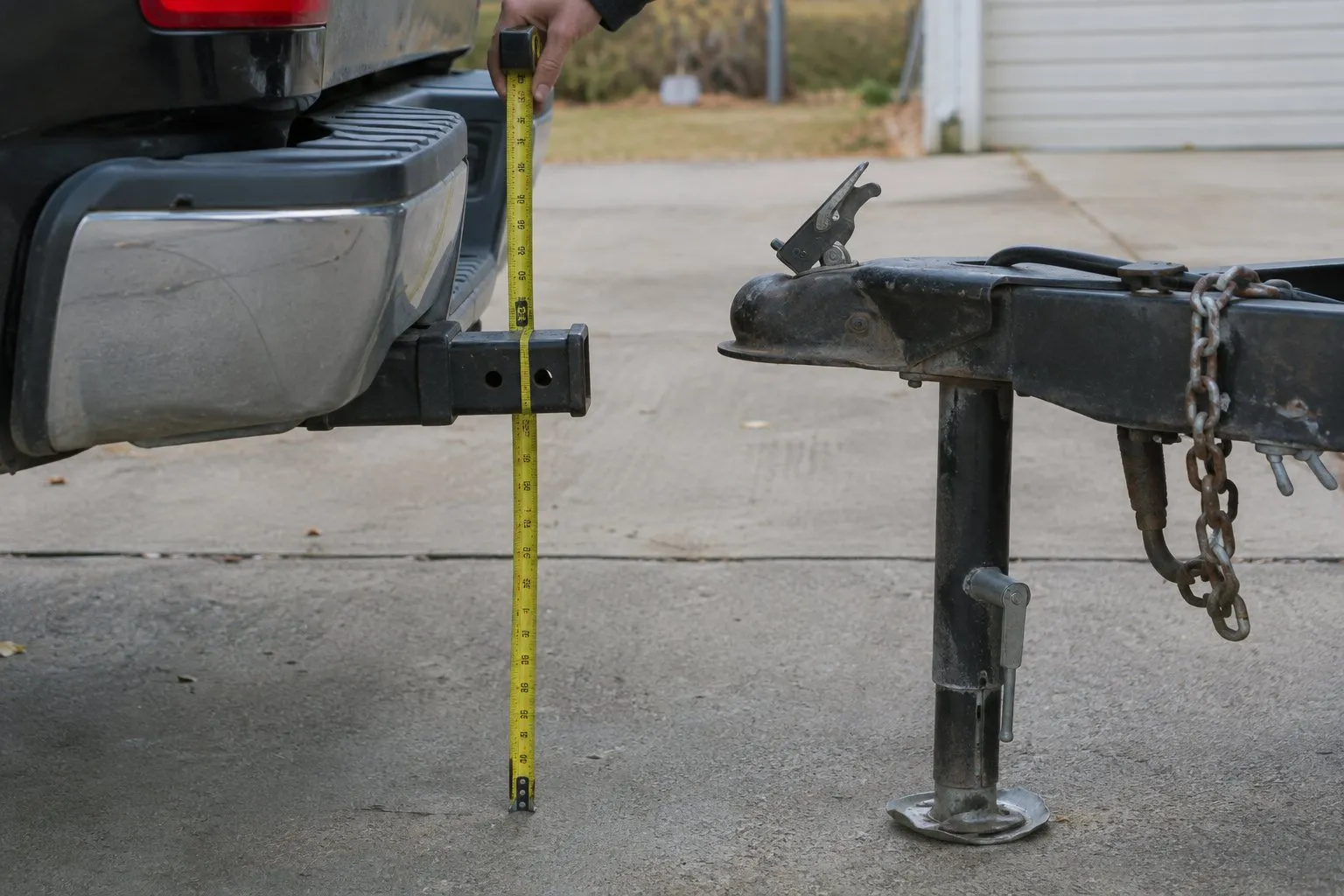
How to measure hitch drop: park truck and trailer loaded on level ground, level the trailer, then measure from the ground to the top of the coupler and from the ground to the inside top of the receiver. The difference tells you whether the shank needs drop or rise. Your hitch maker sets the exact ball height: level with the coupler, or up to an inch above it.
On the ticket
Level the loaded trailer and measure ground to the top of the coupler. Measure the loaded truck from the ground to the inside top of the receiver tube. Equal-i-zer turns the two into drop or rise as (receiver height + 3) minus coupler height. Ford wants the ball at coupler height; Equal-i-zer puts the top of the ball 0 to 1 inch above the top of the coupler.
Why the ball height matters before anything else
A weight distribution hitch is set up from the ball height outward. Ford's set-up places the ball at coupler height before the first fender measurement, and every later step assumes the trailer rides level. Get the height wrong and the trailer tows nose up or nose down, and the fender numbers you work from on how to set up a weight distribution hitch no longer mean what they should.
Hitch drop is how far the ball has to sit below the receiver; hitch rise is how far above. Which one you need, and how much, comes out of two measurements.
What to have ready
- A tape measure and a pencil.
- Wheel chocks.
- The truck and trailer loaded as they will travel. Ford and Equal-i-zer both ask for this, so measure the rig the way you will tow it.
- The hitch manual, because each maker states its own target height.
Six measurements and settings
Load and park
Park truck and trailer on firm, level ground, in line with each other, and chock the trailer.Level the trailer
Run the tongue jack up or down until the frame measures the same from the ground at the front and the rear. Ford accepts level or just slightly nose down.Measure the coupler
Measure from the ground to the top of the trailer coupler. Write it down.Measure the receiver
On the truck, measure from the ground to the inside top of the receiver tube. Equal-i-zer measures drop and rise from that inside top edge.Work out drop or rise
Use the formula your hitch maker gives. Equal-i-zer's is (receiver height + 3) minus coupler height: a positive number is drop, a negative number is rise.Set the ball
Flip or swap the shank and bolt the head at the hole that puts the ball where your maker wants it. Re-check after the first fender measurement.
The target height differs by maker
| Source | Ball height it asks for |
|---|---|
| Ford, 2026 towing guide | Tow ball at the same height as the trailer coupler, trailer unhitched |
| Equal-i-zer 4K manual | Top of the ball 0 to 1 inch above the top of the coupler |
| Blue Ox SwayPro manual | Ball the same height or 1 inch higher than the coupler; 2 inches higher for Ram trucks, with the Ram owner's manual as the reference |
The three agree within about an inch, but they are not the same. Follow the manual for the hitch you own, and if your truck maker gives its own number, as Ram does in its owner's manual, read that too.
When the shank runs out of holes
Most weight distribution shanks turn over. The 2 inch shanks on the CURT 17062 and the CURT TruTrack 4P flip for drop or rise. Equal-i-zer's standard shank covers up to 3 inches of drop or 7 inches of rise, and Equal-i-zer sells specialty shanks with other drops and rises for rigs outside that range.
Lifted trucks are the case to watch. A raised receiver can need more drop than a standard shank offers; the options are on drop hitch for weight distribution and lifted truck weight distribution hitch. If the head is already on the shank and you are setting bolt torque and brackets, continue with how to install a weight distribution hitch. For the names of the pieces, see parts of a weight distribution hitch.
Questions at the scale house
Q01Should the trailer sit nose up or nose down when towing?
Level, or at most slightly nose down. Ford's set-up starts with the trailer level or just slightly nose down. Equal-i-zer has you check the frame front and rear after set-up and move the hitch head up or down on the shank if the difference is more than 1-1/4 inches.
Q02How high should the hitch ball be?
It depends on the hitch maker. Ford's set-up puts the ball at the same height as the coupler with the trailer unhitched. Equal-i-zer's manual puts the top of the ball 0 to 1 inch above the top of the coupler. The SwayPro manual says the same or 1 inch higher, and 2 inches higher for Ram trucks, with Ram's own manual as the reference.
Q03Do I measure with the truck empty or loaded?
Loaded. Ford asks you to load the tow vehicle the way it will be used for the trip, and Equal-i-zer asks for both vehicles loaded just as they will travel, including propane, water and gear. Measure the rig the way it will leave the driveway.
Q04What if my shank cannot reach the height I need?
Flip it first: the 2 inch shanks on the CURT 17062 and the TruTrack 4P turn over for drop or rise. Equal-i-zer's standard shank covers up to 3 inches of drop or 7 inches of rise, and it sells specialty shanks beyond that. A replacement drop shank is the other route.
Weighed against
- [1]Equal-i-zer, frequently asked questions (shank drop and rise formula)
- [2]Equal-i-zer 4K owner's manual (PDF): ball height and trailer pitch
- [3]Ford, 2026 RV & Trailer Towing Guide (weight distribution hitch setup, p. 8)
- [4]Blue Ox, SwayPro owner's manual and installation instructions, 405-0120 Rev AR (PDF via SEMA Data)
- [5]CURT, part 17062 round bar weight distribution hitch
Next stop
- Set-upShop stepsHow to set up a weight distribution hitch: measure H1 and H2 at the front fender, find your truck maker's target, then tension the bars.
- Drop shankBuying sheetA drop hitch for weight distribution is a taller shank under the hitch head. Measure the drop, match the receiver size, and keep every rating in mind.
- Lifted trucksBuying sheetA lifted truck weight distribution hitch starts with the drop: how to measure it, the CURT 8 inch drop shank we pick, and the Andersen option.
- InstallationShop stepsWeight distribution hitch installation in order: coupler height, ball, head on the shank, bars, A-frame brackets, then the torque values.
- Parts explainedHow it worksParts of a weight distribution hitch, from shank and head to spring bars, brackets, pins and sway control: what each one does and where you adjust it.
Who weighs it up
weightdistributionhitch.com Editorial Desk
Towing set-up & hitch picks
We are the editorial desk at weightdistributionhitch.com. For every hitch we pull the tongue weight and trailer weight ratings, the shank and ball size, the bracket spacing and the torque values out of the maker's install sheet, then set them against the receiver label and the tow vehicle's own towing guide.
- — Ratings copied from the install sheet or part page, with document name
- — Set-up targets taken from the truck maker's towing guide, not a rule of thumb
- — "Not stated by maker" wherever a rating, surge-brake note or warranty term is missing