ProPride hitch and Hensley Arrow: how projection hitches differ
Maker fileReading span: 4 minchecked November 28, 2026by the editorial desk
The ProPride hitch and the Hensley Arrow come from the same inventor, Jim Hensley, and work on the same idea: a linkage that moves the trailer's pivot point instead of relying on friction to fight sway. Both carry weight distribution bars and jacks in the same unit. They are sold by two separate companies through their own dealers, not on Amazon, so this page has no buy button for either.
Paid links on this sheet: Links with a * go to Amazon, and a purchase through them pays this site a commission; your price stays the same. As an Amazon Associate I earn from qualifying purchases. How the links pay
On the ticket
ProPride's 3P and the Hensley Arrow are projection hitches. ProPride says the 3P projects a virtual pivot point to near the truck's rear axle; Hensley says the Arrow forces side-to-side movement through a one-way linkage. Both are bought from the makers or their dealers. Want built-in sway control from Amazon? The CURT TruTrack 4P works with friction instead.

One inventor, two companies
Both brands trace back to Jim Hensley. ProPride tells the story on its own site: Hensley patented his first hitch in the late 1980s, and the first one, called the Eliminator, was sold in August 1992. In early 1994 Hensley Mfg. Inc. was formed in Davison, Michigan, under a license, and the hitch was renamed the Hensley Arrow. In mid-2007 the relationship between Jim Hensley and the company named after him ended. Sean Woodruff, ten years vice president of Hensley Mfg., left the same summer and started ProPride, Inc. From October 2007 the two worked on a new design, the ProPride 3P. ProPride says Jim Hensley has always owned his patents and licensed them to both companies.
Hensley Mfg. tells its side from 1994: Colin Connell was introduced to Jim Hensley, and together they turned his idea into a working hitch, the Hensley Arrow. In 2023 Tow Safe, LLC bought Hensley Mfg. The company also builds TrailerSaver fifth-wheel hitches.
The two histories come from the two companies themselves and do not match in every detail. What they agree on: same inventor, same basic idea, two separate products today.
How a projection hitch works
Most sway control is friction. ProPride defines it as damping of sway by friction between two surfaces, which stiffens the connection between truck and trailer. Friction designs like CURT's TruTrack or the Equal-i-zer are explained on integrated vs friction sway control.
A projection hitch uses geometry instead:
- ProPride 3P. ProPride says the 3P works by projecting a virtual pivot point to near the rear axle of the tow vehicle. The effect is one-directional: when the trailer pushes against the hitch, the forward pivot applies; when the truck turns, the pivot stays at the hitch, so the rig still turns normally.
- Hensley Arrow. Hensley says the Arrow allows movement on the ball in every direction except side to side. Sideways movement has to go through a converging strut bar linkage that works in one direction only, mechanically and without friction.
Both hitches carry weight distribution in the same unit, with jacks and spring bars, so they replace a normal weight distribution hitch rather than sit beside one. The set-up target for the bars still comes from your truck maker, as on any weight distribution hitch: see how to set up a weight distribution hitch.
Both makers advertise their hitches in strong words about sway. No independent measurement we could read ranks projection against friction designs, and no hitch replaces correct loading and speed. The bigger picture, truck electronics included, is on trailer sway control.
What each maker states
| ProPride 3P | Hensley Arrow / Cub | |
|---|---|---|
| Maker | ProPride, Inc. | Hensley Mfg., factory in Romeo, Michigan |
| Sway principle | Pivot Point Projection, virtual pivot near the truck's rear axle | Converging strut bar linkage, one-directional |
| Weight distribution | Two heavy-duty jacks rated 2,000 lb, on top of the trailer frame | Heavy-duty jacks and spring bars |
| Spring bars / rating | 1,000 or 1,400 lb weight distributing spring bars | Arrow: 1,600 lb tongue weight with the proper bars, rated 3,000 to 16,000 lb. Cub: 6,000 lb |
| Links | Two 3/4 inch thick control links, solid steel | Patented four-bar linkage |
| Other details | Patented yoke to stop the trailer moving on the ball, adjustable hitch bar with offsets and tilt, no frame drilling | – |
| Warranty | Lifetime warranty | Lifetime warranty for as long as you own the hitch |
| Where to buy | ProPride and its dealer and install network | Hensley and its dealers |
Prices change and are not shown here; check the makers' sites for current figures.
Why there is no Amazon button
Neither the ProPride 3P nor the Hensley Arrow showed up in the Amazon results we checked. Both makers sell direct and through dealers, ProPride with an install network. This page links neither one to a shop, because we only link products we can point to on Amazon with stated ratings.
If you want sway control built into the hitch and bought on Amazon, the closest match in our comparison is a friction design, not a projection hitch:
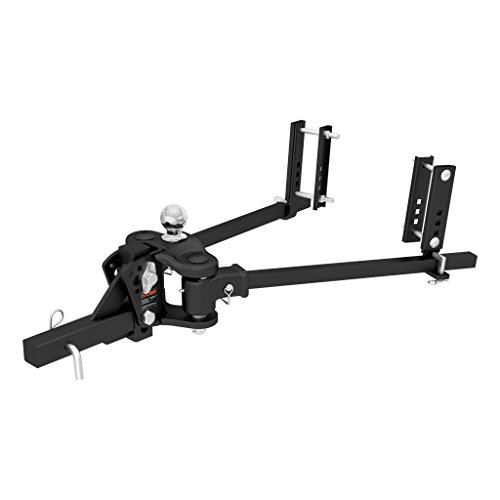
CURT TruTrack 4P
Trunnion hitch with sway control built into the brackets: four friction points resist side-to-side movement.
Why it's on this ticket: Sway control built into the hitch like a ProPride or Hensley, but by friction: four points in brackets and a spring-and-cam head, for 800 to 1,000 lb of tongue weight. Not a projection hitch.
Fits: Travel trailers up to 10,000 lb and 1,000 lb tongue weight where sway control should come built in
- Tongue weight
- 800–1,000 lb
- Max trailer weight
- 10,000 lb
- Spring bars
- Trunnion, forged steel
- Sway control (decides it)
- Integrated, 4 friction points
- Shank
- 2" (flips for drop or rise)
- Ball
- 2-5/16", pre-torqued, included
- Surge brakes
- Not stated
- Integrated sway control with four friction points, no separate bar to hook up
- Includes a pre-torqued 2-5/16" ball
- 2" shank flips for drop or rise
- Built for 800 to 1,000 lb of tongue weight, nothing lighter or heavier
- Needs grease on all lubrication points before first use
- Surge brakes are not addressed on the part page
Heavier tongue, or surge brakes? The other built-in designs are compared on weight distribution hitch with sway control. For another design with sway control built into the head, see Blue Ox SwayPro, and for all hitch families side by side, types of weight distribution hitches.
Questions at the scale house
Q01What is the difference between ProPride and Hensley?
They are two companies selling hitches from the same inventor. Hensley Mfg. builds the Hensley Arrow and the smaller Cub; ProPride, Inc. builds the ProPride 3P, which ProPride calls the latest version of Jim Hensley's design. Both use a linkage instead of friction for sway control and include weight distribution. ProPride lists 1,000 or 1,400 lb spring bars; Hensley states 1,600 lb tongue weight for the Arrow with the proper bars.
Q02What is a pivot point projection hitch?
A hitch whose linkage makes the trailer behave as if it pivoted further forward than the ball. ProPride says its 3P projects a virtual pivot point to near the rear axle of the tow vehicle. The effect is one-directional: it applies when the trailer pushes against the hitch, while turns started by the tow vehicle keep the pivot at the hitch.
Q03Does the ProPride 3P need drilling into the trailer frame?
No. ProPride's FAQ states that the 3P requires no drilling into the frame for installation, and its weight distribution jacks sit on top of the trailer frame rather than hanging on a pin outside it. ProPride works with an install network of dealers, listed on its site.
Weighed against
Next stop
- Hitch typesHow it worksWeight distribution hitch types compared: chain style, fixed bracket, cam, chain-free cone and projection hitches, plus round vs trunnion bars.
- Built-in vs frictionHow it worksWeight distribution hitch with built-in sway control vs a bolt-on friction bar: how 4-point, cam, cone and bar designs resist sway.
- Trailer sway controlHow it worksTrailer sway control comes two ways: electronics in the truck that brake once sway starts, and hitch hardware that resists it all the time. Use both.
- Blue OxMaker fileBlue Ox weight distribution hitch guide: SwayPro sizes from 350 to 2,000 lb, shanks, how its sway control works and which size fits a 2 inch receiver.
- With sway controlBuying sheetWeight distribution hitch with sway control: built-in 4-point designs vs bolt-on friction bars, what each maker states, and which fits.
Who weighs it up
weightdistributionhitch.com Editorial Desk
Towing set-up & hitch picks
We are the editorial desk at weightdistributionhitch.com. For every hitch we pull the tongue weight and trailer weight ratings, the shank and ball size, the bracket spacing and the torque values out of the maker's install sheet, then set them against the receiver label and the tow vehicle's own towing guide.
- — Ratings copied from the install sheet or part page, with document name
- — Set-up targets taken from the truck maker's towing guide, not a rule of thumb
- — "Not stated by maker" wherever a rating, surge-brake note or warranty term is missing