Weight distribution hitch for an F-150: Ford's 5,000 lb line
Will it fit?Reading span: 5 minchecked November 28, 2026by the editorial desk
Do you need a weight distribution hitch for an F150? Yes, once the loaded trailer goes past 5,000 lb: Ford's 2026 guide says not to exceed that without a weight-distribution system. The receiver then moves from 5,000 lb and 500 lb of tongue weight to 13,500 lb and 1,400 lb, with Tow/Haul Package and Max Tow Axle. Ford's set-up target for the F-150 is 50 % front axle load restoration.
Paid links on this sheet: Links with a * go to Amazon, and a purchase through them pays this site a commission; your price stays the same. As an Amazon Associate I earn from qualifying purchases. How the links pay
On the ticket
Over 5,000 lb of trailer, yes. Ford's 2026 F-150 receiver chart: 5,000 lb and 500 lb tongue weight-carrying, 13,500 lb and 1,400 lb weight-distributing, the latter with Tow/Haul Package and optional Max Tow Axle. Set the hitch to Ford's 50 % front axle load restoration, and stay under your truck's own maximum trailer weight and payload.
The short version for 2026 F-150 owners
Everything on this page comes from Ford's 2026 RV & Trailer Towing Guide, whose F-150 pages carry revision dates of December 2025 and October 2026. Other model years can differ, so check the guide or owner's manual for your year.
| Question | Ford's answer for the 2026 F-150 |
|---|---|
| When is a WD hitch needed? | Do not exceed 5,000 lb of trailer without a weight-distribution system |
| Receiver, weight-carrying | 5,000 lb trailer, 500 lb tongue |
| Receiver, weight-distributing | 13,500 lb trailer, 1,400 lb tongue, with Tow/Haul Package (53T) and optional Max Tow Axle |
| Receiver hardware | 2 inch receiver rated at 11,600 lb standard; the Max Tow Axle includes a 2 inch reinforced receiver rated at 14,000 lb |
| Tongue load to plan with | 10 % of the loaded trailer |
| Set-up target | 50 % front axle load restoration (FALR) |
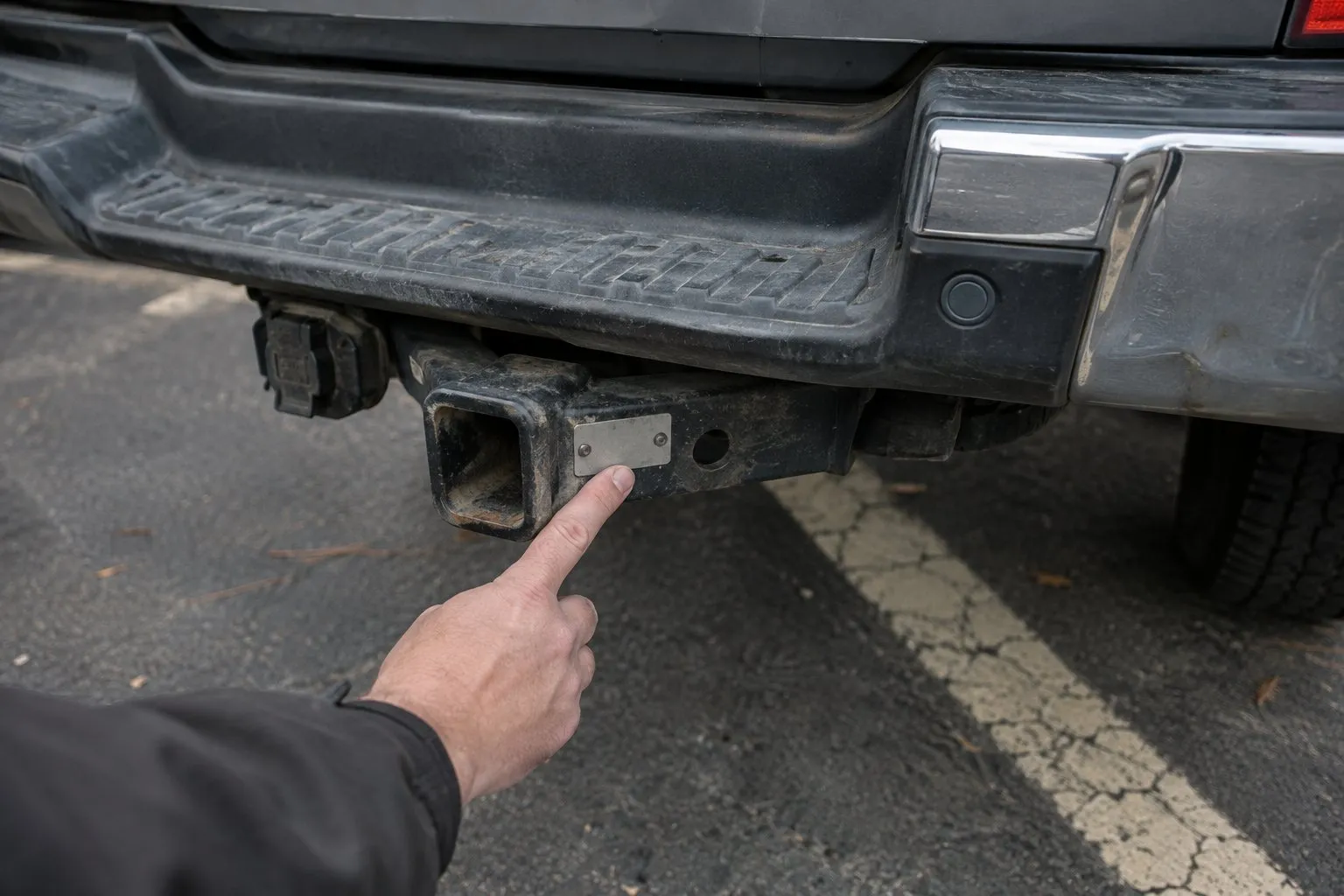
Ford also notes that the receiver capacities are printed on a label on each receiver, and that the receiver ratings may exceed what your particular truck can tow. That is why the next section matters.
Your truck's own ceiling comes first
The receiver is only one limit. The truck's maximum loaded trailer weight depends on engine, cab, drive and axle ratio, and Ford lists it in the Trailer Towing Selector charts. The maximum figures per engine for the 2026 F-150:
| Engine | Max towing | Max payload |
|---|---|---|
| 2.7L EcoBoost V6 | 8,400 lb | 1,775 lb |
| 3.5L EcoBoost V6 | 13,500 lb | 2,440 lb |
| 3.5L PowerBoost Full Hybrid V6 | 12,400 lb | 1,740 lb |
| 5.0L V8 | 12,800 lb | 2,235 lb |
| 3.5L EcoBoost H.O. V6 (Raptor) | 8,200 lb | 1,405 lb |
| 5.2L Supercharged V8 (Raptor R) | 8,700 lb | 1,410 lb |
Ford marks the 13,500, 12,400 and 12,800 lb figures as requiring the Tow/Haul Package and the Max Tow Axle upgrade, and notes that towing and payload are independent maximums that may not be reached at the same time. Your own truck's payload is on the label in the door jamb. For trailers over 11,600 lb on the gas F-150, or over 10,800 lb on the Hybrid, Ford lists the Tow/Haul Package and Max Tow Axle as required equipment.
So a weight distribution hitch does not lift any of these numbers. It lets the receiver go past 5,000 lb, up to whatever your truck is rated for; does a weight distribution hitch increase towing capacity explains why.
Tongue weight and payload on an F-150
Ford's F-150 notes say the trailer tongue load should be 10 % of the loaded trailer, and that your payload has to cover that tongue load plus passengers and cargo, without pushing the truck past its rear GAWR or GVWR. Those ratings sit on the Safety Compliance Certification Label.
That means two checks before you shop for a hitch:
- Weigh or estimate the loaded tongue. The tongue weight calculator gives a range; a scale gives the real figure.
- Add passengers and what you carry in the bed and cab, then compare with the payload on your label. How the numbers add up is on payload capacity and towing.
What the two receiver figures mean is on hitch tongue weight rating.
Setting the hitch to Ford's 50 %
Ford's weight distribution set-up works with two fender measurements, taken from the top of the front fender lip above the wheel center to the ground:
- Load trailer and truck as for the trip, with about 10 % tongue load, on level ground.
- With the trailer unhooked, measure the front fender: that is H1.
- Hitch the trailer to the ball with no spring bars attached and the jack fully up, and measure again: that is H2.
- Target height = H2 minus half the difference between H2 and H1.
Ford's own F-150 example: H1 is 37 inches, H2 is 38 inches, the target is 37.5 inches. You then tension the bars until the fender sits at that target. Never chase the unhitched height; Equal-i-zer's manual calls anything over 100 % over-distributed, with a risk of losing traction. The full procedure is on how to set up a weight distribution hitch.
Which hitch fits an F-150
The F-150's receiver is 2 inches, so look for a hitch with a 2 inch shank that reaches your coupler height; how to measure hitch drop shows how to check that. Beyond the shank, the choice is driven by your loaded tongue weight, not by the truck. For the most common F-150 case, a travel trailer with 800 to 1,000 lb on the tongue, this is our pick:
CURT 17062 Round Bar
Round-bar hitch, friction sway unit and a pre-torqued 2-5/16" ball in one box, for 800 to 1,000 lb of tongue weight.
Why it's on this ticket: Rated 800 to 1,000 lb tongue weight and 8,000 to 10,000 lb trailers, with a 2 inch shank for the F-150 receiver and ball and sway unit in the box.
Fits: Travel and utility trailers with a loaded tongue weight of 800 to 1,000 lb and a 2" receiver

- Tongue weight (decides it)
- 800–1,000 lb
- Max trailer weight
- 8,000–10,000 lb
- Spring bars
- Round bar
- Sway control
- Friction unit #17200 (included)
- Shank
- 2" (flips for drop or rise)
- Ball
- 2-5/16", pre-torqued, included
- Surge brakes
- No (listing)
- Hitch, sway control unit #17200 and a pre-torqued 2-5/16" ball come in the box
- Grease zerk in the head for the spring bar sockets
- 2" shank flips for drop or rise; the head also takes CURT's 2-1/2" shank
- Sway control is a bolt-on friction unit, not built into the head
- Tongue weight range stops at 1,000 lb
- Not for surge brakes (stated in the listing); the hitch needs no drilling, but the included sway unit's plate is drilled into the A-frame
Lighter or heavier tongue? The hitch size guide and the best weight distribution hitch page cover the other ranges.
Two more F-150 notes from Ford
- Frontal area. Ford limits trailer frontal area on the F-150 to 55 square feet for trucks with a trailer tow rating of 7,700 lb or less, 65 square feet from 7,701 lb, and 75 square feet for fifth-wheel and gooseneck use. A tall travel trailer can reach that before its weight does.
- If the trailer sways. Ford's guide says that with electric trailer brakes and a brake controller, you apply the trailer brakes by hand and do not apply the truck's brakes, which can increase sway.
Below 5,000 lb, a weight distribution hitch is optional on the F-150. Whether it is still worth it there is answered on when you need a weight distribution hitch.
Questions at the scale house
Q01What is the max tongue weight on an F-150?
On the 2026 F-150 receiver, Ford lists 500 lb of tongue load for weight-carrying use and 1,400 lb for weight-distributing use, the second with the Tow/Haul Package and optional Max Tow Axle. Your truck's payload can be the tighter limit: tongue load, passengers and cargo together must not exceed payload, rear GAWR or GVWR on the door-jamb label.
Q02What front axle load restoration does Ford recommend for the F-150?
Ford's 2026 guide gives the F-150 and the F-150 Raptor a weight distribution correction factor of 50 %. You measure the front fender height without the trailer (H1) and with the trailer on the ball and no bars (H2), then set the bars until the fender drops back by half the difference. Ford's own example: H1 37 inches, H2 38 inches, target 37.5 inches.
Q03Does an F-150 with a weight distribution hitch tow more?
Only up to the truck's own rating. Ford lists the maximum loaded trailer weight per engine, cab and axle in the Trailer Towing Selector, for example 8,400 lb for the 2.7L EcoBoost. The hitch lets the receiver go past its 5,000 lb weight-carrying limit; it does not raise the engine's figure.
Weighed against
Next stop
- Do I need a weight distribution hitch?Straight answerDo I need a weight distribution hitch? Your vehicle guide and receiver label decide. Ford sets the F-150 line at 5,000 lb; here is how to find yours.
- Set-upShop stepsHow to set up a weight distribution hitch: measure H1 and H2 at the front fender, find your truck maker's target, then tension the bars.
- Hitch tongue ratingHow it worksTrailer hitch tongue weight rating explained: the two limits on the receiver label, why the truck and the ball have their own, and which one wins.
- Does a weight distribution hitch increase towing capacity?Straight answerDoes a weight distribution hitch increase towing capacity? No. It unlocks the receiver's higher rating, while your truck's tow rating stays the same.
- Payload and towingHow it worksPayload capacity and towing: tongue weight counts as cargo in your truck, so passengers, gear, hitch and tongue all share one payload figure.
Who weighs it up
weightdistributionhitch.com Editorial Desk
Towing set-up & hitch picks
We are the editorial desk at weightdistributionhitch.com. For every hitch we pull the tongue weight and trailer weight ratings, the shank and ball size, the bracket spacing and the torque values out of the maker's install sheet, then set them against the receiver label and the tow vehicle's own towing guide.
- — Ratings copied from the install sheet or part page, with document name
- — Set-up targets taken from the truck maker's towing guide, not a rule of thumb
- — "Not stated by maker" wherever a rating, surge-brake note or warranty term is missing