Lifted truck weight distribution hitch: measure the drop, then pick
Buying sheetReading span: 5 minchecked November 28, 2026by the editorial desk
A lifted truck weight distribution hitch is a normal WD hitch on a shank with enough drop to bring the ball down to the trailer's coupler. Measure the drop first. Up to 8 inches on a 2-1/2 inch receiver, use the CURT 17132 shank under a CURT head; on a 2 inch receiver, the Andersen with a 6 inch drop.
On the ticket
Needed drop is receiver height plus 3 inches minus coupler height (Equal-i-zer). Up to 8 inches on a 2-1/2 inch receiver: the CURT 17132 shank under a CURT WD hitch. Up to 6 inches on a 2 inch receiver: the Andersen 6 inch drop. Then set the hitch to your truck maker's target.
Paid links on this sheet: Links with a * go to Amazon, and a purchase through them pays this site a commission; your price stays the same. As an Amazon Associate I earn from qualifying purchases. How the links pay
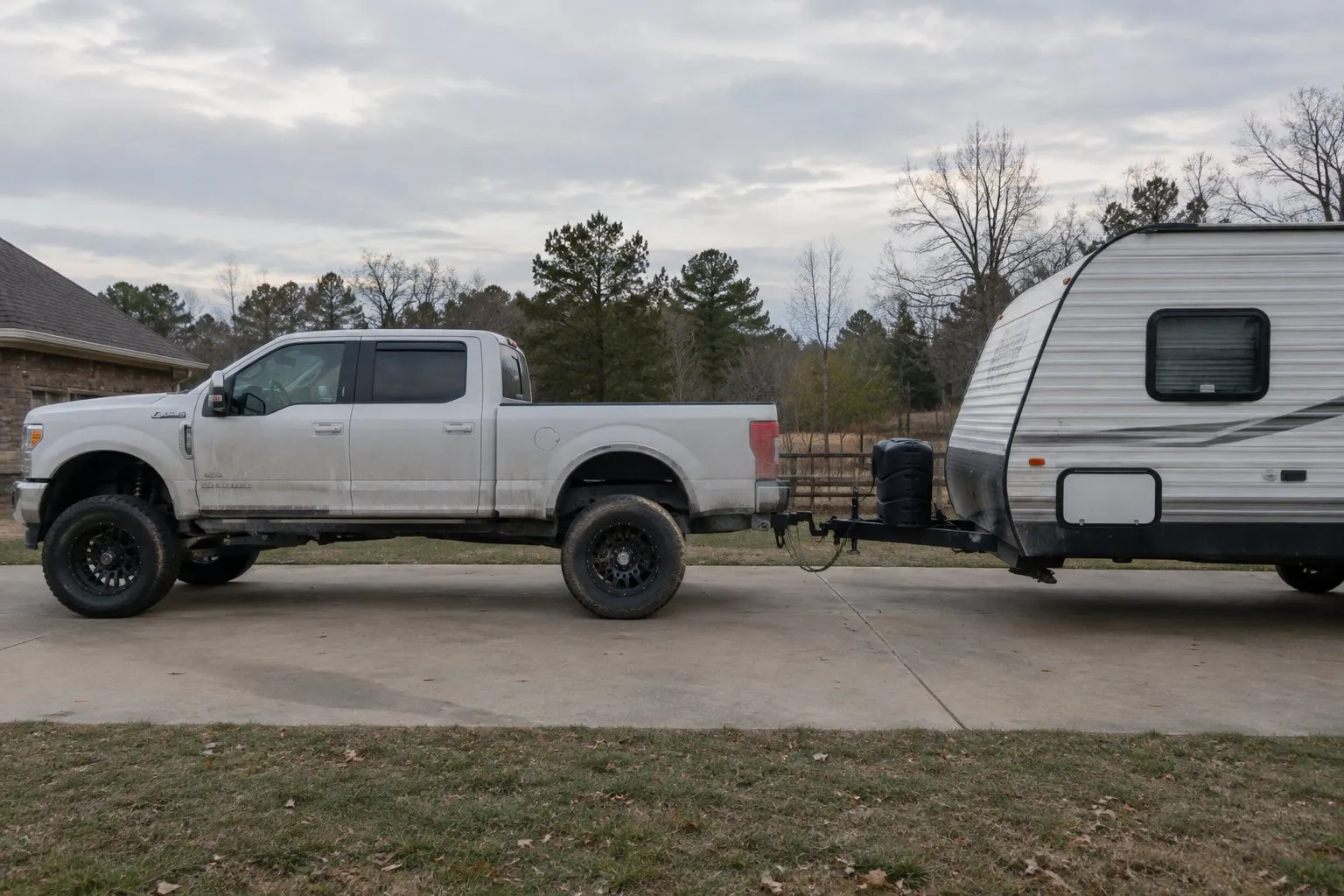
Why a lift changes the hitch, and what it doesn't change
A lift raises the receiver. The trailer's coupler stays where it was. A weight distribution hitch works best with the trailer sitting level and the ball at a set height above the coupler, so the extra inches have to come out of the shank. Equal-i-zer's manual puts the top of the ball 0 to 1 inch above the top of the coupler before hook-up, and CURT sets the uncoupled ball higher than the coupler to allow for the truck's squat once the tongue is on.
The weight side of the job does not change. You still size the hitch by loaded tongue weight, the receiver label still sets a weight-distributing limit, and the spring bar rating still caps the shank: CURT's 17132 is limited to the spring bar capacity of the hitch it carries. A taller truck also needs the same set-up target as before. How to set up a weight distribution hitch walks through that.
Measure the drop in two minutes
Park the truck and trailer on level ground, with the trailer level on its jack. Then take two measurements, the way Equal-i-zer describes them:
- Ground to the inside top of the receiver tube on the truck.
- Ground to the top of the coupler.
Needed drop = receiver height + 3 inches − coupler height. A positive number is drop; a negative number means you need rise. Equal-i-zer measures drop and rise from the inside top of the receiver tube to the base of the ball, which is why the receiver reading comes first. The full method is on how to measure hitch drop.
Match the drop to a shank
| Drop you need | Receiver | What fits | Source |
|---|---|---|---|
| Up to 3 inches | 2 inch | A standard WD shank, for example Equal-i-zer's up to 3 inches of drop or 7 of rise; CURT's 17062 shank flips for drop or rise | Equal-i-zer FAQ; CURT 17062 page |
| Up to 6 inches | 2 inch | Andersen hitch with 6 inch drop shank | Amazon listing; Andersen FAQ |
| Up to 8 inches | 2-1/2 inch | CURT 17132 drop shank under a CURT WD head | CURT 17132 page |
| More than 8 inches | any | None of the shanks here; ask the hitch maker for a specialty shank | Equal-i-zer FAQ |
Equal-i-zer says it offers specialty shanks when you need more than 3 inches of drop or 7 of rise, so the brand you already own may have a longer one. Check the receiver size first: a 2-1/2 inch shank does not go into a 2 inch receiver.
2-1/2 inch receivers: the CURT 17132 shank
The CURT 17132 is a solid shank for a 2-1/2 inch receiver with a 5/8 inch pin hole. It drops the head up to 8 inches, is rated for 15,000 lb gross trailer weight and 1,500 lb tongue weight, and works with all CURT weight distribution hitches. Two limits are worth knowing before you order. It is a shank only, so the head and bars are a separate purchase. And CURT does not rate it for the rise position, so it is no answer for a low truck.
For the head, CURT's 17062 round-bar hitch covers 800 to 1,000 lb of tongue weight, ships with its own ball and friction sway unit, and its head also takes CURT's 2-1/2 inch shank. Heavier tongues need a CURT head with a higher bar rating; heavy duty weight distribution hitch has that range.
CURT 17062 Round Bar
Round-bar hitch, friction sway unit and a pre-torqued 2-5/16" ball in one box, for 800 to 1,000 lb of tongue weight.
Why it's on this ticket: A CURT head for 800 to 1,000 lb of tongue weight that takes the 17132 drop shank, with ball and sway unit in the box.
Fits: Travel and utility trailers with a loaded tongue weight of 800 to 1,000 lb and a 2" receiver

- Tongue weight (decides it)
- 800–1,000 lb
- Max trailer weight
- 8,000–10,000 lb
- Spring bars
- Round bar
- Sway control
- Friction unit #17200 (included)
- Shank
- 2" (flips for drop or rise)
- Ball
- 2-5/16", pre-torqued, included
- Surge brakes
- No (listing)
- Hitch, sway control unit #17200 and a pre-torqued 2-5/16" ball come in the box
- Grease zerk in the head for the spring bar sockets
- 2" shank flips for drop or rise; the head also takes CURT's 2-1/2" shank
- Sway control is a bolt-on friction unit, not built into the head
- Tongue weight range stops at 1,000 lb
- Not for surge brakes (stated in the listing); the hitch needs no drilling, but the included sway unit's plate is drilled into the A-frame
For 2 inch receivers: Andersen with a 6 inch drop
If your lifted truck has a 2 inch receiver, the 17132 will not fit. The Andersen listing we link comes with a 2 inch shank and a 6 inch drop, rated 14,000 lb and 1,400 lb. It uses chains and cone friction instead of spring bars, and Andersen states it needs no grease. The catch: Andersen says its hitch cannot be used with surge brakes, so boat trailers with surge actuators need another hitch. The 4 inch drop version is a separate listing, so order the one your measurement calls for. More on the brand is on the Andersen page.
Andersen No-Sway 6" drop
Chain-free hitch with cone friction sway control and no grease, rated 14,000 lb / 1,400 lb.
Why it's on this ticket: The pick for lifted trucks with a 2 inch receiver: 6 inch drop shank, 1,400 lb tongue rating, no grease.
Fits: Trailers without surge brakes, owners who want a hitch that needs no grease

- Tongue weight
- Up to 1,400 lb
- Max trailer weight
- 14,000 lb
- Spring bars
- None – chain-free, cone friction
- Sway control
- Cone friction, built in
- Shank
- 2", 6" drop
- Ball
- 2-5/16"
- Surge brakes (decides it)
- Not compatible (Andersen FAQ)
- Andersen states it needs no grease
- Rated 14,000 lb / 1,400 lb
- Brackets for 3" to 6" trailer frames listed
- Andersen says it cannot be used with surge brakes
- This listing is the 6" drop; the 4" drop is a different listing
Ground clearance and steep driveways
A deep drop brings the head and bars closer to the road. CURT's instructions allow the inverted shank on high-clearance vehicles but ask you to check for adequate ground clearance afterwards. Equal-i-zer adds a caution for every rig: disengage the weight distribution before towing or backing across a sharp change in grade, such as from a level street up a steep driveway, or the trailer and receiver take excessive strain.
Once the hitch is on, level the trailer. Equal-i-zer's manual says to move the head on the shank if the front and rear of the trailer frame differ by more than 1-1/4 inches, then remeasure. The drop shank only gets you into that window; the drop hitch for weight distribution page covers the other shank options in detail.
CURT 17132 8" Drop Shank: hitch it or leave it?
TKT 19+ Hitch it if …
- If your truck has a 2-1/2 inch receiver and needs up to 8 inches of drop
- If you run or plan to buy a CURT weight distribution hitch
- If your loaded tongue weight stays inside the rating of your spring bars
− Leave it if …
- If your receiver is 2 inch (look at the Andersen 6 inch drop)
- If you need rise instead of drop
- If your drop measurement comes out above 8 inches
Numbers match? Check the CURT 17132 8" Drop Shank listing for the exact rating and what is in the box.
Amazon price: View on Amazon(paid link to Amazon, opens in a new tab)Ad · paid link · check price & delivery on AmazonAd · paid link · price as of ·Questions at the scale house
Q01How much drop do I need on a lifted truck?
Measure it rather than guess. Equal-i-zer measures from the ground to the inside top of the receiver tube and from the ground to the top of the coupler with the trailer level. Needed drop is receiver height plus 3 inches minus coupler height. A positive result is drop, a negative one is rise.
Q02Does a lifted truck need a special weight distribution hitch?
Not a special head, usually a longer shank. The head, bars and brackets stay the same; what changes is how far the shank drops the head. Equal-i-zer's standard shank covers up to 3 inches of drop and 7 of rise, CURT's 17132 shank drops up to 8 inches, and Andersen sells its hitch with a 6 inch drop.
Q03Can I flip the shank for more drop?
On many hitches, yes. CURT's 2 inch shank on the 17062 flips for drop or rise, and its instructions allow the inverted position on high-clearance vehicles if you check ground clearance afterwards. A dedicated drop shank like the CURT 17132 is a different case: CURT does not rate it for use in the rise position.
Weighed against
Next stop
- Drop shankBuying sheetA drop hitch for weight distribution is a taller shank under the hitch head. Measure the drop, match the receiver size, and keep every rating in mind.
- Hitch dropShop stepsHow to measure hitch drop: level the trailer, measure coupler and receiver height, then set the ball at the height your hitch maker asks for.
- AndersenMaker fileAndersen weight distribution hitch: how the chain-free cone design works, its 14,000 lb rating, set-up and care, and why surge brakes rule it out.
- CURTMaker fileCURT weight distribution hitch guide: round bar 17062, 15K trunnion 17422 and TruTrack 4P with built-in sway control, and who each one fits.
- Set-upShop stepsHow to set up a weight distribution hitch: measure H1 and H2 at the front fender, find your truck maker's target, then tension the bars.
- Hitch tongue ratingHow it worksTrailer hitch tongue weight rating explained: the two limits on the receiver label, why the truck and the ball have their own, and which one wins.
Who weighs it up
weightdistributionhitch.com Editorial Desk
Towing set-up & hitch picks
We are the editorial desk at weightdistributionhitch.com. For every hitch we pull the tongue weight and trailer weight ratings, the shank and ball size, the bracket spacing and the torque values out of the maker's install sheet, then set them against the receiver label and the tow vehicle's own towing guide.
- — Ratings copied from the install sheet or part page, with document name
- — Set-up targets taken from the truck maker's towing guide, not a rule of thumb
- — "Not stated by maker" wherever a rating, surge-brake note or warranty term is missing