Weight distribution hitch for a boat trailer: the surge brake question
Buying sheetReading span: 5 minchecked November 28, 2026by the editorial desk
A weight distribution hitch for a boat trailer has to pass one test first: does its maker allow surge brakes? Equal-i-zer says its hitch is compatible with them, Andersen says its hitch is not, and Reese says not to use sway control with surge brakes. For boat trailers up to 1,000 lb of tongue weight, that points to the Equal-i-zer 10K.
On the ticket
Check the brakes before the hitch. With surge brakes, take a hitch whose maker allows them: the Equal-i-zer 10K for tongues up to 1,000 lb, the 14K up to 1,400 lb. Weigh the loaded tongue, boat and gear on board. At the ramp, unhook the spring bars before you back down: Equal-i-zer says never to launch with the hitch engaged.
Paid links on this sheet: Links with a * go to Amazon, and a purchase through them pays this site a commission; your price stays the same. As an Amazon Associate I earn from qualifying purchases. How the links pay
Why boat trailers start with the brakes
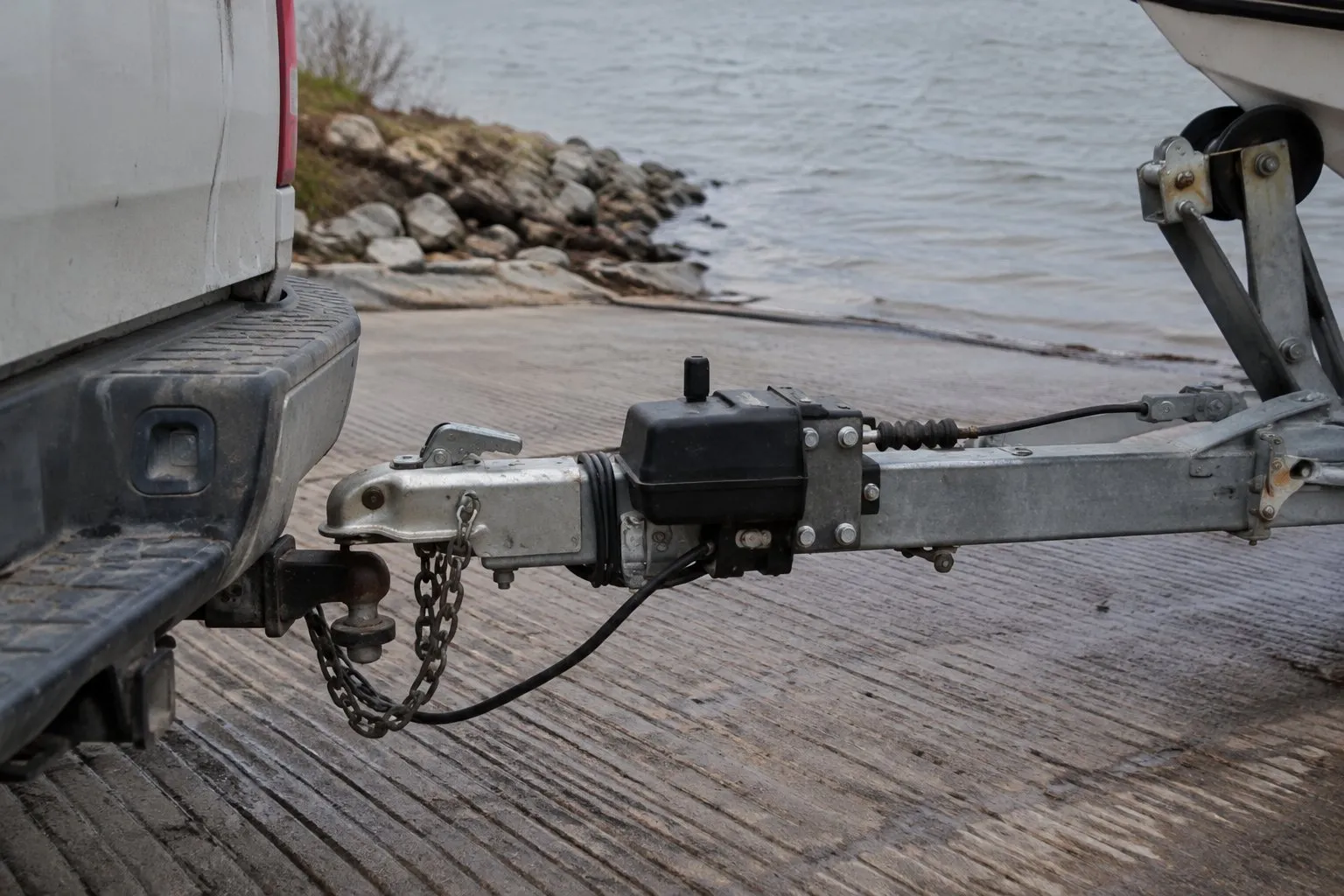
Travel trailers usually stop with electric brakes, run by a controller in the truck. Plenty of boat trailers use surge brakes instead: an actuator in the coupler that pushes the brakes on when the trailer runs up against the truck as it slows.
That actuator is the reason the hitch question changes. A weight distribution hitch puts the spring bars under tension between the hitch head and the trailer frame. Andersen explains its own refusal this way: the forward pressure of the weight distribution can keep surge brakes permanently engaged. Other makers have built around the problem. So before you compare tongue ratings, find out what your hitch maker says about surge brakes. The surge brakes page goes through it maker by maker.
| Maker | What its own documents say about surge brakes |
|---|---|
| Equal-i-zer | Compatible with surge brakes |
| Andersen | Cannot be used with surge brakes |
| Reese (Round Bar Pro) | Some surge brakes will not work with WD hitches; do not use sway control with surge brakes |
| CURT 17062 | No surge brakes, per the Amazon listing |
Ford adds a point that matters for heavier boats: separate brake systems should be used for trailers that weigh more than 1,500 lb loaded. A boat, motor, fuel and gear pass that mark quickly.
Size it on the loaded boat, not the trailer plate
Weigh the tongue with the boat on the trailer, the fuel tank at the level you tow with, and the coolers, anchors and life jackets where they ride. A boat trailer's tongue can fall outside the 10 to 15 % range that travel trailers are planned around, so the scale beats the rule of thumb. The tongue weight percentage page explains the ranges, and the tongue weight measuring guide shows three ways to get the real number.
Then pick spring bars whose tongue rating covers that number. Equal-i-zer builds its 4-point hitch in steps of 600, 1,000, 1,200 and 1,400 lb of tongue weight, with trailer ratings of 6,000 to 14,000 lb. The lowest limit wins: hitch, receiver label or your truck's own rating.
Surge brake boat trailers: start with the Equal-i-zer 10K
The Equal-i-zer 10K is rated 10,000 lb of trailer and 1,000 lb of tongue. Its sway control sits in the hitch itself, at four friction points, so there is no separate friction bar to unhook at the ramp and hook up again in the parking lot. Most important for a boat trailer, Equal-i-zer states in plain words that its hitch is compatible with surge brakes. Shank and ball are not in the Amazon box, so plan a ball whose rating equals or beats the loaded trailer. The Equal-i-zer page explains the sizes and the kit.
A bigger boat: Equal-i-zer 14K
For a heavy cruiser or a tandem-axle trailer with more than 1,000 lb on the tongue, the 14K carries the same design up to 14,000 lb of trailer and 1,400 lb of tongue. Equal-i-zer's FAQ makes its surge brake statement for the Equal-i-zer hitch without naming a size. Past 1,400 lb you are in heavy duty hitch territory; read each maker's surge brake note before you pick one there.
Equal-i-zer 14K
The bigger Equal-i-zer: 14,000 lb trailer weight and 1,400 lb tongue weight with the same 4-point sway control.
Why it's on this ticket: The same 4-point design and surge brake statement as the 10K, for boat trailers with up to 1,400 lb on the tongue.
Fits: Heavier travel trailers with up to 1,400 lb of tongue weight

- Tongue weight (decides it)
- Up to 1,400 lb
- Max trailer weight
- 14,000 lb
- Sway control
- Integrated, 4 points
- Surge brakes
- Compatible (Equal-i-zer FAQ)
- Rated 14,000 lb / 1,400 lb
- 4-point sway control built in
- Same surge-brake statement as the 10K model (Equal-i-zer FAQ)
- Shank and ball not included (listing)
- Model data sheet not read; figures from the listing and the FAQ
Pick by your numbers
If the loaded tongue stays at or under 1,000 lb → Equal-i-zer 10K
Amazon price: View(paid link to Amazon, opens in a new tab)Ad · paid link · check price & delivery on AmazonAd · paid link · price as of ·If the loaded tongue is between 1,000 and 1,400 lb → Equal-i-zer 14K
Amazon price: View(paid link to Amazon, opens in a new tab)Ad · paid link · check price & delivery on AmazonAd · paid link · price as of ·If your boat trailer has electric brakes, not surge brakes
At the ramp: unhook before you back down
A launch ramp is the one place a weight distribution hitch should not be working. Equal-i-zer's manual says never to tow with the hitch engaged while launching a boat, on rough roads or through deep dips, because the extra strain on the spring arms and head can fatigue or break the hitch. It also says to disengage the weight distribution before backing where the grade changes sharply, such as from a level lot onto a steep slope, which describes most ramps.
The routine at the top of the ramp:
- Park in line, chock the trailer wheels.
- Raise the tongue jack until the bars go slack.
- Unhook both bars and stow them in the truck.
- Lower the jack fully, check the coupler, and back down.
After the boat is back on the trailer and you are on level ground, hook the bars up again before the road. If you load the boat differently on the way home, the hook-up steps and the set-up guide show when to measure again.
Boat trailer frames: check the tongue first
Weight distribution brackets clamp onto the trailer frame behind the coupler. Some boat trailers have a single straight tongue instead of an A-frame. Reese's instructions say such a pole tongue needs an adapter that gives the snap-up brackets a place to mount. Equal-i-zer describes mounting its brackets upside down on V-nose trailers and on trailers with a bottom-mount coupler. Look under your tongue before you order, and see the installation guide for where the brackets go.
Ramp grit ends up on the hitch too. Equal-i-zer asks you to clean dirt and debris from the friction surfaces regularly and to grease them before each trip; the maintenance guide lists what each maker wants.
Equal-i-zer 10K: hitch it or leave it?
TKT 04+ Hitch it if …
- If your boat trailer has surge brakes
- If the loaded tongue stays at or under 1,000 lb
- If you want sway control built into the hitch, with no extra bar to unhook at the ramp
− Leave it if …
- If the loaded tongue is over 1,000 lb (the 14K covers up to 1,400 lb)
- If you want shank and ball in the box
- If the trailer has a straight pole tongue and you have not checked how the brackets mount
Numbers match? Check the Equal-i-zer 10K listing for the exact rating and what is in the box.
Amazon price: View on Amazon(paid link to Amazon, opens in a new tab)Ad · paid link · check price & delivery on AmazonAd · paid link · price as of ·Questions at the scale house
Q01Do I unhook the spring bars before launching the boat?
Yes. Equal-i-zer's manual says never to tow with the hitch engaged on rough roads, through deep ditches and dips, or while launching a boat, because the extra strain on the spring arms and head can fatigue or break the hitch. Take the tension off with the tongue jack, unhook the bars, launch, then hook them up again before the road.
Q02Can I use a hitch with sway control on a surge brake boat trailer?
It depends on the maker. Reese's Round Bar Pro instructions say not to use sway control with surge brakes, and that some surge brakes will not work with weight distributing hitches at all. Equal-i-zer builds sway control into its head and says the hitch is compatible with surge brakes. Check the brake actuator's own instructions too.
Q03My boat trailer has a straight tongue. Can it take a weight distribution hitch?
Usually with an adapter. Reese's instructions say a trailer with a straight tongue instead of an A-frame needs a pole tongue adapter, which gives the snap-up brackets a place to mount. Equal-i-zer's 4K manual describes mounting its brackets upside down on V-nose trailers and bottom-mount couplers. Measure the tongue before you order.
Weighed against
- [1]Equal-i-zer, frequently asked questions (surge brakes)
- [2]Equal-i-zer 4K owner's manual (PDF): safety information, boat launching
- [3]Equal-i-zer 6K–14K owner's manual, ratings index
- [4]Andersen, weight distribution FAQ (surge brakes)
- [5]Reese, Round Bar Pro 49911/49912/49913 installation instructions (PDF)
- [6]Ford, 2026 RV & Trailer Towing Guide
Next stop
- Surge brakesWill it fit?Surge brakes and a weight distribution hitch: Equal-i-zer says yes, Andersen says no, CURT's 17062 listing says no. What each maker states, and why.
- Equal-i-zerMaker fileEqualizer weight distribution hitch: the six Equal-i-zer sizes, how the 4-point sway control works, what is in the box and where it fits surge brakes.
- How much tongue weight should a trailer have?Straight answerHow much tongue weight should a trailer have? 10 to 15 % of its loaded weight, Ford plans with 10 %. What is acceptable and how to fix it.
- Heavy dutyBuying sheetHeavy duty weight distribution hitch for tongues over 1,000 lb: 12K, 14K, 15K and 20K classes, the 2-1/2 inch shank question and the kit to start with.
- Measure tongue weightShop stepsHow to calculate tongue weight the reliable way: weigh the loaded coupler on a tongue scale, a truck-stop scale or a bathroom scale.
Who weighs it up
weightdistributionhitch.com Editorial Desk
Towing set-up & hitch picks
We are the editorial desk at weightdistributionhitch.com. For every hitch we pull the tongue weight and trailer weight ratings, the shank and ball size, the bracket spacing and the torque values out of the maker's install sheet, then set them against the receiver label and the tow vehicle's own towing guide.
- — Ratings copied from the install sheet or part page, with document name
- — Set-up targets taken from the truck maker's towing guide, not a rule of thumb
- — "Not stated by maker" wherever a rating, surge-brake note or warranty term is missing