Weight distribution hitch for a camper: the kit we pick
Buying sheetReading span: 5 minchecked November 28, 2026by the editorial desk
The right weight distribution hitch for a camper is sized on the packed tongue, with water, propane, batteries and gear on board, not on the brochure's dry number. For campers up to 1,000 lb of tongue weight the first kit to look at is the Camco Eaz-Lift Elite, sold ready to tow with the ball already installed.
On the ticket
Weigh the camper packed for a trip. Up to 1,000 lb on the tongue, take the Eaz-Lift Elite: ball pre-installed and a friction sway bar in the kit. Want sway control built into the hitch, or does the camper have surge brakes? Take the Equal-i-zer 10K. Over 1,000 lb, you need a bigger class.
Paid links on this sheet: Links with a * go to Amazon, and a purchase through them pays this site a commission; your price stays the same. As an Amazon Associate I earn from qualifying purchases. How the links pay
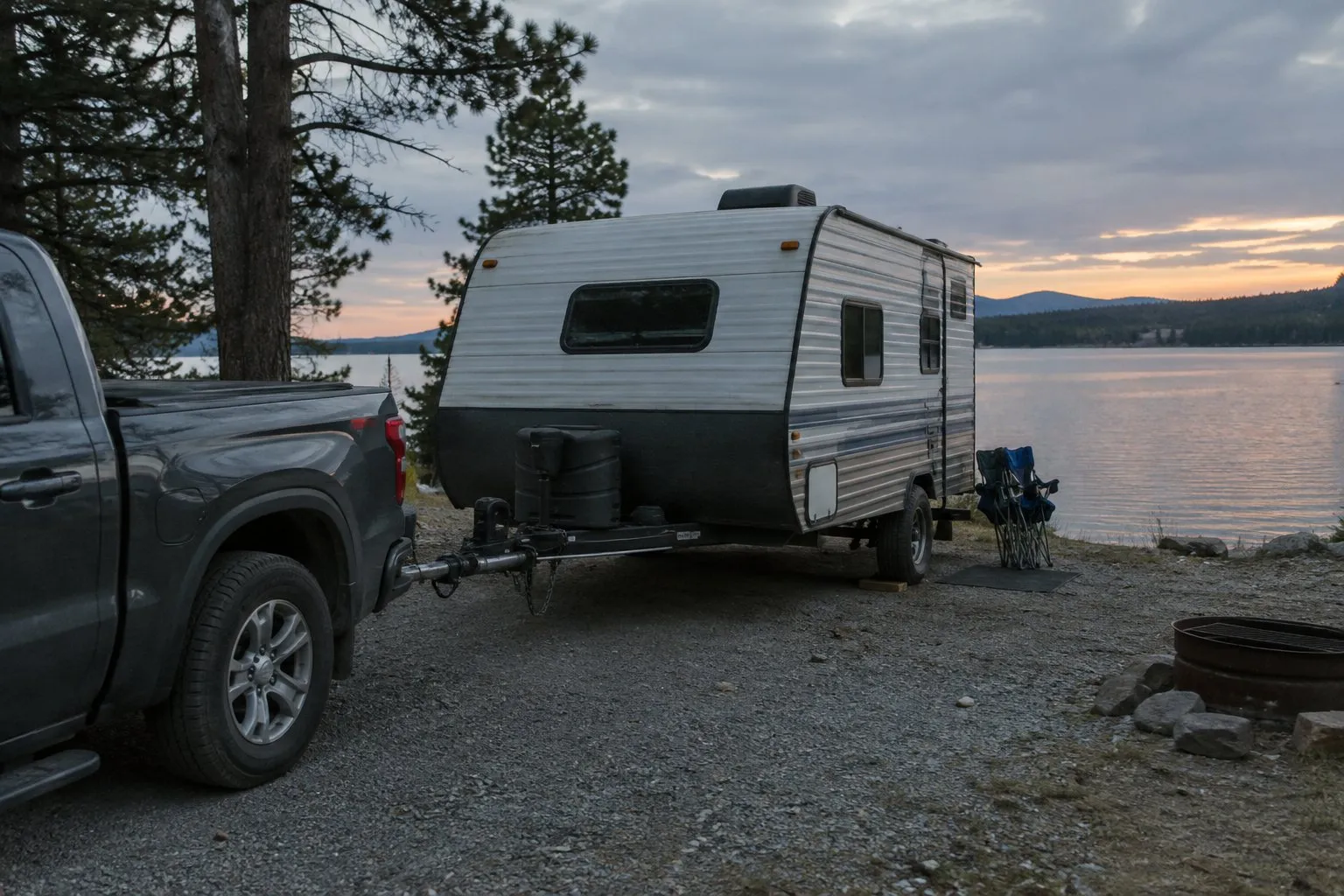
Campers are heavier than the brochure says
A camper or travel trailer is the classic weight distribution rig: a tall, boxy bumper-pull trailer behind a pickup or SUV. It is also the trailer whose brochure figures mislead most often. Equal-i-zer points out that listed tongue weights are dry numbers that usually leave out batteries and propane. Add fresh water, the gear in the front pass-through and a generator on the A-frame, and the packed tongue can sit well above the brochure.
Three numbers decide the hitch:
- Packed tongue weight. Weigh it the way the tongue weight measuring guide shows. Add cargo in the truck bed behind the rear axle, which Equal-i-zer counts toward the hitch's tongue rating.
- Camper GVWR. The hitch's maximum trailer weight has to sit above it. If the camper lists UVW and CCC instead, Equal-i-zer adds them up to get the GVWR; the dry weight vs GVWR page explains the terms.
- Your truck's limits. The receiver label and your vehicle guide. Ford's 2026 guide says not to tow over 5,000 lb with an F-150 without a weight-distribution system, and the receiver label adds its own tongue weight limit.
If the tongue lands between two size classes, the hitch size guide shows how the ratings step up.
Three kits for campers up to 1,000 lb
| Eaz-Lift Elite | Eaz-Lift ReCurve R3 | Equal-i-zer 10K | |
|---|---|---|---|
| Tongue weight | 1,000 lb class | Sold as the 1,000 lb hitch, rated up to 1,200 lb | Up to 1,000 lb |
| Sway control | Manually adjusted friction bar | Adjustable clamp at the head | Built in, 4 points |
| Ball | Pre-installed | 2-5/16 in, included (listing) | Not included |
| Surge brakes | Not stated | Not stated | Compatible (Equal-i-zer FAQ) |
| Data we could read | Listing only | Camco installation instructions | Maker FAQ and manual |
Eaz-Lift Elite: ready to tow, ball already on
The Elite is sold as a 1,000 lb kit with the hitch ball pre-installed and a manually adjusted sway control bar. For a first camper that is the shortest path from box to hitch: no ball to buy, no ball to torque. Camco's own product page showed no data when we tried to read it, so every detail here comes from the Amazon listing. The trailer weight on listings differs between sellers, so read the rating on the bars before your first trip. More on the brand is on the Eaz-Lift page.
Eaz-Lift ReCurve R3: sway control at the head
Camco sells part 48752 as the 1,000 lb R3, and its installation instructions rate it up to 1,200 lb of tongue weight and 12,000 lb of trailer. The sway control is a clamp at the head that you tighten for the trip and loosen for hooking up and on slippery roads. Two points from the same instructions: the trunnion spindle needs wheel bearing grease before each use, whatever a listing says about grease-free bars, and Camco tells you to disable the truck's electronic sway control while a hitch with built-in sway control is in use. The Eaz-Lift page has all four R3 sizes.
Eaz-Lift ReCurve R3
Camco's ReCurve R3 kit, part 48752, rated 1,200 lb tongue weight and 12,000 lb trailer, with adjustable sway control.
Why it's on this ticket: Camco rates this R3 up to 1,200 lb tongue and 12,000 lb trailer, with an adjustable sway clamp at the head.
Fits: Campers and travel trailers with up to 1,200 lb of tongue weight

- Tongue weight (decides it)
- Up to 1,200 lb
- Max trailer weight
- 12,000 lb
- Sway control
- Adjustable clamp, built in
- Ball
- 2-5/16", included (listing)
- Rated 1,200 lb tongue weight and 12,000 lb trailer weight in Camco's instructions (sold as the "1,000 lb hitch")
- Adjustable sway control you loosen for hook-up and for slippery roads
- The trunnion spindle needs wheel bearing grease before each use (Camco instructions)
- Camco says to disable the truck's electronic sway control while this built-in sway control is in use
Equal-i-zer 10K: sway control in the hitch, and surge brakes allowed
If you would rather not hook up a separate sway bar, the Equal-i-zer builds sway control into the hitch at four points. It is rated 10,000 lb and 1,000 lb, and Equal-i-zer says it is compatible with surge brakes. The brackets sit 27 to 32 inches from the coupler, and Equal-i-zer says you can back up and take tight turns with the hitch hooked up. Shank and ball are not in the box.
Equal-i-zer 10K
4-point sway control hitch rated 10,000 lb / 1,000 lb, and the maker says it works with surge brakes.
Why it's on this ticket: Built-in 4-point sway control for campers up to 1,000 lb of tongue weight, and its maker says it works with surge brakes.
Fits: Boat and travel trailers with surge brakes, up to 1,000 lb of tongue weight

- Tongue weight
- Up to 1,000 lb
- Max trailer weight
- 10,000 lb
- Sway control
- Integrated, 4 points
- Shank
- Not included
- Ball
- Not included
- Surge brakes (decides it)
- Compatible (Equal-i-zer FAQ)
- Equal-i-zer states its hitch is compatible with surge brakes
- Sway control built in at four points
- Equal-i-zer explains you can back up; brackets sit 27" to 32" from the coupler
- Shank and ball are not included (stated in the listing)
- Equal-i-zer's set-up target is a range (50 to 100 %), so you still need your vehicle's figure
- Brand page and model details come from the FAQ, not a model data sheet
Pick by your numbers
If you want the shortest path to a hitched camper → Eaz-Lift Elite 1,000 lb · Listing data only
Amazon price: View(paid link to Amazon, opens in a new tab)Ad · paid link · check price & delivery on AmazonAd · paid link · price as of ·If you want sway control built into the hitch → Equal-i-zer 10K
Amazon price: View(paid link to Amazon, opens in a new tab)Ad · paid link · check price & delivery on AmazonAd · paid link · price as of ·If your camper has surge brakes → Equal-i-zer 10K
Amazon price: View(paid link to Amazon, opens in a new tab)Ad · paid link · check price & delivery on AmazonAd · paid link · price as of ·If your packed tongue is over 1,000 lb
Pack the camper before you set the bars
Where the load sits changes the tongue. Ford's guide puts about 60 % of the cargo in the front half of the trailer and 40 % in the rear, within the tongue limit, balanced side to side and tied down. Sherline warns never to put heavy objects on add-ons hung off the rear bumper or across the tongue frame, because they hurt handling in corners and over bumps.
Then follow your vehicle's target, not a rule of thumb: Ford recommends 50 % front axle load restoration, and Equal-i-zer calls 50 to 100 % good and never over 100 %. The steps are on the weight distribution hitch set-up page.
What a hitch will not do for a camper
Equal-i-zer's own manual says no hitch setup guarantees that sway will be avoided, and lists loading, tire pressure, speed, passing vehicles and weather among the causes. Sherline's towing guide is just as plain about wind: the way to lower the risk is to slow down, and in extreme wind to park. A hitch raises your margin; it does not replace either habit. The rest of the routine is on towing a travel trailer.
Not towing a camper? Other trailers have their own pages: boat trailers, horse trailers and utility trailers.
Eaz-Lift Elite 1,000 lb: hitch it or leave it?
TKT 06+ Hitch it if …
- If you tow a camper with a packed tongue weight up to 1,000 lb
- If you want a kit with the ball already in place
- If you are fine with a sway bar you hook up separately
− Leave it if …
- If your packed tongue weight is over 1,000 lb
- If you want sway control built into the hitch head
- If you need a maker data sheet before you buy
Numbers match? Check the Eaz-Lift Elite 1,000 lb listing for the exact rating and what is in the box.
Amazon price: View on Amazon(paid link to Amazon, opens in a new tab)Ad · paid link · check price & delivery on AmazonAd · paid link · price as of ·Questions at the scale house
Q01Should I size a camper hitch by the dry weight?
No. Equal-i-zer notes that the tongue weights trailer makers list are dry numbers that usually leave out batteries and propane. Use them only for a first estimate with your loading plan, then weigh the packed tongue. For the trailer rating, compare the hitch with the camper's GVWR; if only UVW and CCC are listed, their sum is the GVWR.
Q02Do I load water and propane before setting up the hitch?
Yes. Equal-i-zer's installation steps say the truck and trailer should be loaded just as they will be while traveling, including propane, water, ATVs, generators and other cargo. Ford's set-up starts the same way. A hitch set up on an empty camper is set up for a trip you will never take.
Q03Does a fifth-wheel camper need a weight distribution hitch?
No, the two do not go together. A weight distribution hitch works with a receiver at the rear of the truck. Ford describes the fifth-wheel hitch as mounted in the pickup bed, with its center line at least two inches forward of the rear axle, to put more of the trailer weight directly over the truck.
Q04Can I back the camper into a sloped campsite with the hitch engaged?
Be careful at steep transitions. Equal-i-zer's manual tells you to disengage the weight distribution before towing or backing where the grade changes sharply, for example from a level street onto a steep driveway, because the bars would put excessive strain on the trailer and receiver.
Weighed against
Next stop
- Best hitchesBuying sheetBest weight distribution hitch for your trailer: four picks sorted by loaded tongue weight, surge brakes and sway control, with stated limits.
- Towing a travel trailerHow it worksTowing a travel trailer for the first time: the weights that must fit, how to load, brakes and chains, and how to drive, back up and park the rig.
- Dry weight vs GVWRHow it worksDry weight vs GVWR on a travel trailer: what UVW leaves out, how CCC fits in, and which number to use for the truck, the hitch and the tongue.
- What size weight distribution hitch do I need?Straight answerWhat size weight distribution hitch do I need? Size the bars by loaded tongue weight plus rear cargo, then check trailer GVWR and the receiver label.
- Eaz-LiftMaker fileEaz-Lift weight distribution hitch from Camco: how the Elite and the ReCurve R3 differ, what the R3 ratings mean, and how to grease and store it.
Who weighs it up
weightdistributionhitch.com Editorial Desk
Towing set-up & hitch picks
We are the editorial desk at weightdistributionhitch.com. For every hitch we pull the tongue weight and trailer weight ratings, the shank and ball size, the bracket spacing and the torque values out of the maker's install sheet, then set them against the receiver label and the tow vehicle's own towing guide.
- — Ratings copied from the install sheet or part page, with document name
- — Set-up targets taken from the truck maker's towing guide, not a rule of thumb
- — "Not stated by maker" wherever a rating, surge-brake note or warranty term is missing