Lightweight weight distribution hitch for small trailers
Buying sheetReading span: 5 minchecked November 28, 2026by the editorial desk
A lightweight weight distribution hitch is the same design as a big one, with lighter spring bars rated for small tongues: makers sell sizes from 400 lb of tongue and 4,000 lb of trailer. Match the bar rating to your loaded tongue, floor included. Of the kits we link, the Reese Pro 49912, listed for 8,000 lb trailers, is the one we'd start with.
On the ticket
Weigh the loaded tongue first; light kits start at 400 lb. Of the hitches we link, the Reese Pro 49912 for 8,000 lb trailers and up to 800 lb of tongue is our pick, with sway control and drop shank in the box. With no stated floor, the Equal-i-zer 10K is the alternative.
Paid links on this sheet: Links with a * go to Amazon, and a purchase through them pays this site a commission; your price stays the same. As an Amazon Associate I earn from qualifying purchases. How the links pay
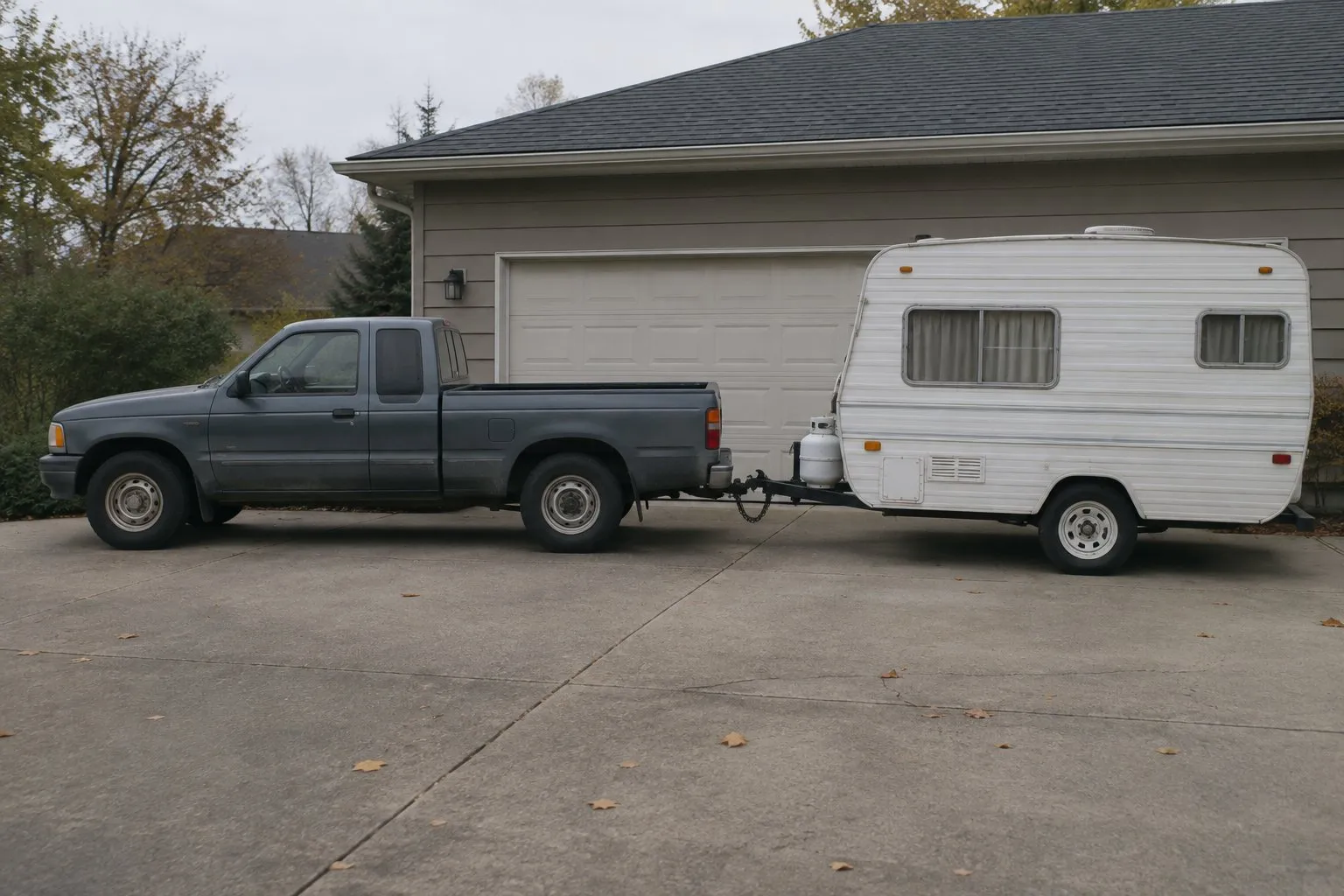
Light hitch, light bars: what the word means
A lightweight weight distribution hitch is not a different kind of hitch. It has the same head, shank and two spring bars as the big ones; the bars are simply rated for a smaller tongue, and the head is sized to match. Equal-i-zer says its spring arms are sized for a head of the same rating and will not fit a head of a different rating, so the size you buy is the size you keep.
The light end of the market, as the makers rate it:
| Maker and kit | Tongue weight | Max trailer weight |
|---|---|---|
| Equal-i-zer 4K (90-00-0400) | Up to 400 lb | 4,000 lb |
| Husky round bar 31421 | 400–600 lb | 6,000 lb |
| Husky Center Line TS 32215 / 32216 | 400–600 lb | 6,000 lb |
| Camco Eaz-Lift ReCurve R3, 400 lb hitch (48750) | Up to 600 lb | 6,000 lb |
| Husky round bar 31422 | 501–800 lb | 8,000 lb |
| Camco Eaz-Lift ReCurve R3, 600 lb hitch (48751) | Up to 800 lb | 8,000 lb |
These light sizes are not among the hitches we link on Amazon yet. The ones we do link start at the 8,000 lb trailer class, and the rest of this page shows how to tell whether one of them fits your trailer.
5,000 and 6,000 lb trailers: what lands on the tongue
Carry-On's trailer manual gives its own example: a 6,000 lb loaded trailer should have 10 to 15 % of that, 600 to 900 lb, on the hitch. For small trailers it drops the rule of thumb to 6 to 10 %. The trailer maker's figure for your model comes first, and a scale beats any percentage.
So a 6,000 lb trailer can need anything from a 600 lb kit to a 1,000 lb kit, depending on how it is built and packed. That is why the tongue weight calculator gives a range, and why the next step is a scale. The hitch size guide explains how to read the two ratings on the bars.
Whether a light trailer needs weight distribution at all is a question for your vehicle guide, not the trailer. Where truck makers draw the line is collected on do you need a weight distribution hitch.
The floor on the bar rating
A light trailer on a heavy hitch is not automatically fine. Many makers state a range, not only a maximum:
- Husky's round bar bands are 400–600, 501–800, 801–1,200 and 1,001–1,400 lb.
- CURT states 800 to 1,000 lb for its 17062.
- Equal-i-zer states only a maximum for each size.
If your loaded tongue sits below a kit's range, it is outside that kit's rating. Stay inside the range printed on the bars. And keep the set-up target in mind: Equal-i-zer calls 50 to 100 % weight distribution good and warns that over-distribution, past 100 %, can remove too much weight from the rear axle and cost traction. Heavier bars cranked down hard on a light tongue do not buy safety.
Husky adds a step that is easy to skip on a small trailer: have the trailer and tongue weighed before you pick a kit, then weigh again after the trailer is fully loaded, to make sure the hitch you chose is still the right one.
Two kits from our list for lighter trailers
| Reese Pro 49912 | Equal-i-zer 10K | |
|---|---|---|
| Max trailer weight | 8,000 lb | 10,000 lb |
| Tongue weight | Up to 800 lb (Reese) | Up to 1,000 lb, no floor stated |
| Spring bars | Round bar | Spring arms |
| Sway control | Included | Built in, 4 points |
| Shank | 8.5 in drop shank, included | Not included on the listing we link |
| Data we could read | Reese part page and instructions | Maker FAQ and manual |
Reese Pro 49912: the lightest trailer rating we link
The Reese Pro 49912 is rated for trailers up to 8,000 lb and 800 lb of tongue weight, the lowest trailer rating among the hitches we link. Reese ships it with round spring bars, integrated sway control, the ball already on the head and an 8.5 inch drop shank, for trailer frames 4 to 7 inches tall. Reese makes the same kit in 600 lb and 1,150 lb sizes, and says not to use sway control with surge brakes. It sits at the top of this page; the Reese weight distribution hitch page covers the whole range.
Equal-i-zer 10K: no stated floor
If your loaded tongue lands somewhere between a light and a mid-size kit and you want room to grow, the Equal-i-zer 10K states only a maximum of 1,000 lb tongue and 10,000 lb trailer. Its sway control is built into the hitch, and Equal-i-zer says it is compatible with surge brakes. Shank and ball are not in the listing's box.
Equal-i-zer 10K
4-point sway control hitch rated 10,000 lb / 1,000 lb, and the maker says it works with surge brakes.
Why it's on this ticket: States up to 1,000 lb tongue with no lower limit, so a lighter loaded tongue stays within its rating; sway control is built in.
Fits: Boat and travel trailers with surge brakes, up to 1,000 lb of tongue weight

- Tongue weight
- Up to 1,000 lb
- Max trailer weight
- 10,000 lb
- Sway control
- Integrated, 4 points
- Shank
- Not included
- Ball
- Not included
- Surge brakes (decides it)
- Compatible (Equal-i-zer FAQ)
- Equal-i-zer states its hitch is compatible with surge brakes
- Sway control built in at four points
- Equal-i-zer explains you can back up; brackets sit 27" to 32" from the coupler
- Shank and ball are not included (stated in the listing)
- Equal-i-zer's set-up target is a range (50 to 100 %), so you still need your vehicle's figure
- Brand page and model details come from the FAQ, not a model data sheet
Pick by your numbers
If your trailer is rated at or under 8,000 lb and you want shank and sway control in one box → Reese Pro 49912
Amazon price: View(paid link to Amazon, opens in a new tab)Ad · paid link · check price & delivery on AmazonAd · paid link · price as of ·If your loaded tongue is between sizes and you want no stated floor → Equal-i-zer 10K
Amazon price: View(paid link to Amazon, opens in a new tab)Ad · paid link · check price & delivery on AmazonAd · paid link · price as of ·If you don't know your loaded tongue yet
If your loaded tongue is over 1,000 lb
For every tongue class side by side, see the best weight distribution hitch comparison. Once the hitch is on, the weight distribution hitch set-up decides whether the size does its job.
Reese Pro 49912: hitch it or leave it?
TKT 12+ Hitch it if …
- If your trailer is rated at or under 8,000 lb
- If you want sway control and a drop shank in the box
- If you will check the tongue range on the bar label before the first trip
− Leave it if …
- If you need a maker data sheet with the tongue range before you buy
- If your loaded tongue is well under the bar rating
- If your trailer is heavier than 8,000 lb
Numbers match? Check the Reese Pro 49912 listing for the exact rating and what is in the box.
Amazon price: View on Amazon(paid link to Amazon, opens in a new tab)Ad · paid link · check price & delivery on AmazonAd · paid link · price as of ·Questions at the scale house
Q01What is the smallest weight distribution hitch size?
The lightest sizes we found start at 400 lb of tongue weight. Equal-i-zer's 4K model is rated 400 lb tongue and 4,000 lb trailer. Husky's smallest round bar and Center Line TS kits cover 400 to 600 lb with a 6,000 lb trailer rating, and Camco's 400 lb ReCurve R3 is rated up to 600 lb tongue and 6,000 lb trailer.
Q02Do light weight distribution hitches come with sway control?
Many do, but check the exact kit. Equal-i-zer's 4K has its 4-point sway control built in, Camco's small ReCurve R3 sizes carry an adjustable sway clamp, and Husky sells 400 to 600 lb round bar kits with and without a friction sway control. Its Center Line TS has sway control in the head in every size.
Q03Is a heavier weight distribution hitch safer on a small trailer?
Not by itself. More bar tension does not mean more safety: Equal-i-zer warns that over-distribution, more than 100 % of the weight returned to the front axle, can cost traction at the rear. Many kits also state a floor, such as Husky's 801 to 1,200 lb bars, and a lighter tongue then sits outside the rating.
Weighed against
- [1]Reese, Round Bar Pro 49911/49912/49913 installation instructions (PDF)
- [2]Equal-i-zer 4K owner's manual (PDF)
- [3]Equal-i-zer, frequently asked questions
- [4]Husky Towing, round bar kits 31421 to 31425 instructions, REV. 10 (PDF on SEMA Data)
- [5]Husky Towing, Center Line TS 32215 to 33092 instructions (PDF on SEMA Data)
- [6]Camco Eaz-Lift, ReCurve R3 installation instructions (PDF)
- [7]Carry-On Trailer, bumper pull horse trailer owner's manual (PDF)
Next stop
- What size weight distribution hitch do I need?Straight answerWhat size weight distribution hitch do I need? Size the bars by loaded tongue weight plus rear cargo, then check trailer GVWR and the receiver label.
- Do I need a weight distribution hitch?Straight answerDo I need a weight distribution hitch? Your vehicle guide and receiver label decide. Ford sets the F-150 line at 5,000 lb; here is how to find yours.
- ReeseMaker fileReese weight distribution hitch lines explained: Round Bar Pro 6K to 11.5K, Dual Cam II, the 83660 friction bar and the surge brake rule.
- Best hitchesBuying sheetBest weight distribution hitch for your trailer: four picks sorted by loaded tongue weight, surge brakes and sway control, with stated limits.
- Tongue weight calculatorHow it worksTongue weight calculator: enter your loaded trailer weight, get the 10 to 15 % span and the hitches whose stated rating covers it, plus the rules.
Who weighs it up
weightdistributionhitch.com Editorial Desk
Towing set-up & hitch picks
We are the editorial desk at weightdistributionhitch.com. For every hitch we pull the tongue weight and trailer weight ratings, the shank and ball size, the bracket spacing and the torque values out of the maker's install sheet, then set them against the receiver label and the tow vehicle's own towing guide.
- — Ratings copied from the install sheet or part page, with document name
- — Set-up targets taken from the truck maker's towing guide, not a rule of thumb
- — "Not stated by maker" wherever a rating, surge-brake note or warranty term is missing