Tongue weight scale: which hydraulic gauge fits your trailer
Buying sheetReading span: 7 minchecked November 29, 2026by the editorial desk
A tongue weight scale reads the load your trailer puts on the hitch ball, right at the coupler, in your driveway. Our pick is the Sherline LM-2000: a hydraulic dial from 0 to 2,000 lb, no batteries, one moving part. Pick a range that puts your reading near the middle of the dial.
On the ticket
For travel and utility trailers, take the Sherline LM-2000 with its 0 to 2,000 lb dial. Sherline rates its gauges at about 2 % in the middle of the range and about 3 % at the ends, so a tongue near 1,000 lb reads best on it. Sherline paused new direct orders on October 19, 2026, so buy where it is in stock.
Paid links on this sheet: Links with a * go to Amazon, and a purchase through them pays this site a commission; your price stays the same. As an Amazon Associate I earn from qualifying purchases. How the links pay
Stops on this page
- 01Why a scale beats the 10 % guess
- 02Sherline LM-2000: what you get
- 03Pick the dial by your tongue, not by the biggest number
- 04Reading it right at the coupler
- 05Storage: upright, padded, above freezing
- 06The second option, and the no-buy options
- 07Which reading tool for which rig
- 08The scale check before you order
- 09The reading is only step one
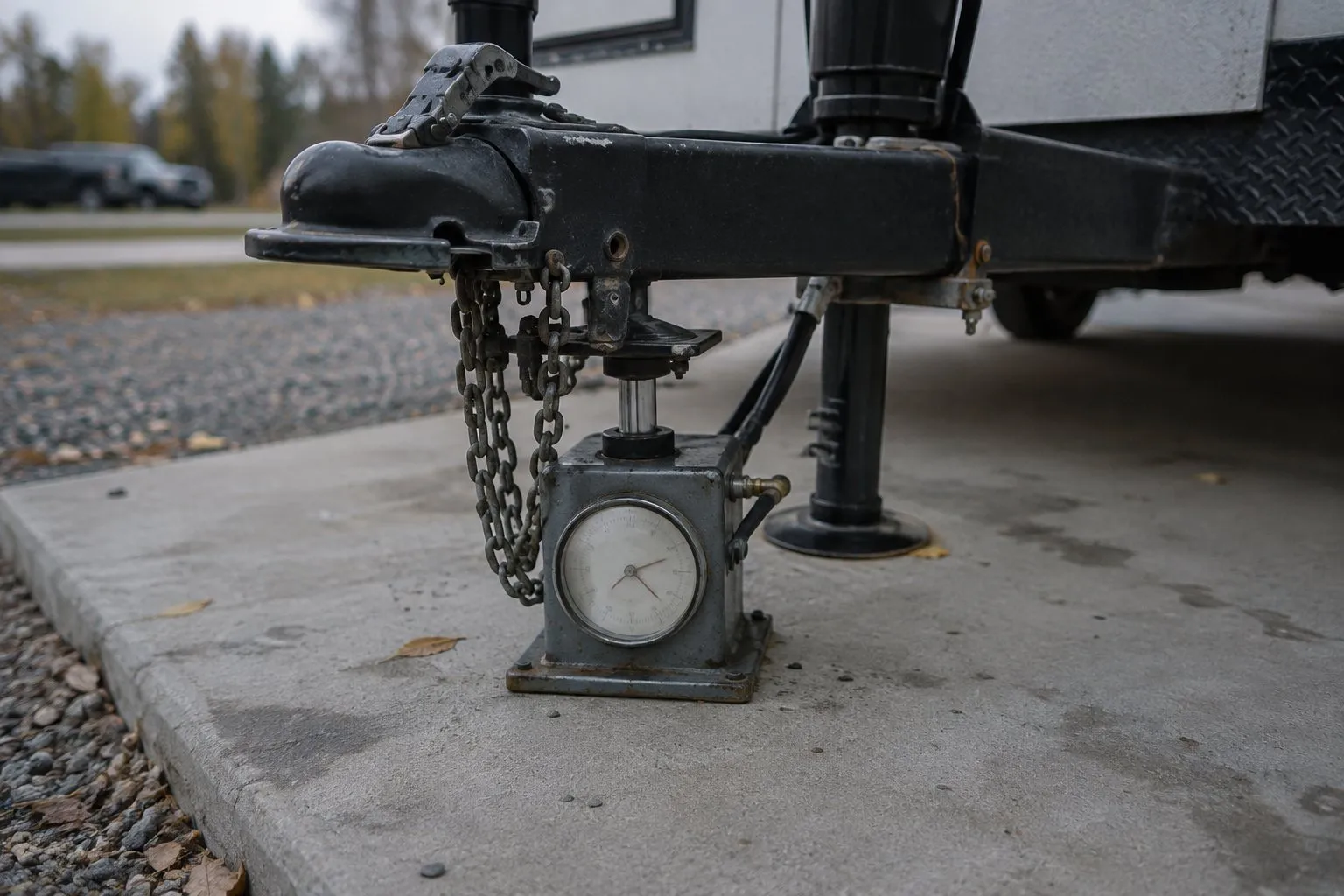
Why a scale beats the 10 % guess
Spring bars are sized by tongue weight, and Equal-i-zer points out that the tongue rating is usually the first limit a rig hits. The trouble is that the number in the trailer brochure is a dry figure, without batteries, propane or what you pack up front. A scale replaces the guess with a reading, and it lets you check again after you move the cooler or fill the fresh-water tank. For one-off readings there are other ways; the tongue weight measuring guide covers the truck-stop and bathroom-scale methods.
Sherline LM-2000: what you get
The Sherline turns pressure into pounds with a simple hydraulic principle. A piston sits in an oil-filled body, the gauge reads the pressure in PSI, and that number is read directly as weight in pounds. There are no electronics, no batteries and only one moving part.
- 0–2,000 lb
- Dial range (0–900 kg on the inner ring)
- about 2 %
- Gauge accuracy mid-range (Sherline)
- 4.5 in
- Height without the extension, 6.75 in with it
- 4.4 lb
- Weight of the scale
The body is machined from solid steel and aluminum, about 3.25 inches across, and a screw-on extension brings the top up to the coupler. Sherline also sells 0 to 1,000 lb and 0 to 5,000 lb gauges that screw into the same body.
Sherline gives a one-year guarantee and says the scale is not meant for trade use, that is, for selling goods by weight. For your own trailer that does not matter; for anything billed by the pound it does.
Primary source: Sherline trailer tongue weight scale product page and the Sherline instructions and towing guide booklet (lm_booklet2_2021), read 29.11.2026.
Order status. On October 20, 2026 Sherline announced that it had suspended new orders from October 19, while it is in talks with an American manufacturer about a possible purchase. The button below shows whether Amazon has it in stock.
Pick the dial by your tongue, not by the biggest number
Sherline's advice is to choose a gauge that puts your final reading in about the middle of its range. Its gauges hold about 2 % in the middle and drift to about 3 % at the extremes.
| Gauge | Reads | Fits |
|---|---|---|
| 0–1,000 lb | up to 460 kg | Light tongues |
| 0–2,000 lb (LM-2000) | up to 900 kg | Sherline's own example: a tongue of about 1,000 lb |
| 0–5,000 lb | up to 2,250 kg | Heavy tongues and kingpins |
Never let the reading run off the end. Sherline warns that pegging the gauge can bend the needle or break the linkage, and the gauge cannot be repaired.
Reading it right at the coupler
Sherline's booklet gets the most accurate reading where the coupler actually rests on the ball:
- Load the trailer, park it level and block the wheels.
- Support the tongue on its jack and set the scale on strong, secure blocks under the coupler, at about the height the coupler will have on the truck.
- Lower the tongue jack until the full weight rests on the scale and read the pounds.
- Lift the weight off again right away; the O-ring seal is not meant to carry load for long.
The scale has to stand level and square under the load. A side load makes the piston bind and read low or give readings you cannot repeat. Do not drop the coupler onto it, and do not pick the scale up by the piston, which can draw air into the cylinder.
Once you know your trailer, Sherline offers a shortcut: weigh once at the coupler, once under the tongue jack, and keep the ratio. Later readings at the jack, multiplied by that factor, give the weight at the hitch.
Storage: upright, padded, above freezing
Sherline's warning is short: do not store the scale on its side or below 32 °F. Store it upright, pack it so it cannot bounce around in the truck bed, and put a piece of wood between the piston head and the body while it sits unused, which protects the seals. If it has sat for months, turn the piston slightly and push it down a little before the first reading. Do not pull on it.
The second option, and the no-buy options
Simple Weigh
A second tongue weight scale option for reading the load at the coupler.
Why it's on this ticket: A tongue weight scale made for reading the load at the coupler – a second choice when the Sherline is not in stock; read the range on the listing first.
Fits: A second choice when the Sherline is out of stock
We could read only the Amazon listing for this product, so every figure here comes from that listing.

- Type (decides it)
- Tongue weight scale
- Made for reading tongue weight at the coupler
- Only the listing title could be read
- Range not in the listing title
Everything we know about the Simple Weigh comes from its listing title, which does not state a range. Check that the stated range sits well above your expected tongue before you order.
| Option | Reading | Accuracy stated | Hard trade-off | Best for |
|---|---|---|---|---|
| Sherline LM-2000 | Tongue at the coupler, 0–2,000 lb | About 2 % mid-range, about 3 % at the ends | A pegged gauge cannot be repaired; no storage on its side or below 32 °F | Repeat readings at home |
| Simple Weigh | Tongue at the coupler | Not stated by maker | Range not in the listing title, so you cannot match it to your tongue before you order | Second choice |
| Truck-stop scale | Tongue as a difference, plus axle weights | Not part of our sources | A trip to the scale for every change to the load | One reading of the whole rig |
| Bathroom scale | Tongue up to the scale's maximum | Not part of our sources | Reads only up to its own maximum | Light trailers |
A missing range is the real risk with a listing-only scale: if your tongue runs past the end of the dial, the reading is useless and, on a hydraulic gauge like Sherline's, the gauge itself can be ruined.
Ford's guide sends you to a commercial scale for the same job: disconnect the trailer and put only the tongue on the scale at hitch ball height. Weigh Safe, whose measuring guide we quote on this site, has its own Weigh Safe brand page.
Which reading tool for which rig
- Take the Sherline 0–2,000 lb dial instead of the 0–1,000 lb one if your loaded tongue could reach 1,000 lb: the larger dial puts that reading in its accurate middle and keeps it off the end stop.
- Take Sherline's 0–5,000 lb gauge instead of the LM-2000 if you weigh a fifth wheel kingpin; the booklet sets the scale on blocks in the truck bed for that job.
- Take a truck-stop scale instead of any tongue scale if you need axle weights too, or you weigh only once before a trip.
- Take the Simple Weigh instead of the Sherline only when the Sherline is out of stock and the listing you open states a range that covers your tongue with room to spare.
The scale check before you order
- Your expected tongue weight, 10 to 15 % of the loaded trailer, sits near the middle of the dial you pick.
- The highest load you might ever put on it stays below the end of the dial.
- You have strong, level blocks that bring the scale to coupler height, or the screw-on extension covers the gap.
- You can store it upright, padded so it cannot bounce around, and above 32 °F.
- You know which reading you will compare it with: the tongue weight range on your hitch's spring bars.
The reading is only step one
A number on the dial still needs a target. Compare it with the trailer weight on the tongue weight percentage page, or let the tongue weight calculator show the 10 to 15 % span for your trailer. Ford's rule for fixing it: too heavy, move cargo rearward; too light, move it forward. When the tongue sits where it should, a trip over a truck-stop scale checks the axles too.
Sherline LM-2000: hitch it or leave it?
TKT 17+ Hitch it if …
- If you don't know your loaded tongue weight
- If your tongue weight is likely under 2,000 lb
- If you want to re-weigh after every change to the load
− Leave it if …
- If your tongue is light enough for a bathroom scale
- If a truck-stop scale is close by and you only need one reading
Numbers match? Check the Sherline LM-2000 listing for the exact rating and what is in the box.
Amazon price: View on Amazon(paid link to Amazon, opens in a new tab)Ad · paid link · check price & delivery on AmazonAd · paid link · price as of ·Questions at the scale house
Q01How accurate is a tongue weight scale?
Sherline says its pressure gauges are accurate to within about 2 % in the middle of their range and about 3 % at the very low and very high end. That is why Sherline tells you to pick a gauge that puts your reading near the middle, for example the 2,000 lb dial for a tongue of about 1,000 lb.
Q02Which dial range do I need?
Sherline sells gauges reading 0 to 1,000 lb, 0 to 2,000 lb and 0 to 5,000 lb. Choose the one that puts your expected tongue weight near its middle, and never one your tongue could top out: a load past the end of the dial can bend the needle, and Sherline says the gauge cannot be repaired.
Q03Can I weigh at the tongue jack instead of the coupler?
Yes, once you know your trailer. Sherline suggests weighing once at the coupler, then once with the scale under the tongue jack, and noting the ratio. In its example, 950 lb at the hitch and 1,000 lb at the jack give a factor of 0.95 to apply to later jack readings.
Q04Does a tongue weight scale work on a fifth wheel?
Sherline describes it: block the scale to the right height on the truck bed behind the hitch, back the kingpin over it and lower the trailer onto it with the trailer jack. Pin weights run higher than bumper-pull tongues, so pick the gauge whose middle matches yours; Sherline's largest reads to 5,000 lb.
Weighed against
Next stop
- Measure tongue weightShop stepsHow to calculate tongue weight the reliable way: weigh the loaded coupler on a tongue scale, a truck-stop scale or a bathroom scale.
- Tongue weight calculatorHow it worksTongue weight calculator: enter your loaded trailer weight, get the 10 to 15 % span and the hitches whose stated rating covers it, plus the rules.
- Weigh SafeMaker fileWeigh Safe weight distribution hitch: the three True Tow sizes, what the built-in gauge reads, live adjustment, and the model with no scale.
- How much tongue weight should a trailer have?Straight answerHow much tongue weight should a trailer have? 10 to 15 % of its loaded weight, Ford plans with 10 %. What is acceptable and how to fix it.
- Weigh truck and trailerShop stepsHow to weigh your truck and trailer on a three-platform truck-stop scale: where each axle goes, what the ticket shows, which label to check.
Who weighs it up
weightdistributionhitch.com Editorial Desk
Towing set-up & hitch picks
We are the editorial desk at weightdistributionhitch.com. For every hitch we pull the tongue weight and trailer weight ratings, the shank and ball size, the bracket spacing and the torque values out of the maker's install sheet, then set them against the receiver label and the tow vehicle's own towing guide.
- — Ratings copied from the install sheet or part page, with document name
- — Set-up targets taken from the truck maker's towing guide, not a rule of thumb
- — "Not stated by maker" wherever a rating, surge-brake note or warranty term is missing