What size weight distribution hitch do I need?
Straight answerReading span: 4 minchecked November 28, 2026by the editorial desk
What size weight distribution hitch do I need? One whose stated tongue weight rating covers your loaded tongue plus the cargo behind your truck's rear axle, and whose trailer rating is above your trailer's GVWR. The receiver label and your vehicle guide set the ceiling.
Paid links on this sheet: Links with a * go to Amazon, and a purchase through them pays this site a commission; your price stays the same. As an Amazon Associate I earn from qualifying purchases. How the links pay
Read-out
Size it by tongue weight, not by truck. Weigh the loaded tongue, add any cargo behind the rear axle, and pick a hitch whose stated tongue weight range covers that total. Its maximum trailer weight must sit above your trailer's GVWR. Then check the receiver label and vehicle guide: the lowest of the three ratings is your limit.
Two ratings on every hitch, and which one you hit first
A weight distribution hitch is sold with two numbers: the heaviest trailer it may tow and the heaviest tongue its spring bars may carry. Equal-i-zer's rule is simple: the hitch must never exceed either of them. In practice the tongue rating decides, because most trailers put 10 to 15 % of their weight on the ball. A 10,000 lb hitch with a 1,000 lb tongue rating runs out of tongue long before it runs out of trailer on many rigs.
Two more things count toward the tongue rating:
- Your loaded tongue, not the brochure. Listed tongue weights are dry figures. Water, batteries, propane and gear in the front storage all add to it. The tongue weight measuring guide shows how to get the real number.
- Cargo behind the rear axle. Equal-i-zer counts what rides in the bed behind the truck's rear axle toward the hitch's tongue rating, since it loads the rear the same way the tongue does.
No scale yet? The tongue weight calculator gives you the 10 to 15 % span from your trailer weight and lists hitches whose stated rating covers it. Treat that as the first draft, not the order.
The size classes you will find
Hitch makers sell the same design in steps of tongue weight. The ratings below are what the makers or the listings state for the hitches on this site.
| Stated tongue weight | Examples on this site | Trailer rating stated |
|---|---|---|
| 800 to 1,000 lb | CURT 17062 round bar, CURT TruTrack 4P | 10,000 lb |
| Up to 1,000 lb | Equal-i-zer 10K, Eaz-Lift Elite (1,000 lb class) | 10,000 lb (Equal-i-zer) |
| 800 to 1,200 lb | Husky 31423 round bar | 12,000 lb |
| Up to 1,400 lb | Equal-i-zer 14K, Andersen | 14,000 lb |
| Up to 1,500 lb | CURT 17422 trunnion | 15,000 lb |
Above 1,000 lb you are in heavy duty weight distribution hitch territory; small trailers with light tongues are on the lightweight weight distribution hitch page.
The spring bars belong to the head. Equal-i-zer's manual says its spring arms are sized for a hitch head of the same rating and will not fit a head of a different rating. If your tongue grows past the bars, you are buying a new hitch, not new bars.
The lowest rating wins
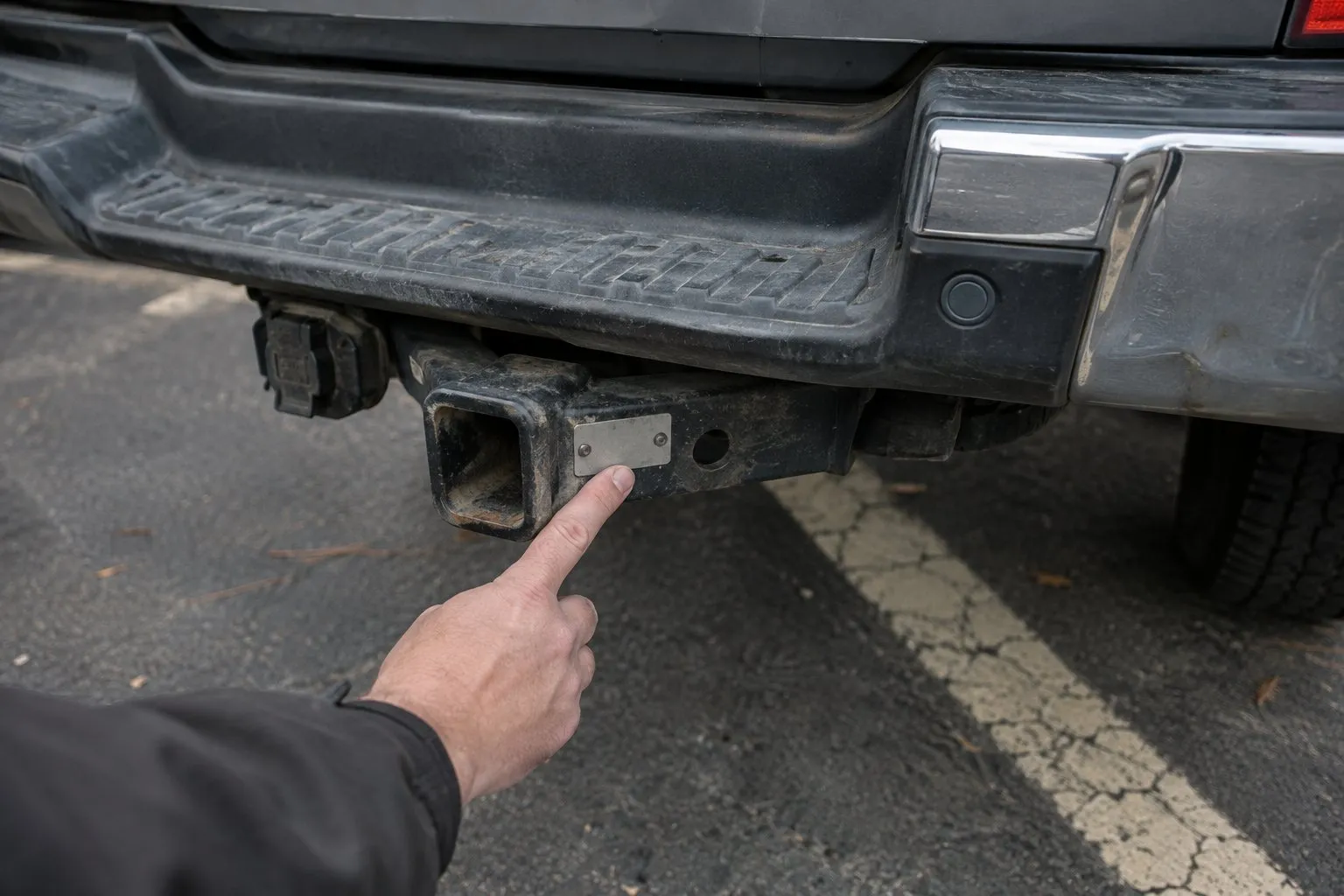
The hitch is only one of three limits. The receiver on your truck has its own label with two pairs of numbers, one for weight-carrying and one for weight-distributing use; Ford puts both on a label fixed to its receivers. On the 2026 F-150 that is 5,000 lb and 500 lb tongue weight without weight distribution, and 13,500 lb and 1,400 lb with it. Your vehicle guide adds the third limit, and Ford reminds you that the tongue load must not push the truck past its GVWR or rear axle rating.
Receiver size and the shank
Size also means the square tube. Most hitches here ship with a 2 inch shank; the CURT 17422 and the CURT 17062 head can take a 2-1/2 inch shank that CURT sells separately, and some heavy hitches need a 2-1/2 inch receiver. Equal-i-zer's standard shank covers up to 3 inches of drop or 7 inches of rise. If your receiver sits much higher than the coupler, see the drop hitch for weight distribution page.
A pick for tongues up to 1,000 lb with no stated floor
If your loaded tongue lands somewhere below 1,000 lb and you have no exact number yet, a hitch that states only a maximum leaves more room than one with a narrow range.
Equal-i-zer 10K
4-point sway control hitch rated 10,000 lb / 1,000 lb, and the maker says it works with surge brakes.
Why it's on this ticket: States up to 1,000 lb tongue and 10,000 lb trailer with no lower limit, has 4-point sway control built in, and its maker says it works with surge brakes.
Fits: Boat and travel trailers with surge brakes, up to 1,000 lb of tongue weight

- Tongue weight
- Up to 1,000 lb
- Max trailer weight
- 10,000 lb
- Sway control
- Integrated, 4 points
- Shank
- Not included
- Ball
- Not included
- Surge brakes (decides it)
- Compatible (Equal-i-zer FAQ)
- Equal-i-zer states its hitch is compatible with surge brakes
- Sway control built in at four points
- Equal-i-zer explains you can back up; brackets sit 27" to 32" from the coupler
- Shank and ball are not included (stated in the listing)
- Equal-i-zer's set-up target is a range (50 to 100 %), so you still need your vehicle's figure
- Brand page and model details come from the FAQ, not a model data sheet
For the full field of picks, sorted by tongue weight and brakes, go to the best weight distribution hitch comparison. Once the hitch is on, the weight distribution hitch set-up decides whether that size does its job.
Questions at the scale house
Q01How big of a weight distribution hitch do I need?
Big enough that neither of its two ratings is ever exceeded. Equal-i-zer asks for a maximum trailer weight above your trailer's GVWR and a tongue rating above your loaded tongue weight plus any cargo behind the tow vehicle's rear axle. Because the tongue usually carries 10 to 15 % of the trailer, the tongue rating is the one most rigs hit first.
Q02Should I size the hitch by the trailer's dry tongue weight?
No. Equal-i-zer notes that the tongue weights trailer makers list are dry numbers that usually leave out batteries and propane. Use them only as a starting estimate together with your loading plan, then weigh the loaded tongue. If the trailer lists only UVW and CCC, add the two to get its GVWR.
Q03Can a weight distribution hitch be too big for my trailer?
Some ratings have a floor. CURT states 800 to 1,000 lb of tongue weight for its 17062, so a lighter tongue sits outside the stated range. Other hitches, such as the Equal-i-zer 10K, state only a maximum. Read the full range on the spring bar sticker, not just the top number, and stay inside it.
Weighed against
Next stop
- Tongue weight calculatorHow it worksTongue weight calculator: enter your loaded trailer weight, get the 10 to 15 % span and the hitches whose stated rating covers it, plus the rules.
- Measure tongue weightShop stepsHow to calculate tongue weight the reliable way: weigh the loaded coupler on a tongue scale, a truck-stop scale or a bathroom scale.
- Best hitchesBuying sheetBest weight distribution hitch for your trailer: four picks sorted by loaded tongue weight, surge brakes and sway control, with stated limits.
- Heavy dutyBuying sheetHeavy duty weight distribution hitch for tongues over 1,000 lb: 12K, 14K, 15K and 20K classes, the 2-1/2 inch shank question and the kit to start with.
- Lightweight hitchesBuying sheetLightweight weight distribution hitch: the light sizes makers sell for 4,000 to 8,000 lb trailers, why bar ratings have a floor, and which kit fits.
Who weighs it up
weightdistributionhitch.com Editorial Desk
Towing set-up & hitch picks
We are the editorial desk at weightdistributionhitch.com. For every hitch we pull the tongue weight and trailer weight ratings, the shank and ball size, the bracket spacing and the torque values out of the maker's install sheet, then set them against the receiver label and the tow vehicle's own towing guide.
- — Ratings copied from the install sheet or part page, with document name
- — Set-up targets taken from the truck maker's towing guide, not a rule of thumb
- — "Not stated by maker" wherever a rating, surge-brake note or warranty term is missing