Weight distribution hitch installation: ball, head, brackets, torque
Shop stepsReading span: 6 minchecked November 28, 2026by the editorial desk
Weight distribution hitch installation is a one-time job of about eight steps: measure the coupler height, mount the ball, set the head on the shank, fit the spring bars, clamp the brackets to the A-frame and torque every bolt to the manual. After that comes the set-up, where you tune the bar tension to your truck maker's target.
On the ticket
Park level and measure the coupler height. Torque the ball onto the head, put the shank in the receiver and bolt the head at the height the manual gives. Fit the bars, couple the trailer, and clamp the brackets where the chain hangs straight up, 27 to 32 inches back on an Equal-i-zer. Hook up, check the links, then torque all bolts.
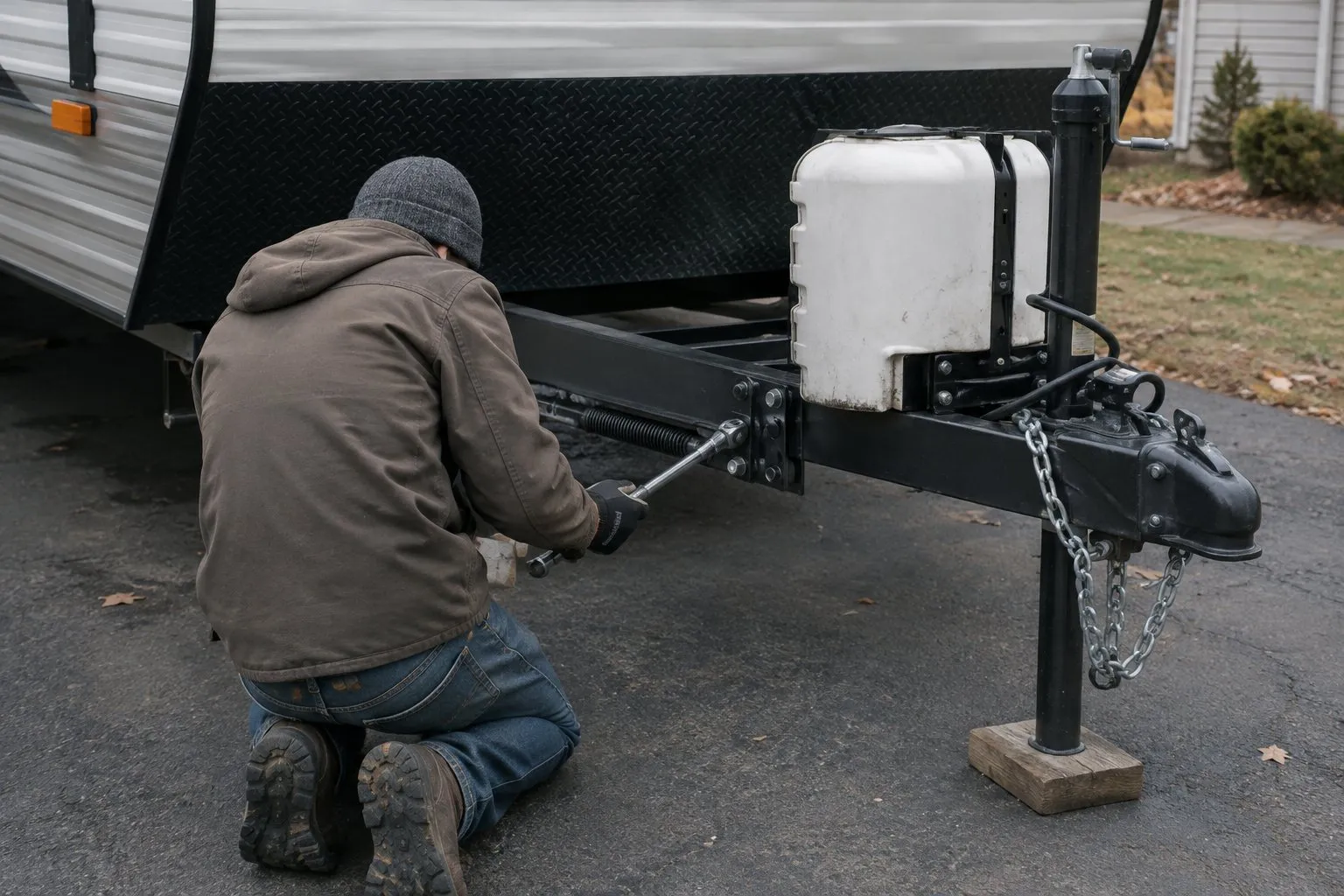
What you are about to do, and what comes after
Installation puts the hardware on: ball on the head, head on the shank, brackets on the trailer. It happens once per truck and trailer. The set-up comes right after and decides how much tension the bars carry, measured at the front fender against your truck maker's target. Daily hitching is a third job, on how to hook up a weight distribution hitch.
The steps below follow CURT's round bar sheet and Equal-i-zer's 4K manual, the two we read in full. Your hitch's own manual wins wherever it differs. No hitch yet? The best weight distribution hitch page sorts four hitches by tongue weight.
Tools. A torque wrench that reaches the highest value in your manual (Equal-i-zer lists 430 ft-lb for its balls, CURT 200 ft-lb for its head bolts), sockets and box-end wrenches for the sizes in the parts list, a tape measure, a pencil, wheel chocks and heavy fibrous or multi-purpose grease.
Eight steps, in order
Park level and measure the coupler
Line up truck and trailer on level pavement and chock the trailer. Load both the way they will travel, water and propane included, and inflate all tires. Level the trailer with its jack and measure from the pavement to the top of the coupler socket. CURT also has you note front and rear bumper heights on the truck as reference points.Mount the hitch ball
Equal-i-zer asks for a ball with a 1-1/4 inch threaded shank no longer than 2-3/8 inches, rated at or above the trailer's gross weight. Its own balls take 430 ft-lb. Other balls get their maker's torque. Kits like the CURT 17062 come with the ball already torqued. Sizes and shanks are on the hitch ball for a weight distribution hitch.Put the shank in the receiver
Slide the shank in and fit the hitch pin and clip. On tall trucks CURT lets you turn the shank over for rise, and asks you to check ground clearance when you do. If the standard shank cannot reach, work out the drop you need on how to measure hitch drop.Bolt the head at the right height
Equal-i-zer puts the top of the ball 0 to 1 inch above the top of the coupler and starts with five spacer washers. CURT sets the uncoupled ball higher than the coupler to allow for squat, starts with six washers on the pin, rotates the head forward and checks that the ball sits vertical or tilted slightly back. Hand tighten the main bolts only.Fit the spring bars
On the CURT round bar kit, bolt each chain to the tapered bar end with the U-bolt, two or three threads showing below the nut, grease the round end and push it up into the head until it clicks. Trunnion bars go in from the side; Equal-i-zer arms go into the sockets with the notched ends inside and the labels facing out.Clamp the brackets to the A-frame
Couple the trailer and raise tongue and truck about 3 inches with the jack. Hold each bar parallel to the tongue, let the chain hang straight up and center the bracket on it. Mark, then clamp. On CURT, turn the bracket bolt until it touches the frame and a quarter turn more. Equal-i-zer wants the link plates flat against the frame with no gaps. Both sides sit the same distance from the coupler.Hook up and check
Hook the chains or arms onto the brackets and lock them with the pins. Retract the jack. CURT wants at least five chain links between bracket and bar, the same on both sides, and bars nearly horizontal. Equal-i-zer wants at least 3 inches from the arm end to the bracket center. Then measure the fender as shown on the set-up page.Torque every bolt
Only when height, head angle and tension are final. On CURT: 3/4 inch head bolts 200 ft-lb, 5/8 inch set screw 50 ft-lb. On the Equal-i-zer 4K: shank bolts 180 ft-lb, L-bracket bolts 45 ft-lb, socket bolts 60 to 100 ft-lb, angle set bolt against the shank plus half a turn. Then work through the checklist below.
Where the brackets go on your trailer
The bracket position is the one measurement every maker states differently:
| Hitch | Bracket distance from the coupler | Source |
|---|---|---|
| Equal-i-zer | 27–32 in from the coupler center, leaving 2–3 in for the arms to move | Equal-i-zer FAQ |
| Equal-i-zer 4K | 25–32 in | 4K owner's manual |
| Fastway e2 round bar | About 24–27 in behind the ball center | Fastway e2 page |
| Fastway e2 trunnion | About 27–30 in behind the ball center | Fastway e2 page |
| CURT round and trunnion kits | Where the chain hangs vertical with the bar parallel to the tongue | CURT install sheets |
| Andersen | Measure coupler center to each bracket center; both must match | Andersen FAQ |
Too far back and the arms run out of room in turns; too far forward and the chain sits at an angle. CURT warns that a chain angled fore or aft at the top of the bracket can catch when turning and damage or pry open the bracket.
Something in the way? Equal-i-zer says its range avoids most battery supports and propane tanks, and asks you to relocate items on the frame if needed. CURT offers an offset lift bracket kit for frames blocked on one side. A trailer with a bottom-mount coupler or a V-nose takes Equal-i-zer's brackets upside down. A straight pole tongue needs a pole tongue adapter, CURT notes, because the brackets are made for A-frames.
Torque values: read your own table
The values above belong to two specific hitches. They are not interchangeable, and even one manual can be easy to misread: the Equal-i-zer 4K manual gives one link plate bolt value in the bracket steps and another in its final torque table. Use the table of your own hitch and model, and ask the maker if two figures disagree. Never tighten link plate or L-bracket bolts with an impact wrench; Equal-i-zer rules that out.
Chain-free hitches install differently
The Andersen has no spring bars. Its brackets carry chains with red urethane springs. Andersen starts with the trailer level front to back, within about an inch, hand-tightens the tension nuts with a 1-1/4 inch socket and then turns them three to four more threads with a wrench, until the red springs show a slight bulge. Its pages cover the rest; see the Andersen brand page.
Next: set the tension
The bars are on, but their tension is only a starting point. CURT's sheet judges it by how evenly the truck settles; Ford gives a fender target from two measurements, H1 and H2. Use your truck maker's figure: Ford recommends 50 % front axle load restoration. The full routine is on how to set up a weight distribution hitch, and fine-tuning with washers and brackets on weight distribution hitch adjustment. Every part named here is labeled on parts of a weight distribution hitch, and the weight distribution hitch handbook start page has the rest of the topics.
Questions at the scale house
Q01How far from the coupler do the spring bar brackets go?
It depends on the hitch. Equal-i-zer's FAQ gives 27 to 32 inches from the center of the coupler, which leaves 2 to 3 inches for the arms to move in turns; its 4K manual allows 25 to 32 inches. Fastway gives about 24 to 27 inches for e2 round bar models and 27 to 30 for trunnion. CURT places the bracket wherever the chain hangs straight up.
Q02What if a propane tank or battery box is in the way of the brackets?
Equal-i-zer says its 25 to 32 inch range avoids most obstructions such as battery supports and propane tanks, and to relocate items on the frame if needed. On CURT kits you can order an offset lift bracket kit when one side of the frame is blocked. Equal-i-zer also asks you to move electrical or propane lines so the bracket sits without gaps.
Q03Do I have to drill the trailer frame?
Not for the spring bar brackets on CURT and Equal-i-zer kits; they clamp around the A-frame with bolts. A bolt-on friction sway bar is different: CURT's 17200 needs six 11/32 inch holes drilled in the frame for its attachment plate, 24 inches back from the coupler.
Q04What torque does the hitch ball need?
The ball maker's value. Equal-i-zer tightens its own balls to 430 ft-lb with a 1-7/8 inch thin-walled socket and asks for a ball with a 1-1/4 inch threaded shank no longer than 2-3/8 inches. CURT ships the 17062 with a pre-torqued 2-5/16 inch ball.
Weighed against
- [1]CURT, round bar weight distribution kit installation instructions (PDF)
- [2]Equal-i-zer 4K owner's manual (PDF)
- [3]Equal-i-zer, frequently asked questions
- [4]Fastway Trailer Products, e2 hitch (bracket installation area)
- [5]Andersen, weight distribution FAQ
- [6]Ford, 2026 RV & Trailer Towing Guide (weight distribution hitch setup, p. 8)
Next stop
- Set-upShop stepsHow to set up a weight distribution hitch: measure H1 and H2 at the front fender, find your truck maker's target, then tension the bars.
- Hitch ballHow it worksThe 2-5/16 hitch ball on a WD hitch: why the coupler sets the size, which shank fits the head, the ball rating you need and how tight the nut goes.
- Hitch dropShop stepsHow to measure hitch drop: level the trailer, measure coupler and receiver height, then set the ball at the height your hitch maker asks for.
- Parts explainedHow it worksParts of a weight distribution hitch, from shank and head to spring bars, brackets, pins and sway control: what each one does and where you adjust it.
- Hook-up routineShop stepsHow to use a weight distribution hitch on every trip: couple, lift with the jack, hook the bars, lower, connect chains and wiring. Unhooking too.
Who weighs it up
weightdistributionhitch.com Editorial Desk
Towing set-up & hitch picks
We are the editorial desk at weightdistributionhitch.com. For every hitch we pull the tongue weight and trailer weight ratings, the shank and ball size, the bracket spacing and the torque values out of the maker's install sheet, then set them against the receiver label and the tow vehicle's own towing guide.
- — Ratings copied from the install sheet or part page, with document name
- — Set-up targets taken from the truck maker's towing guide, not a rule of thumb
- — "Not stated by maker" wherever a rating, surge-brake note or warranty term is missing