Trailer hitch tongue weight: reading the rating on your receiver
How it worksReading span: 4 minchecked November 28, 2026by the editorial desk
A trailer hitch tongue weight rating is the most load the hitch may carry at the ball. Every receiver has two: one for weight-carrying use and a higher one for weight-distributing use, printed on a label on the receiver. On the 2026 F-150 they are 500 lb and 1,400 lb. The lowest limit in your rig is the one that counts.
On the ticket
Look at the label on the receiver. It lists a maximum trailer weight and a maximum tongue load for a plain ball mount, and a second, higher pair for a weight distribution hitch. Then check the tongue rating of your ball mount or WD hitch, the ball, and the payload left on your truck. Your maximum tongue weight is the lowest of these numbers.
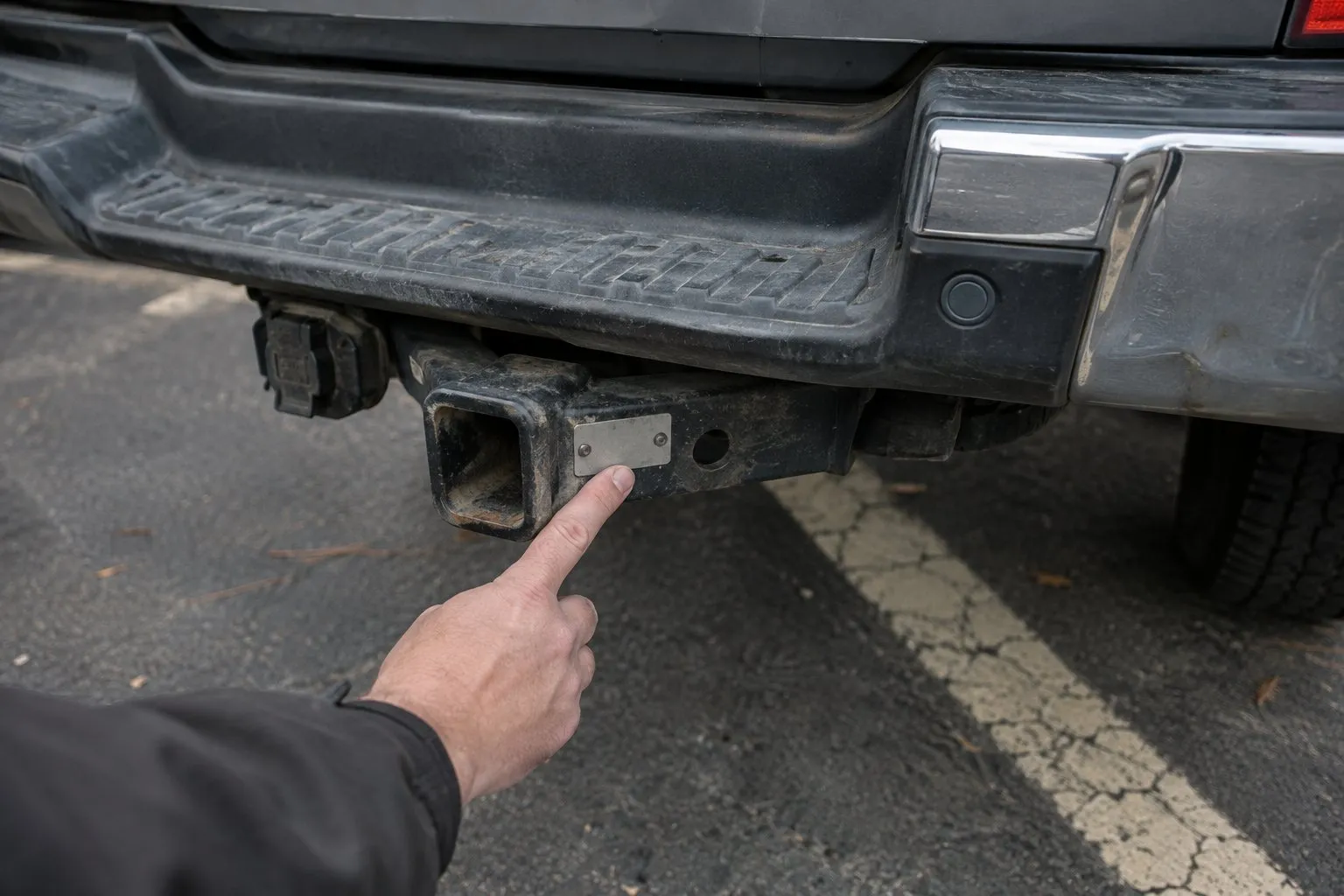
Two pairs of numbers on one label
Crawl behind your truck and look at the receiver, the square tube under the bumper. Somewhere on it sits a sticker or plate. Ford's guide explains what it shows: both the weight-carrying and the weight-distributing capacity of that receiver. Each capacity is a pair, a maximum trailer weight and a maximum tongue load.
- Weight-carrying means a plain ball mount. The whole tongue load hangs on the receiver and presses down the truck's rear.
- Weight-distributing means a hitch with spring bars, which moves part of that load to the front axle and the trailer axles. With the bars in use, the receiver is allowed a higher pair of numbers.
The two hitch types side by side are on weight-carrying vs weight-distributing hitch. Here is how far apart the numbers sit on two Ford trucks:
| 2026 Ford | Hitch position | Max trailer | Max tongue load |
|---|---|---|---|
| F-150 | Receiver, weight-carrying | 5,000 lb | 500 lb |
| F-150 | Receiver, weight-distributing | 13,500 lb | 1,400 lb |
| Ranger | Rear step bumper, weight-carrying | 3,500 lb | 350 lb |
| Ranger | Receiver, weight-carrying | 7,500 lb | 750 lb |
The F-150's 13,500 lb needs the Tow/Haul Package and the Max Tow Axle. Footnotes like that are why you read your own label and your own vehicle page, not a chart for a similar truck. The F-150 has its own page on weight distribution hitches for the Ford F-150.
The receiver rating is not the truck's rating
A receiver can be rated higher than the truck behind it. Ford's guide says so directly: the hitch receiver capacities may exceed the maximum loaded trailer weight of the vehicle, and the Trailer Towing Selector chart for your model sets that number. The same goes for the tongue. Ford counts the tongue load as part of the truck's cargo weight, so every pound on the ball uses up payload. Together with passengers and gear, it must not push the truck past its GVWR or its rear axle rating (GAWR), both printed on the label in the driver's door jamb. How to work out what is left is on payload capacity and towing.
A weight distribution hitch does not change any of these truck ratings. Ford states that trailer towing values are the same for weight-carrying and weight-distributing hitches on its Super Duty pickups. Only the receiver's own limit goes up.
Every part in the chain has a rating
Between the receiver and the trailer sit two or three more parts, and each carries its own limit:
| Part | Where the rating is | Example |
|---|---|---|
| Ball mount or WD hitch | Sticker or listing; on WD hitches the spring bars carry it | CURT 17062: 800 to 1,000 lb tongue, 8,000 to 10,000 lb trailer |
| WD hitch, one maker's range | Size chart | Equal-i-zer: 400 to 1,600 lb tongue across six sizes |
| Hitch ball | Stamped on the ball | Equal-i-zer: at least the trailer's gross weight |
| Shank | Part listing | Some shanks are rated higher than the bars and limited to the bar rating |
Equal-i-zer's manual puts the rule in one line: never exceed the specified weight ratings for the trailer, tow vehicle, hitch, hitch ball or any other towing equipment. Its FAQ adds a detail people miss. Cargo in the truck behind the rear axle presses the rear down just like the tongue, so count it toward the hitch's tongue rating too. The sizing steps for a WD hitch are on the hitch size guide.
Finding your maximum tongue weight in four checks
Read the receiver label
Note the tongue limit for the hitch type you plan to use. With a plain ball mount, the weight-carrying number applies.Read your vehicle page
Ford's guide points to the specific vehicle pages for tongue load recommendations with its factory receivers. For other brands, look in the towing section of the owner's manual.Work out your payload
Subtract passengers and cargo from the payload on the door-jamb label. The tongue load has to fit in what is left.Check the hitch and ball
The spring bar sticker or ball mount listing and the stamp on the ball give the last two limits.
The lowest of these numbers is your maximum. Then compare it with what your trailer actually puts on the ball. Ford plans with 10 % of the loaded trailer for conventional trailers, and the normal range is on tongue weight. A heavy tongue can hit the receiver's weight-carrying limit long before the trailer reaches its own limit; that is often the moment a weight distribution hitch becomes necessary.
What hitch classes tell you, and what they don't
Receivers are often sold as class III, IV or V. The class gives you a rough size, but the ranges differ between sources and no class number replaces the label. The common ranges are on hitch classes. When the label and a class chart disagree, the label is the one to follow.
Questions at the scale house
Q01What is max tongue weight?
It is the heaviest downward load a hitch part may carry at the ball. Ford's receivers list two: a weight-carrying maximum for a plain ball mount and a weight-distributing maximum for use with spring bars. Your ball mount or WD hitch, the ball and the truck's payload each set their own limit, and the lowest one is your real maximum.
Q02What tongue weight can a truck handle?
Start with the receiver label, then read the tongue load recommendation on your vehicle's page in the maker's towing guide or owner's manual. Ford's guide also reminds you that the tongue load counts as cargo, so it must fit within payload without pushing the truck past its GVWR or rear axle rating. The smallest of these numbers is what your truck can handle.
Q03Is a bumper hitch rated lower than a receiver hitch?
Usually by a lot. Ford's 2026 guide lists the Ranger's rear step bumper at 3,500 lb with a 350 lb tongue, and its hitch receiver at 7,500 lb with a 750 lb tongue, both for weight-carrying use. Never use the receiver numbers for a ball on the bumper.
Weighed against
Next stop
- Tongue weightHow it worksTongue weight is the part of the trailer's weight that presses on the hitch ball. Normal range, what too much or too little does, where it counts.
- Carrying vs distributingSide by sideWeight carrying hitch vs weight distribution hitch: where the tongue load goes, what the receiver label allows for each, and when Ford calls for it.
- Hitch classesHow it worksClass 3 hitch, class 4 and class 5: receiver sizes, typical ratings, how weight distribution changes them, and why the label beats the class.
- Payload and towingHow it worksPayload capacity and towing: tongue weight counts as cargo in your truck, so passengers, gear, hitch and tongue all share one payload figure.
- What size weight distribution hitch do I need?Straight answerWhat size weight distribution hitch do I need? Size the bars by loaded tongue weight plus rear cargo, then check trailer GVWR and the receiver label.
- Ford F-150Will it fit?Weight distribution hitch for F150 owners: Ford's 5,000 lb line, the 500 and 1,400 lb tongue limits, the 50 % set-up target and what to check first.
Who weighs it up
weightdistributionhitch.com Editorial Desk
Towing set-up & hitch picks
We are the editorial desk at weightdistributionhitch.com. For every hitch we pull the tongue weight and trailer weight ratings, the shank and ball size, the bracket spacing and the torque values out of the maker's install sheet, then set them against the receiver label and the tow vehicle's own towing guide.
- — Ratings copied from the install sheet or part page, with document name
- — Set-up targets taken from the truck maker's towing guide, not a rule of thumb
- — "Not stated by maker" wherever a rating, surge-brake note or warranty term is missing