Drop hitch for weight distribution: picking the right shank
Buying sheetReading span: 5 minchecked November 28, 2026by the editorial desk
A drop hitch for weight distribution is not a plain drop ball mount. It is the shank, the vertical bar that slides into your receiver and carries the hitch head. When the standard shank cannot bring the ball down to coupler height, you swap it for one with more drop. For a 2-1/2 inch receiver and a CURT hitch head, the CURT 17132 does the job, with up to 8 inches of drop.
On the ticket
Measure first: needed drop = receiver height + 3 inches − coupler height (Equal-i-zer). Up to 8 inches on a 2-1/2 inch receiver with a CURT head: take the CURT 17132 shank. On a 2 inch receiver, the standard shank flips for drop or rise, and the Andersen hitch comes with a 6 inch drop. The shank never raises the bars' rating.
Paid links on this sheet: Links with a * go to Amazon, and a purchase through them pays this site a commission; your price stays the same. As an Amazon Associate I earn from qualifying purchases. How the links pay
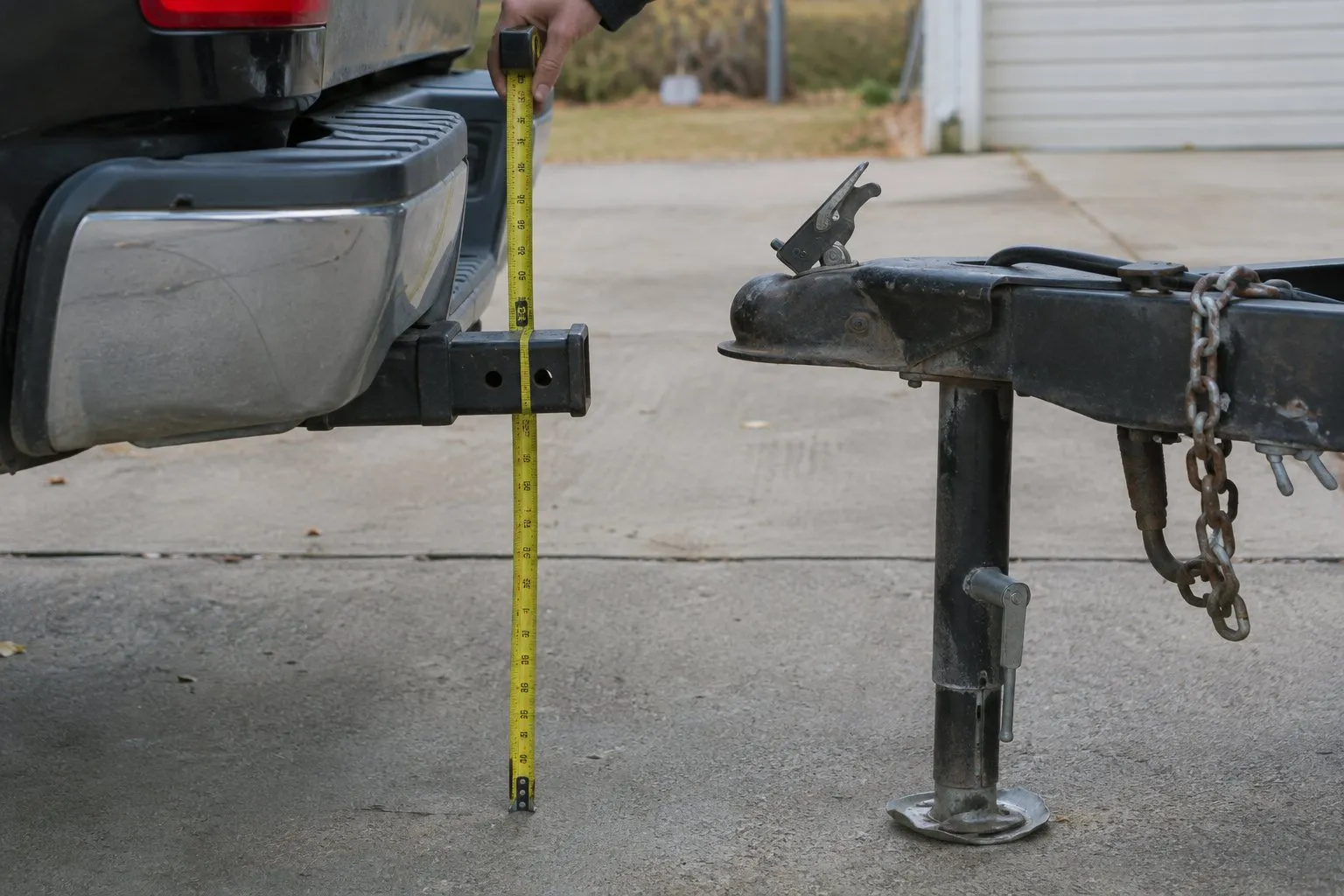
The shank sets the ball height, nothing else
Every weight distribution hitch hangs its head on an adjustable shank. CURT describes it as the part that mounts the hitch onto the receiver and lets you find the exact height for each trailer load. The head bolts to the shank through a row of holes, so you can slide it up or down.
Why the height matters: Ford's set-up asks for the ball at the same height as the coupler with the trailer level, before you take a single measurement. Equal-i-zer's manual puts the top of the ball between 0 and 1 inch above the top of the coupler. A ball set too high or too low tilts the trailer and changes how much the bars distribute, which is why the set-up on how to set up a weight distribution hitch starts there.
If the head is already at the bottom hole and the ball still sits above the coupler, you need a shank with more drop. That is what people mean by a drop hitch for weight distribution.
Measure the drop before you buy
Equal-i-zer's FAQ gives a two-measurement method:
- Measure from the ground to the inside top of the receiver tube on the truck.
- Measure from the ground to the top of the coupler, with the trailer level.
- Needed rise or drop = (receiver height + 3) − coupler height. A positive result is the drop you need; a negative one means rise.
Do it with truck and trailer loaded for the trip; Ford's set-up asks for both vehicles loaded the way they will travel. The method with photos is on how to measure hitch drop.
Three ways to get the drop
| Your result | What to do | Example |
|---|---|---|
| Inside the standard shank's range | Move the head on the shank, or flip the shank | CURT's 2 inch shanks on the 17062 and TruTrack 4P flip for drop or rise. Equal-i-zer's standard shank gives up to 3 inches of drop or 7 inches of rise |
| More drop than the standard shank, 2-1/2 inch receiver | Swap the shank | CURT 17132: up to 8 inches of drop, for all CURT weight distribution heads |
| More drop, 2 inch receiver | A kit that ships with the drop you need, or a maker's specialty shank | Andersen kit with a 2 inch, 6 inch drop shank. Equal-i-zer offers specialty shanks with other drops and rises |
Lifted trucks are a typical case for extra drop; that one, with the truck-side checks, is on lifted truck weight distribution hitch.
CURT 17132: 8 inches of drop on a 2-1/2 inch receiver
The CURT 17132 is a replacement shank, sold without a hitch head. CURT lists it as compatible with all CURT weight distribution hitches, either to replace a damaged shank or to get more vertical range. Our pick for this job, because the maker states every figure that matters:
- Fit: 2-1/2 x 2-1/2 inch receiver tube with a 5/8 inch hitch pin hole, so it suits class 5 and other heavy-duty receivers with that opening.
- Drop: up to 8 inches. CURT says it is not rated for use in the rise position.
- Size: 14-1/2 inches high and 12-1/2 inches long, measured between the outermost hole centers. The 3/4 inch holes sit 1-1/4 inches apart for fine height steps.
- Rating: 15,000 lb gross trailer weight and 1,500 lb tongue weight, but limited to the spring bar capacity of the hitch on it.
- Build: solid steel with a carbide black powder coat. Limited lifetime warranty, with one year on the finish and one year on parts.
The rating line is the one people miss. A shank rated for 1,500 lb under a head with 1,000 lb bars is a 1,000 lb hitch. The lowest rating in the chain, bars, shank, ball, receiver or truck, is your limit. Reading the receiver side is covered on hitch tongue weight rating.
The CURT round-bar 17062 is the usual partner: it ships with a 2 inch shank, and CURT says its head also takes the 2-1/2 inch shanks.
Andersen with a 6 inch drop: for 2 inch receivers
On a 2 inch receiver the 17132 does not fit. The Andersen hitch we list comes with a 2 inch shank and a 6 inch drop in the box, rated 14,000 lb and 1,400 lb of tongue weight, with cone friction sway control and no spring bars. One firm limit: Andersen says its weight distribution hitch cannot be used with surge brakes, because the forward pressure would permanently engage them.
Andersen No-Sway 6" drop
Chain-free hitch with cone friction sway control and no grease, rated 14,000 lb / 1,400 lb.
Why it's on this ticket: Ships with a 2 inch shank and 6 inches of drop, so a 2 inch receiver gets the extra drop without a separate shank. Not for surge brakes.
Fits: Trailers without surge brakes, owners who want a hitch that needs no grease

- Tongue weight
- Up to 1,400 lb
- Max trailer weight
- 14,000 lb
- Spring bars
- None – chain-free, cone friction
- Sway control
- Cone friction, built in
- Shank
- 2", 6" drop
- Ball
- 2-5/16"
- Surge brakes (decides it)
- Not compatible (Andersen FAQ)
- Andersen states it needs no grease
- Rated 14,000 lb / 1,400 lb
- Brackets for 3" to 6" trailer frames listed
- Andersen says it cannot be used with surge brakes
- This listing is the 6" drop; the 4" drop is a different listing
Which shank for which truck
Pick by your numbers
If you run a CURT hitch head on a 2-1/2 inch receiver and need up to 8 inches of drop → CURT 17132 8" Drop Shank
Amazon price: View(paid link to Amazon, opens in a new tab)Ad · paid link · check price & delivery on AmazonAd · paid link · price as of ·If your receiver is 2 inch and you need about 6 inches of drop, without surge brakes → Andersen No-Sway 6" drop
Amazon price: View(paid link to Amazon, opens in a new tab)Ad · paid link · check price & delivery on AmazonAd · paid link · price as of ·If the standard shank already reaches when flipped
If you still need the hitch itself
After the swap: set up again
A new shank changes the ball height, and the ball height changes the distribution. Equal-i-zer's manual has you level the trailer, then re-measure the front wheel well after any change to the ball height. Run the fender measurements again, then torque the shank bolts to the hitch maker's value; for the Equal-i-zer 4K that is 180 ft-lbs. Fine-tuning tension after that is on weight distribution hitch adjustment. The other spare parts, from spring bars to brackets, are on weight distribution hitch parts, and what each part is called on parts of a weight distribution hitch.
CURT 17132 8" Drop Shank: hitch it or leave it?
TKT 19+ Hitch it if …
- If your receiver sits so high that the standard shank can't reach the coupler height
- If you run a CURT WD hitch on a 2-1/2" receiver
− Leave it if …
- If your receiver is 2"
- If you need rise rather than drop
Numbers match? Check the CURT 17132 8" Drop Shank listing for the exact rating and what is in the box.
Amazon price: View on Amazon(paid link to Amazon, opens in a new tab)Ad · paid link · check price & delivery on AmazonAd · paid link · price as of ·Questions at the scale house
Q01Do I need a 2 inch or a 2-1/2 inch weight distribution shank?
The one that matches your receiver opening. A 2 inch shank fits a 2 x 2 inch receiver, a 2-1/2 inch shank a 2-1/2 x 2-1/2 inch receiver. CURT ships its 17062 with a 2 inch shank and says the same head also takes its 2-1/2 inch shanks; the 17132 is one of them. The receiver label tells you the opening and the ratings.
Q02Does a weight distribution hitch come with a shank?
Depends on the kit. CURT's 17062 and TruTrack 4P include a 2 inch shank that flips for drop or rise. Equal-i-zer's standard shank gives up to 3 inches of drop or 7 inches of rise, but the Equal-i-zer 10K listing we link says shank and ball are not included. Check the box contents before you order.
Q03Can a longer shank help with tight turns?
It can. Equal-i-zer's manual says extended bumper guards, truck campers or rear-mounted spare tires can limit the turning radius, and points you to its longer 18 inch shank if the standard 12 inch shank does not let you turn tightly. Check the trailer's chain and coupler layout first, since those can also cut the clearance.
Weighed against
- [1]CURT, part 17132 weight distribution shank, 2-1/2 inch, 8 inch drop
- [2]CURT, part 17062 round bar weight distribution hitch
- [3]Equal-i-zer, frequently asked questions (do I need a longer shank?)
- [4]Equal-i-zer 4K owner's manual (PDF), step 3
- [5]Andersen, weight distribution hitch FAQ
- [6]Ford, 2026 RV & Trailer Towing Guide (weight distribution hitch setup, p. 8)
Next stop
- Hitch dropShop stepsHow to measure hitch drop: level the trailer, measure coupler and receiver height, then set the ball at the height your hitch maker asks for.
- Lifted trucksBuying sheetA lifted truck weight distribution hitch starts with the drop: how to measure it, the CURT 8 inch drop shank we pick, and the Andersen option.
- Replacement partsBuying sheetWeight distribution hitch parts: which shank, brackets, spring bars, washers, pins and sway bar to buy, and why each part has to match your hitch.
- Parts explainedHow it worksParts of a weight distribution hitch, from shank and head to spring bars, brackets, pins and sway control: what each one does and where you adjust it.
- Hitch classesHow it worksClass 3 hitch, class 4 and class 5: receiver sizes, typical ratings, how weight distribution changes them, and why the label beats the class.
Who weighs it up
weightdistributionhitch.com Editorial Desk
Towing set-up & hitch picks
We are the editorial desk at weightdistributionhitch.com. For every hitch we pull the tongue weight and trailer weight ratings, the shank and ball size, the bracket spacing and the torque values out of the maker's install sheet, then set them against the receiver label and the tow vehicle's own towing guide.
- — Ratings copied from the install sheet or part page, with document name
- — Set-up targets taken from the truck maker's towing guide, not a rule of thumb
- — "Not stated by maker" wherever a rating, surge-brake note or warranty term is missing