Weight distribution hitch vs sway bar: two jobs, often one kit
Side by sideReading span: 4 minchecked November 28, 2026by the editorial desk
Weight distribution hitch vs sway bar is not an either-or. The weight distribution hitch moves part of the tongue load from the truck's rear axle to the front axle and the trailer axles. A sway bar moves no load at all; it adds friction that resists side-to-side movement. Many hitches ship with both.
On the ticket
A sway bar cannot fix a sagging rear or a light front end; only the spring bars of a weight distribution hitch do that. Spring bars alone are not sway control either. Tall travel trailers usually want both, and kits like the CURT 17062 include a friction sway bar. Set the weight distribution first, then add or adjust the sway control.
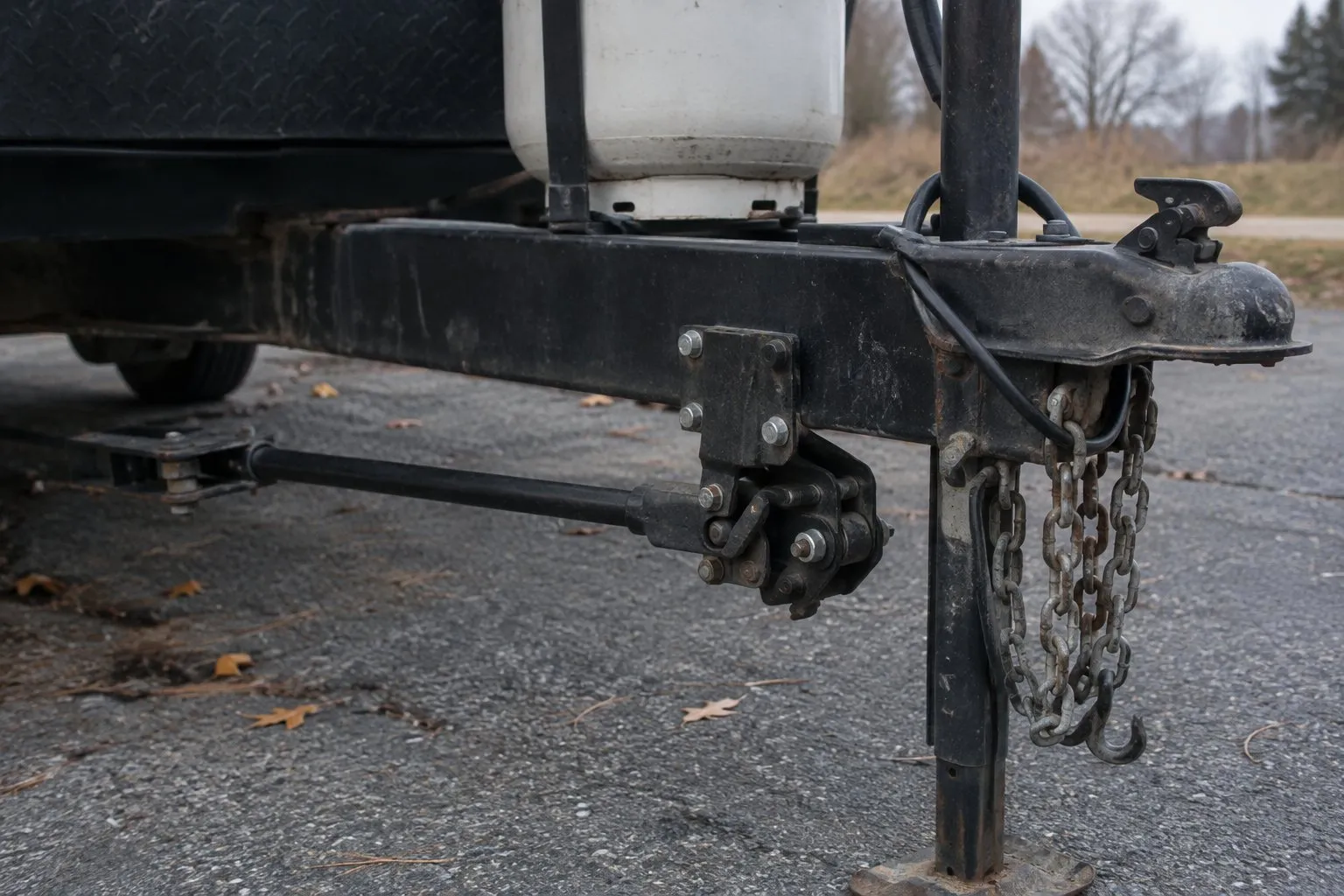
The difference in one sentence each
Weight distribution hitch: spring bars under chain tension lift some weight off the truck's rear wheels and pass it to the front wheels and the trailer wheels. Ford describes it as chains pulled up to bend the spring bars upward.
Sway bar: a friction unit bolted between a small ball on the ball mount and a bracket on the trailer's A-frame. When the trailer starts to swing sideways, the bar has to slide against that friction.
Lippert puts it in four words: related but not interchangeable.
Two jobs, side by side
| Weight distribution hitch | Friction sway bar | |
|---|---|---|
| What it fixes | Rear sag, light front end, weak steering and braking | Side-to-side movement from wind, trucks passing, sudden moves |
| How | Bent spring bars move load forward and back | Friction resists the bar sliding in and out |
| Moves tongue load? | Yes, part of it | No |
| Resists sway? | Not on its own; CURT says its hitch should not be considered a sway control | Yes, that is its only job |
| Set-up | Fender measurements to your truck maker's target | Mount 24 in back from the coupler, preset tension, road test |
| Slippery roads | Stays on | CURT requires the 17200 to be removed on wet, icy, gravel or snowy roads |
| Surge brakes | Depends on the model | CURT 17200 cannot be used with surge brakes |
What a sway bar cannot do
If the back of your truck squats and the steering feels light with the trailer on, a sway bar will not change that. It carries none of the tongue load. Equal-i-zer's manual is direct about what too little weight on the front axle means: a loss of steering and braking control, and reduced resistance to sway. So a front end that is too light also makes sway worse, and the cure is weight distribution, not more friction. The mechanics are on how a weight distribution hitch works.
What spring bars cannot do
The reverse holds too. Spring bars hold the rig level, but on their own they do not hold the trailer straight. CURT's part page for its trunnion hitch says the hitch should not be considered a sway control, and its installation sheet recommends a sway control device for trailers with a large surface area, such as travel trailers, to help with sudden moves, gusts and buffeting from passing vehicles.
Often one kit: three ways the two jobs combine
Many weight distribution hitches handle both jobs. Lippert notes that some hitches have sway control built in, while others accept a separate unit. On the hitches we cover, it looks like this:
- Spring bars plus a bolt-on friction bar. The CURT 17062 and 17422 ship with the 17200 friction unit, which mounts on built-in tabs on the head. The head takes two sway balls, so larger trailers can run two bars. Which bar to add is covered on trailer sway bar.
- Friction built into the hitch. Equal-i-zer's manual describes its integrated 4-point sway control as sway control and weight distribution in one unit; the four friction points are explained on the Equal-i-zer page. CURT's TruTrack uses friction brackets plus a cam system. No separate bar to hook up.
- A friction cone at the ball. Andersen's chain-free hitch presses the ball into a friction liner and, by Andersen's account, can stay connected while backing up and on wet, slick or gravel roads.
Which of these suits you is on built-in vs friction sway control. Equal-i-zer's 4K manual adds a caution that applies to all three: there is no 100 % qualitative measurement of trailer sway or sway control, so no design can be ranked by a single number.
Which one do you need?
- Rear sags, front feels light, or your vehicle guide calls for weight distribution: a weight distribution hitch. Ford's 2026 guide says not to tow over 5,000 lb with an F-150 without a weight-distribution system.
- Light trailer, level rig, but it gets pushed around by wind and trucks: a sway bar on your ball mount can be enough.
- Travel trailer of any real size: both, either as a kit with a friction bar or as a hitch with sway control built in. Hitches with sway control built in are compared on weight distribution hitch with sway control.
Lippert's order of work is worth keeping: set tongue weight first, then add sway control as needed. A trailer with too little tongue weight sways no matter what is bolted to it; CURT's sheet names insufficient tongue weight and tail-heavy loading as causes. The rest of the causes are on what causes trailer sway.
Questions at the scale house
Q01Can I use a sway bar without a weight distribution hitch?
Yes, a friction sway bar can work with a plain ball mount. CURT's 17200 kit includes a weld-on tab for ball mounts without a sway ball plate, and CURT wants any welding done in a qualified welding shop. It will not move any tongue load, so if your vehicle guide calls for weight distribution above a certain weight, the sway bar does not meet that requirement.
Q02Can I use a weight distribution hitch without the sway bar?
The spring bars work without it, but they are not sway control. CURT's part page for the 17422 says the hitch on its own should not be considered a sway control, and CURT's sheet recommends a sway control device for trailers with a large surface area, such as travel trailers. On wet, icy, gravel or snowy roads CURT requires its friction bar to be removed.
Q03Is a trailer sway bar the same as the sway bar under a truck?
No. The sway bar on the chassis is an anti-roll bar that links the left and right suspension. The sway bar at the hitch is a friction unit between the ball mount and the trailer A-frame. The two share a name and nothing else.
Weighed against
- [1]Lippert, What is a weight distribution hitch? (weight distribution vs sway control)
- [2]Ford, 2026 RV & Trailer Towing Guide (hitch styles, p. 5)
- [3]CURT, round bar weight distribution kit and 17200 sway control installation instructions (PDF)
- [4]CURT, part 17422 short trunnion bar weight distribution hitch
- [5]Equal-i-zer 4K owner's manual (PDF)
- [6]Andersen, weight distribution FAQ
Next stop
- Trailer sway barsBuying sheetTrailer sway bar guide: how a friction sway control bar works, the CURT 17200 we pick, where it mounts, when to take it off, and what it cannot fix.
- Built-in vs frictionHow it worksWeight distribution hitch with built-in sway control vs a bolt-on friction bar: how 4-point, cam, cone and bar designs resist sway.
- How it worksHow it worksHow does a weight distribution hitch work? Spring bars under tension lever part of the tongue load to the front axle and trailer axles.
- With sway controlBuying sheetWeight distribution hitch with sway control: built-in 4-point designs vs bolt-on friction bars, what each maker states, and which fits.
- Causes of swayFault and fixWhat causes trailer sway: too little tongue weight, a tail-heavy load, speed, wind and loose bar tension. How to stop it and fix the cause.
Who weighs it up
weightdistributionhitch.com Editorial Desk
Towing set-up & hitch picks
We are the editorial desk at weightdistributionhitch.com. For every hitch we pull the tongue weight and trailer weight ratings, the shank and ball size, the bracket spacing and the torque values out of the maker's install sheet, then set them against the receiver label and the tow vehicle's own towing guide.
- — Ratings copied from the install sheet or part page, with document name
- — Set-up targets taken from the truck maker's towing guide, not a rule of thumb
- — "Not stated by maker" wherever a rating, surge-brake note or warranty term is missing