How to calculate tongue weight: weigh it at the coupler, three ways
Shop stepsReading span: 5 minchecked November 28, 2026by the editorial desk
How to calculate tongue weight? You weigh it. Load the trailer for the trip, set the coupler at hitch ball height on a scale and read the number. A tongue scale, a truck-stop scale or, for light trailers, a bathroom scale all work; the 10 to 15 % rule is only the estimate you start from.
Paid links on this sheet: Links with a * go to Amazon, and a purchase through them pays this site a commission; your price stays the same. As an Amazon Associate I earn from qualifying purchases. How the links pay
On the ticket
Load the trailer as you will tow it. Block the wheels, set the coupler at hitch ball height on a tongue weight scale and raise the tongue jack until the full weight sits on the scale. At a truck stop, weigh the truck alone, then with the trailer hitched and its wheels off the deck: the difference is the tongue weight.
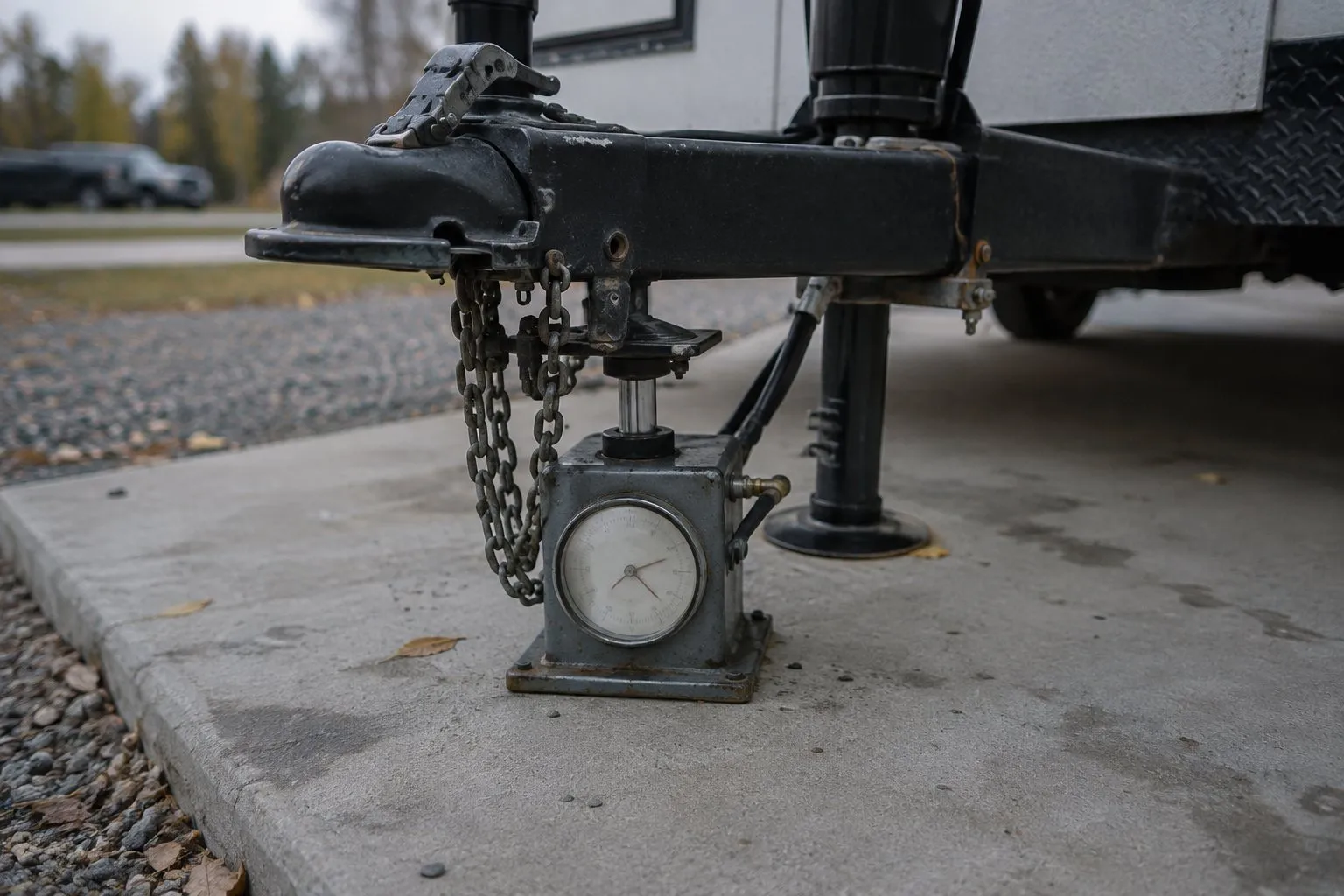
The 10 to 15 % rule tells you roughly where your tongue weight should land. It does not tell you where it is. Two campers of the same model can differ by a few hundred pounds once one carries full water tanks and a generator up front. Equal-i-zer says it plainly: to know your tongue weight exactly, weigh it after you load the trailer.
Three ways to weigh the tongue, side by side
| Method | What you need | Good for | Watch out for |
|---|---|---|---|
| Tongue weight scale | A hydraulic scale and strong blocks | Any bumper-pull trailer, at home, as often as you like | The scale must stand level and match your weight range |
| Truck-stop scale | A drive-on scale and two weigh tickets | Heavy trailers, and the whole rig at once | Trailer wheels must stay off the deck |
| Bathroom scale | A household scale and a solid base at ball height | Light utility and small trailers | Useless once the tongue is heavier than the scale's maximum |
Whatever you use, load the trailer first. Weighing an empty trailer gives you a number you will never tow with.
Method 1: a tongue weight scale at the coupler
This is the method the hitch makers build their sizing around, and the one you can repeat in the driveway before every trip. Sherline's instructions put the reading right where the coupler rests on the ball, because that is where the tongue load really acts.
Load and park
Pack the trailer for the trip and park it on level ground. Chock the wheels.Block the scale to ball height
Set the scale on strong, secure blocks under the coupler, so the coupler sits at about the height it will have on the truck. Sherline mentions a hydraulic floor jack as an easy way to lift the scale into place.Let the jack go slack
Crank the tongue jack until the full weight of the coupler rests on the scale and the jack carries nothing.Read it once, then lift off
Read the pounds from the dial and take the weight off again. Sherline warns against leaving the trailer resting on the scale longer than the reading takes.
Three things spoil a reading. A scale that is not level binds and reads low. Dropping the coupler onto it can knock the needle off zero. And a load above the dial's range can bend the needle for good, so pick a scale whose range sits well above your expected number. The tongue weight scale page compares the scales and their ranges.
Sherline LM-2000
Hydraulic tongue scale with a 0–2,000 lb dial, machined steel and aluminum, no batteries.
Why it's on this ticket: Reads the tongue right at the coupler on a 0 to 2,000 lb dial, with no batteries – the scale this method is written around.
Fits: Measuring the loaded tongue weight of travel and utility trailers before you pick spring bars

- Range (decides it)
- 0–2,000 lb (0–900 kg)
- Type
- Hydraulic dial, no batteries
- Size
- 3.25" body, 4.5" tall
- 0–2,000 lb dial in pounds and kilograms
- No electronics or batteries, one moving part
- Hitch extension included
- Sherline warns not to store it on its side or below 32 °F
- Sherline paused new direct orders in October 2026; buy where it is in stock
Method 2: a truck-stop scale, two weigh tickets
A drive-on scale at a truck stop gives you the tongue weight as a difference. Weigh Safe describes it in two passes:
- Drive the truck onto the scale without the trailer and get the weight.
- Come back with the trailer hitched, truck on the deck, trailer wheels off it, and weigh again.
- Truck weight with the trailer attached minus truck weight alone equals tongue weight.
Do the second pass with the spring bars unhooked. Tensioned bars move part of the load onto the trailer axles, and those sit off the scale, so the difference would come out too low.
Ford's guide uses the same kind of scale for a cleaner reading: disconnect the trailer and place only the tongue on the scale, at hitch ball height. While you are on the deck, weigh the trailer axles too. Sherline adds that the trailer axles plus the tongue reading give you the gross trailer weight, and with both numbers you can work out your real tongue percentage. The full walk-through of axle weights is on how to weigh your truck and trailer.
Method 3: a bathroom scale for light tongues
A household scale works when the tongue is light. Weigh Safe raises the scale to hitch ball height on a box or a cinder block and lowers the coupler straight onto it. That is all there is to it, and it stops at the scale's own maximum.
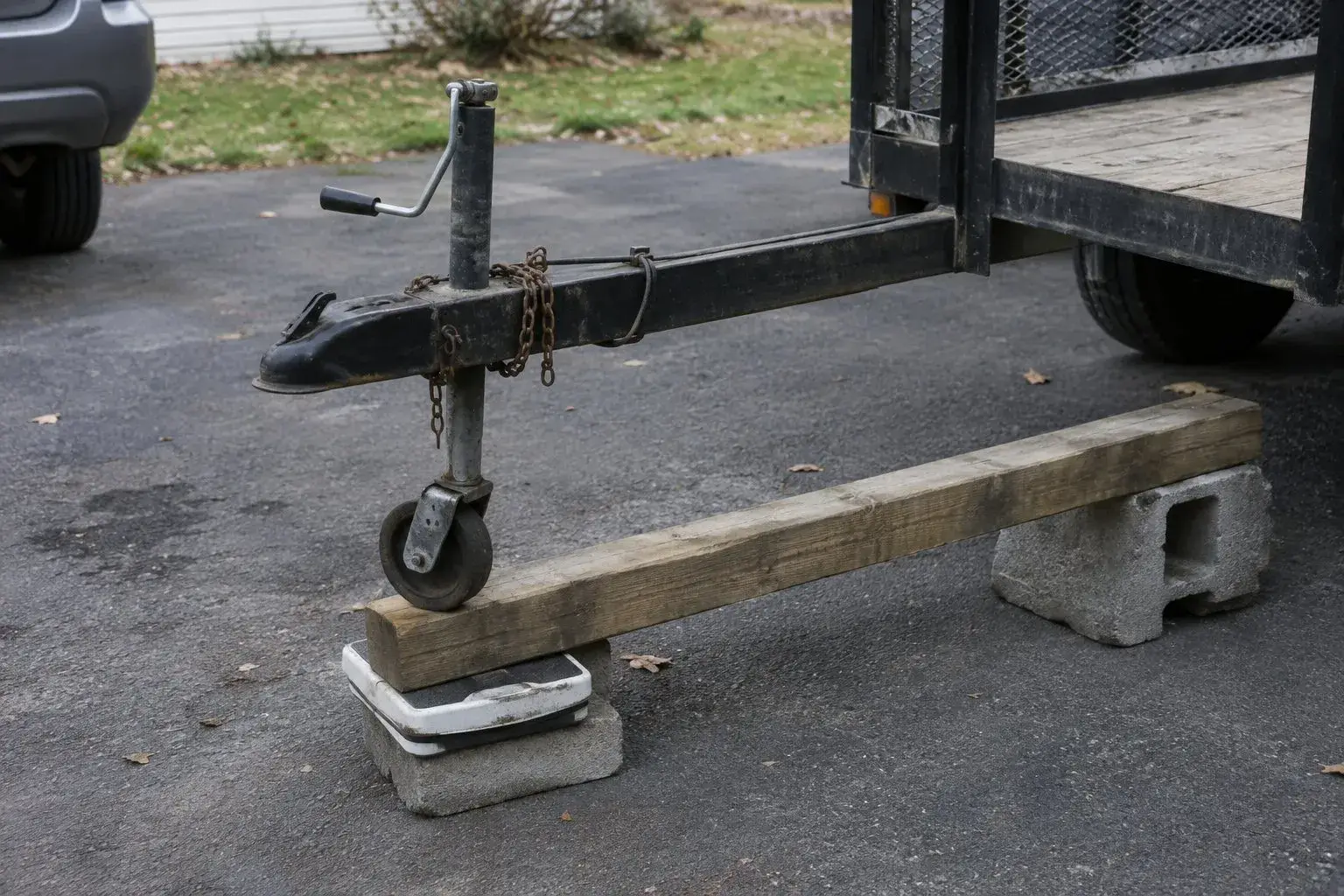
You will also find lever set-ups with a board and a pipe that let a bathroom scale read heavier tongues. The multiplier depends on exact distances, and a small error in placing the board gets multiplied into the result. We do not give a formula for it. Once the tongue is heavier than the scale, a tongue scale or a truck-stop scale is the safer number.
The reading is in: what to do with it
Ford gives the rule for correcting the load: if the tongue is above the upper limit, move more of the trailer's contents rearward; if it is below the lower limit, shift the load forward. Then weigh again.
- Compare it with the trailer weight. Ford plans with 10 % for conventional trailers over 2,000 lb; Equal-i-zer says most tongues land between 10 and 15 %. The tongue weight percentage page explains the ranges, and the tongue weight calculator does the math.
- Add the cargo behind the rear axle. Equal-i-zer counts what rides in the truck bed behind the rear axle toward the hitch's tongue rating, because it presses the rear down the same way.
- Size the hitch on the total. Pick spring bars whose stated range covers it; the hitch size guide shows how.
- Way off? Start with the 60/40 loading rule, and if the tongue stays too heavy, read too much tongue weight.
With the number on paper, the next job is the hitch itself: the weight distribution hitch set-up starts with the trailer loaded exactly as you just weighed it.
Questions at the scale house
Q01How do you calculate tongue weight?
For an estimate, take 10 to 15 % of the loaded trailer weight; Ford plans with 10 % for conventional trailers over 2,000 lb. For the real number, weigh it: put only the loaded trailer's coupler on a scale at hitch ball height, or weigh the truck at a truck stop with and without the trailer hitched and take the difference.
Q02How do I determine tongue weight without a scale?
Without any scale you only get an estimate: 10 to 15 % of the loaded trailer weight, or 10 % in Ford's planning. Equal-i-zer points out that the tongue weights printed in brochures are dry figures that usually leave out batteries and propane, so a packed camper often sits above them. Weigh it before you buy spring bars.
Q03Can I use a bathroom scale to measure tongue weight?
Yes, for light tongues. Weigh Safe describes raising the bathroom scale to hitch ball height on a box or cinder block and lowering the coupler onto it. It is not for trailers whose tongue weight is above the scale's own maximum. Heavier tongues belong on a tongue weight scale or a truck-stop scale.
Weighed against
Next stop
- Tongue weightHow it worksTongue weight is the part of the trailer's weight that presses on the hitch ball. Normal range, what too much or too little does, where it counts.
- Tongue weight scalesBuying sheetTongue weight scale for trailers: what the Sherline LM-2000 reads, which dial range fits, how to read it at the coupler and store it.
- Tongue weight calculatorHow it worksTongue weight calculator: enter your loaded trailer weight, get the 10 to 15 % span and the hitches whose stated rating covers it, plus the rules.
- How much tongue weight should a trailer have?Straight answerHow much tongue weight should a trailer have? 10 to 15 % of its loaded weight, Ford plans with 10 %. What is acceptable and how to fix it.
- Weigh truck and trailerShop stepsHow to weigh your truck and trailer on a three-platform truck-stop scale: where each axle goes, what the ticket shows, which label to check.
Who weighs it up
weightdistributionhitch.com Editorial Desk
Towing set-up & hitch picks
We are the editorial desk at weightdistributionhitch.com. For every hitch we pull the tongue weight and trailer weight ratings, the shank and ball size, the bracket spacing and the torque values out of the maker's install sheet, then set them against the receiver label and the tow vehicle's own towing guide.
- — Ratings copied from the install sheet or part page, with document name
- — Set-up targets taken from the truck maker's towing guide, not a rule of thumb
- — "Not stated by maker" wherever a rating, surge-brake note or warranty term is missing