How to weigh your truck and trailer at a truck-stop scale
Shop stepsReading span: 4 minchecked November 28, 2026by the editorial desk
How to weigh your truck and trailer: load everything for the trip, drive onto a three-platform truck-stop scale with the steer axle on the first platform, the drive axle on the second and the trailer axles on the third, and push the intercom button. The ticket gives each axle and the total; compare them with the ratings on your door label.
On the ticket
Pack truck and trailer as for the trip, people included. At a CAT-type scale, put the truck's front axle on platform 1, the rear axle on platform 2 and the trailer axles on platform 3, then call the cashier over the intercom. The ticket shows each axle group and the gross. Check front and rear axle against GAWR, truck against GVWR, total against GCWR.
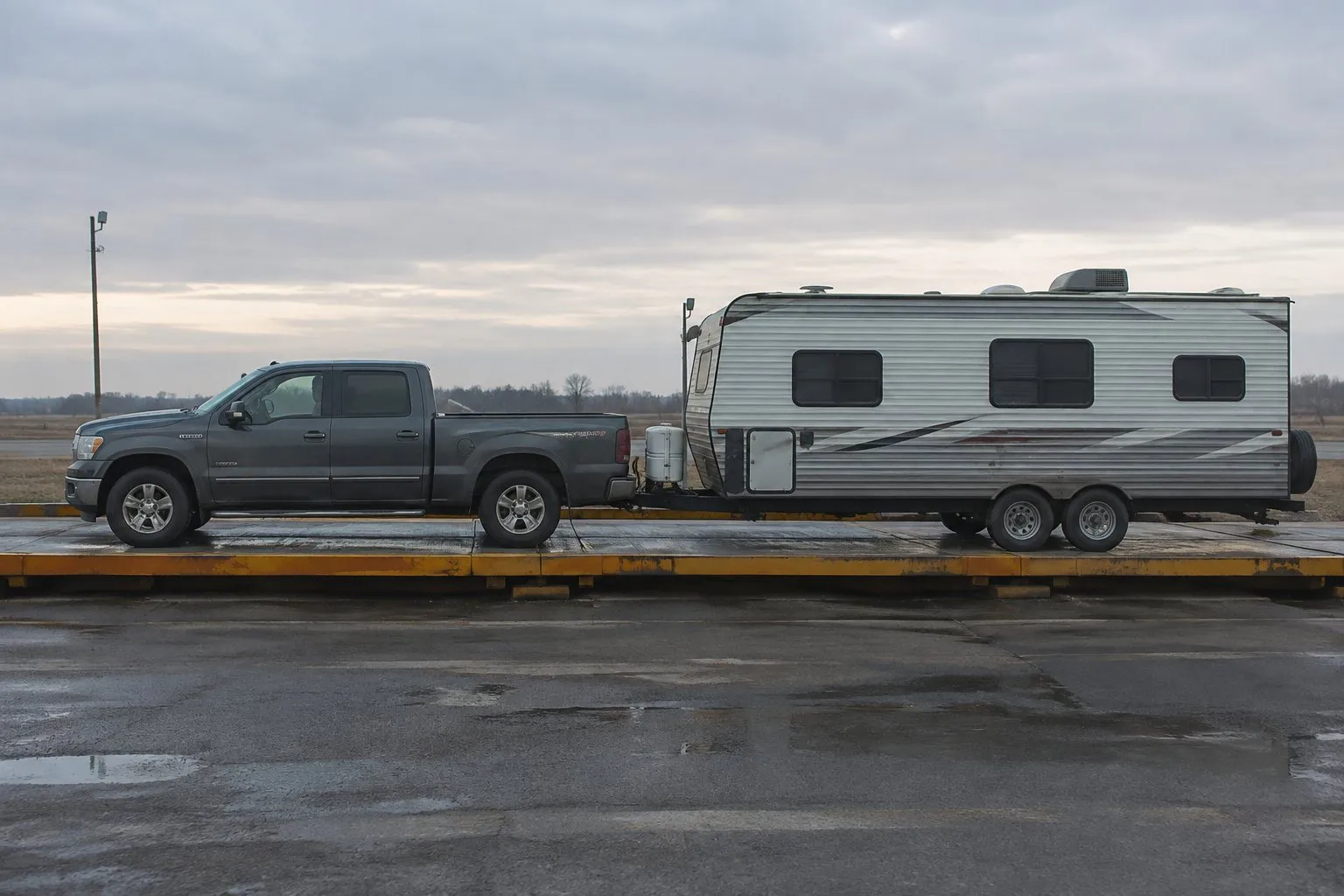
A tongue scale tells you what presses on the ball. A truck-stop scale tells you everything else: what sits on each axle of the truck, what the trailer carries on its own axles, and what the whole rig weighs. Those are the numbers that the labels on your truck are written for. Ford's guide is direct about it: the gross vehicle weight is not a specification, it is the actual weight you get when the fully loaded vehicle is driven onto a scale.
The numbers you are going to check
Before you drive on, take a photo of the Safety Compliance Certification Label in the driver's door jamb. Ford's guide lists what it holds and what each figure means.
| Rating | What it limits | Where to find it |
|---|---|---|
| Front GAWR | Weight on the front axle | Door label |
| Rear GAWR | Weight on the rear axle, tongue load included | Door label |
| GVWR | The loaded truck, passengers, cargo and tongue load | Door label |
| GCWR | Truck plus loaded trailer | Vehicle guide or owner's manual |
| Receiver rating | What the hitch receiver may carry and pull | Label on the receiver |
Ford counts the tongue load as part of the truck's cargo weight. That is why a heavy tongue can push the rear axle or the whole truck over its rating while the trailer itself is well within the tow rating. The terms are explained on GVWR and GCWR and payload capacity and towing.
Weighing the rig, step by step
Load everything for the trip
Pack the trailer and the truck the way you will travel: water, propane, gear, fuel and the people who ride along. Equal-i-zer asks for the same loaded state, propane, water and generators included, before you set up a hitch.Pull onto the scale in three parts
On a three-platform scale such as CAT Scale's, a truck towing a trailer has to be completely on the scale. Put the truck's front (steer) axle on platform 1, its rear (drive) axle on platform 2, and the trailer axles land on platform 3.Push the intercom button
CAT Scale needs no appointment. Push the button on the intercom sign once you are in position; a cashier takes your details and the ticket prints.Check the ticket before you leave
Tickets cannot be changed once printed, so read it at the counter. Note platform 1, platform 2, platform 3 and the gross.Compare with your ratings
Platform 1 against the front GAWR, platform 2 against the rear GAWR, platforms 1 and 2 together against the GVWR, the gross against the GCWR.
Ford's way: front axle first
Ford's 2026 guide describes the same job on any scale, even a single-platform one. With the trailer attached, put only the front wheels of the truck on the scale: that is the front axle weight. Then put all four wheels of the truck on the scale, trailer still attached: subtract the front axle weight and you have the rear axle weight. Weigh truck and trailer together for the combination weight.
Weigh with the spring bars hooked up as you tow, so the axle weights match the trip. The hitch itself is not set up on the scale: the truck makers set the target through fender heights, and the weight distribution hitch adjustment page shows how to change the bar tension.
Getting the tongue weight while you are there
A truck-stop scale can give you the tongue weight too, by difference: weigh the truck alone, then with the trailer hitched and its wheels off the deck, spring bars unhooked. The how to measure tongue weight guide walks through that method and two others. Ford's version is cleaner still: disconnect the trailer and set only the tongue on the scale at hitch ball height.
When the numbers are over
The ticket does not tell you what to change, but the ratings do.
- Rear axle or GVWR over: the truck carries too much. Lighten what rides in the cab and bed, and check that the tongue sits inside its range. Ford says that if GVWR or rear GAWR is exceeded, go with a larger vehicle or a smaller trailer.
- Tongue outside the range: Ford says to move cargo rearward if the tongue is above the upper limit, forward if it is below. Ford plans with 10 % of the loaded trailer for conventional trailers over 2,000 lb; the tongue weight page explains the range.
- Gross over GCWR: only a lighter load or a different rig fixes that.
After a change, CAT Scale allows a reweigh within 24 hours on the same scale with the same vehicle. Keep both tickets with the trailer papers; they are the best record of what you actually tow.
Questions at the scale house
Q01Can a truck-stop scale weigh a pickup without a trailer?
Usually, if the vehicle is heavy enough. CAT Scale sets its scales to a 2,000 lb threshold and asks you to call its 24-hour help desk for vehicles estimated under that. The scale gives axle weights and a total, but it cannot weigh each corner of the vehicle.
Q02Can I weigh again after moving the load?
Yes, as a reweigh. CAT Scale's FAQ says a reweigh must be within 24 hours of the full-price ticket, on the same scale and with the same vehicle, and that the manager on duty may stop further reweighs. Move the cargo, drive back on in the same positions and compare the two tickets.
Q03How do I find a truck-stop scale near me?
CAT Scale offers a scale locator on its website and as a locator app, plus a separate app for the weighing itself. No appointment is needed at its scales. Plan the stop with the trailer packed for the trip, so the ticket shows what you really tow.
Weighed against
Next stop
- Measure tongue weightShop stepsHow to calculate tongue weight the reliable way: weigh the loaded coupler on a tongue scale, a truck-stop scale or a bathroom scale.
- GVWR and GCWRTermsGVWR, GCWR and GAWR explained: what each towing weight rating limits, where the door label lists them, and how tongue weight counts against them.
- Payload and towingHow it worksPayload capacity and towing: tongue weight counts as cargo in your truck, so passengers, gear, hitch and tongue all share one payload figure.
- Tongue weightHow it worksTongue weight is the part of the trailer's weight that presses on the hitch ball. Normal range, what too much or too little does, where it counts.
- Dry weight vs GVWRHow it worksDry weight vs GVWR on a travel trailer: what UVW leaves out, how CCC fits in, and which number to use for the truck, the hitch and the tongue.
Who weighs it up
weightdistributionhitch.com Editorial Desk
Towing set-up & hitch picks
We are the editorial desk at weightdistributionhitch.com. For every hitch we pull the tongue weight and trailer weight ratings, the shank and ball size, the bracket spacing and the torque values out of the maker's install sheet, then set them against the receiver label and the tow vehicle's own towing guide.
- — Ratings copied from the install sheet or part page, with document name
- — Set-up targets taken from the truck maker's towing guide, not a rule of thumb
- — "Not stated by maker" wherever a rating, surge-brake note or warranty term is missing