Air suspension towing with a weight distribution hitch: set-up by system
Will it fit?Reading span: 5 minchecked November 28, 2026by the editorial desk
Air suspension towing with a weight distribution hitch works on every system we found covered in a manual, but leveling changes the result. Auto-leveling lifts the rear back up after you set the bars and takes some of the weight distribution away. Each system needs its own set-up step, and your vehicle manual comes first.
On the ticket
Yes, you can use a weight distribution hitch with air suspension or auto-leveling. Equal-i-zer says 4-corner leveling cuts the weight distribution by 20 to 25 %, so set 75 to 100 % if it cannot stay off. With rear-only leveling, let the truck level before the last measurement. Ram's 2500/3500 keeps the engine running while you hitch.
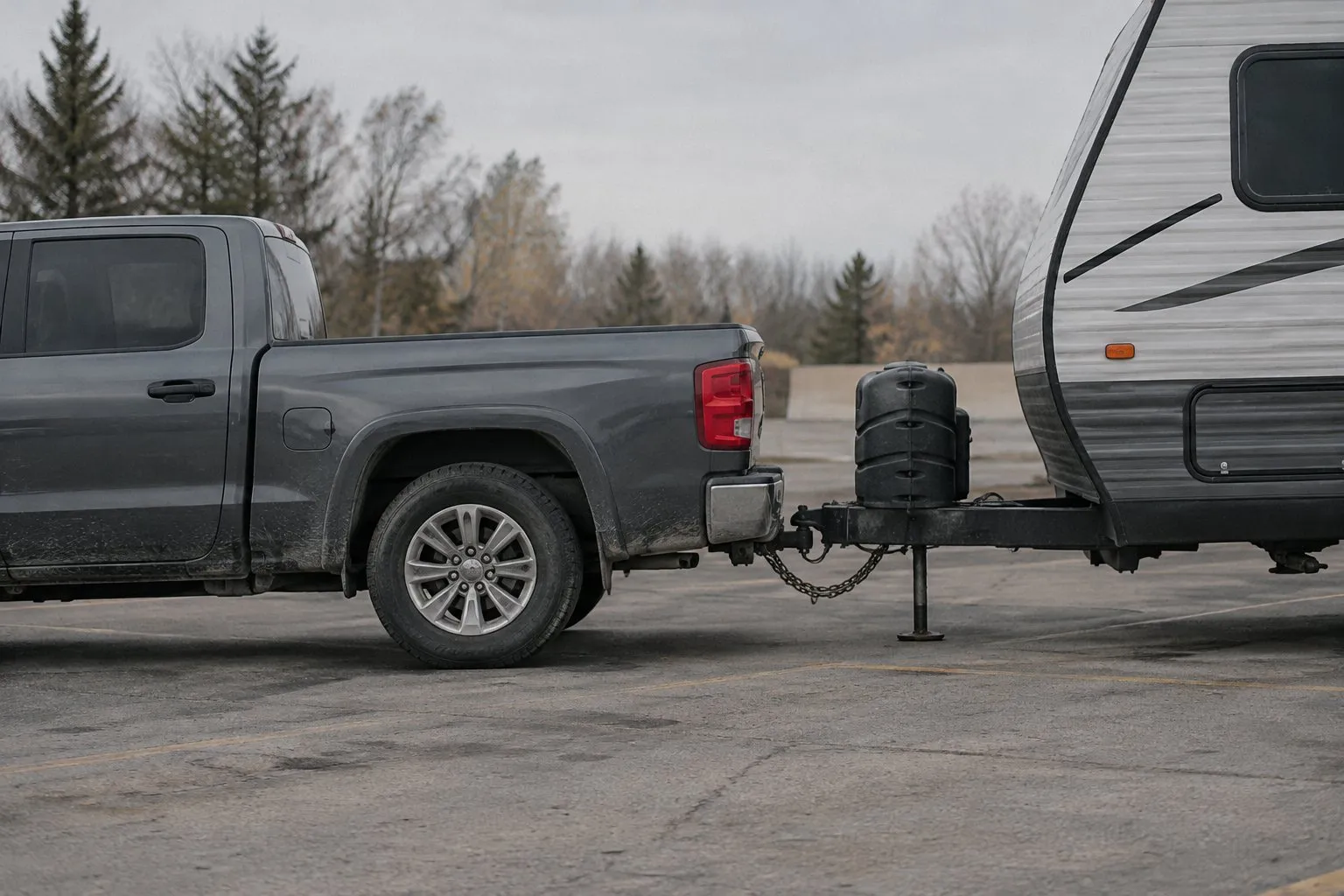
Yes, it works. Here is the catch
A weight distribution hitch is set up by measuring the front fender: before hitching (H1), hitched without bars (H2), and with the bars under tension. The bars are tensioned until the fender comes back down to a target your truck maker sets. Ford, for example, uses half the rise on the F-150.
Leveling systems interfere with that measurement. They raise the rear of the truck on their own, so the fender heights you measured no longer match what the truck does on the road. Equal-i-zer's manual puts it plainly: auto-leveling and air suspension systems decrease the amount of weight distribution the hitch provides after set-up. Load that the bars were meant to move forward stays on the rear axle.
So the answer is not "don't use one". It is "set it up for your system".
Set-up by system
| Your truck has | What changes | Who says so |
|---|---|---|
| Factory air suspension, Ram 2500/3500 (2022) | Engine running while you attach the trailer so the air suspension can level; Standard Ride Height or Alternate Trailer Height; fender target about halfway between H1 and H2 | Ram 2022 2500/3500 manual |
| 4-corner auto-leveling | Takes 20 to 25 % off the weight distribution. Keep it off while driving if possible; if not, set the hitch to 75 to 100 % | Equal-i-zer 4K manual |
| Rear-only auto-leveling | Let the truck level the rear before the last fender measurement (engine idling on hydraulic or pneumatic systems) | Equal-i-zer 4K manual |
| Aftermarket air springs or air shocks | Let them down to their minimum recommended pressure before set-up, unless your vehicle or air spring instructions say otherwise | CURT install sheets |
| Other trucks with leveling | Follow the owner's manual; the system may have an off switch, a jack mode, or switch off with the engine | Equal-i-zer 4K manual |
Where these sources differ, the vehicle maker wins. Equal-i-zer and CURT both send you to the owner's manual first, and Ram's own steps for its heavy-duty trucks keep the air suspension working during hitching rather than off.
Ram 2500 and 3500 with air suspension
Ram's 2022 heavy-duty manual is the most specific source we read:
- Park the truck near the trailer without coupling it. Use Standard Ride Height or Alternate Trailer Height; the alternate height may not be available when the truck is lightly loaded.
- Keep the engine running while you hitch, so the air suspension can level.
- Measure H1, from the top of the front wheel opening on the fender to the ground.
- Couple the trailer without the bars and measure H2 the same way.
- Fit the bars and set their tension to the hitch maker's instructions so the fender sits at about H1 + (H2 − H1) ÷ 2, above Standard Ride Height.
Ram's manual uses the same halfway target for the 2500/3500 without air suspension; only the ride height and engine steps are added. Ram also asks you to tow in TOW/HAUL mode.
For the half-ton Ram 1500 we give no set-up figure here. Take it from the owner's manual for your model year; hitch limits are on the Ram 1500 tongue weight capacity page.
Trucks with 4-corner or rear-only leveling
Equal-i-zer's appendix walks through both:
- Before set-up: let the suspension settle to its normal position, then switch leveling off. Depending on the truck that means an off switch, a jack mode, or turning off the vehicle.
- 4-corner systems: they reduce the weight distribution by 20 to 25 %. Keep leveling off while driving if your truck allows it. If not, set the hitch to 75 to 100 % instead of the usual 50 to 100 % window.
- Rear-only systems: measure A and B as usual, then let the truck level the rear before measurement C. If your system only levels while driving, mark where the truck stood, drive, and come back to the same spot to measure.
- After the bars are right: check the trailer pitch again, front and rear of the frame, and adjust the ball height if needed.
- Hitching and unhitching later: turn leveling off first, by switching off the vehicle or using jack mode.
The washers, bracket heights and head tilt that change the percentage are on weight distribution hitch adjustment.
Aftermarket air bags and a weight distribution hitch
Air springs added under the rear axle lift the rear the same way factory leveling does. CURT's installation sheets ask for them to be let down to their minimum recommended pressure before you assemble and adjust the hitch, unless your vehicle or air spring instructions say otherwise. Andersen notes that some owners add airbags or other suspension upgrades to help level the tow vehicle.
Leveling the rear is not the same as moving load to the front axle, though. Only the spring bars (or Andersen's chains) do that. Whether you need both, and in which order, is on weight distribution hitch vs airbags. How the bars move load in the first place is on how a weight distribution hitch works.
Before your first trip
Do the whole set-up loaded the way you travel, with leveling handled as your manual says, then measure again after any change to the load. The step-by-step measuring routine without leveling is on how to set up a weight distribution hitch. Still choosing the hitch itself? The best weight distribution hitch page matches four hitches to tongue weight ranges.
Questions at the scale house
Q01How do I set up a weight distribution hitch on a truck with air suspension?
Follow your owner's manual first. Ram's 2022 2500/3500 manual keeps the engine running while you hitch, measures H1 and H2 at the front fender, and sets the bars so the fender sits about halfway between them. Equal-i-zer has you switch leveling off for set-up, then, on 4-corner systems that cannot stay off, aim for 75 to 100 % weight distribution.
Q02Should I deflate my aftermarket air bags before setting up the hitch?
CURT's installation sheets say yes, unless your vehicle manual or the air spring instructions say otherwise: air springs and air shocks should be let down to their minimum recommended pressure before you assemble and adjust the weight distributing hitch. Add pressure back only as those instructions allow.
Q03Should auto-leveling stay off while I tow?
On 4-corner systems, Equal-i-zer says to keep it off while driving if the truck allows that. If it cannot be switched off for the drive, set the hitch to 75 to 100 % weight distribution to make up for the 20 to 25 % the leveling takes away. Your owner's manual decides whether turning it off is allowed.
Weighed against
- [1]Equal-i-zer 4K owner's manual, appendix on auto-leveling suspensions (PDF)
- [2]Ram 2022 2500/3500 owner's manual, recommended distribution hitch adjustment
- [3]CURT, round bar weight distribution kit installation instructions (PDF)
- [4]Ford, 2026 RV & Trailer Towing Guide (weight distribution hitch setup, p. 8)
- [5]Andersen, weight distribution FAQ
Next stop
- Set-upShop stepsHow to set up a weight distribution hitch: measure H1 and H2 at the front fender, find your truck maker's target, then tension the bars.
- WD hitch vs airbagsSide by sideWeight distribution hitch vs airbags: the hitch moves tongue load to the front axle, airbags lift a sagging rear. Different jobs, one team.
- Ram 1500Will it fit?Ram 1500 tongue weight capacity: the 2026 handbook rates the factory Class IV hitch at 1,155 lb. Why payload and your axle ratings can stop you first.
- AdjustmentShop stepsWeight distribution hitch adjustment: which washer, bracket or ball change adds or removes tension, and how to spot over- and under-distribution.
- How it worksHow it worksHow does a weight distribution hitch work? Spring bars under tension lever part of the tongue load to the front axle and trailer axles.
Who weighs it up
weightdistributionhitch.com Editorial Desk
Towing set-up & hitch picks
We are the editorial desk at weightdistributionhitch.com. For every hitch we pull the tongue weight and trailer weight ratings, the shank and ball size, the bracket spacing and the torque values out of the maker's install sheet, then set them against the receiver label and the tow vehicle's own towing guide.
- — Ratings copied from the install sheet or part page, with document name
- — Set-up targets taken from the truck maker's towing guide, not a rule of thumb
- — "Not stated by maker" wherever a rating, surge-brake note or warranty term is missing