Heavy duty weight distribution hitch: 1,000 lb tongue and up
Buying sheetReading span: 5 minchecked November 28, 2026by the editorial desk
A heavy duty weight distribution hitch starts where the common 10K class stops: above 1,000 lb of loaded tongue weight. The CURT 17422 covers that band: rated 15,000 lb and 1,500 lb, with sway control and ball in the box. Check the shank first: heavy-duty trucks often have a 2-1/2 inch receiver, and the CURT ships with a 2 inch shank.
On the ticket
Weigh the loaded tongue. Between 1,000 and 1,500 lb, take the CURT 17422 trunnion hitch: 15,000 lb trailer, 1,500 lb tongue, sway unit and ball included. Want sway control built in? The Equal-i-zer 14K covers up to 1,400 lb. Above 1,500 lb on a 2-1/2 inch receiver, the Blue Ox BXW2000 is listed for 2,000 lb.
Paid links on this sheet: Links with a * go to Amazon, and a purchase through them pays this site a commission; your price stays the same. As an Amazon Associate I earn from qualifying purchases. How the links pay
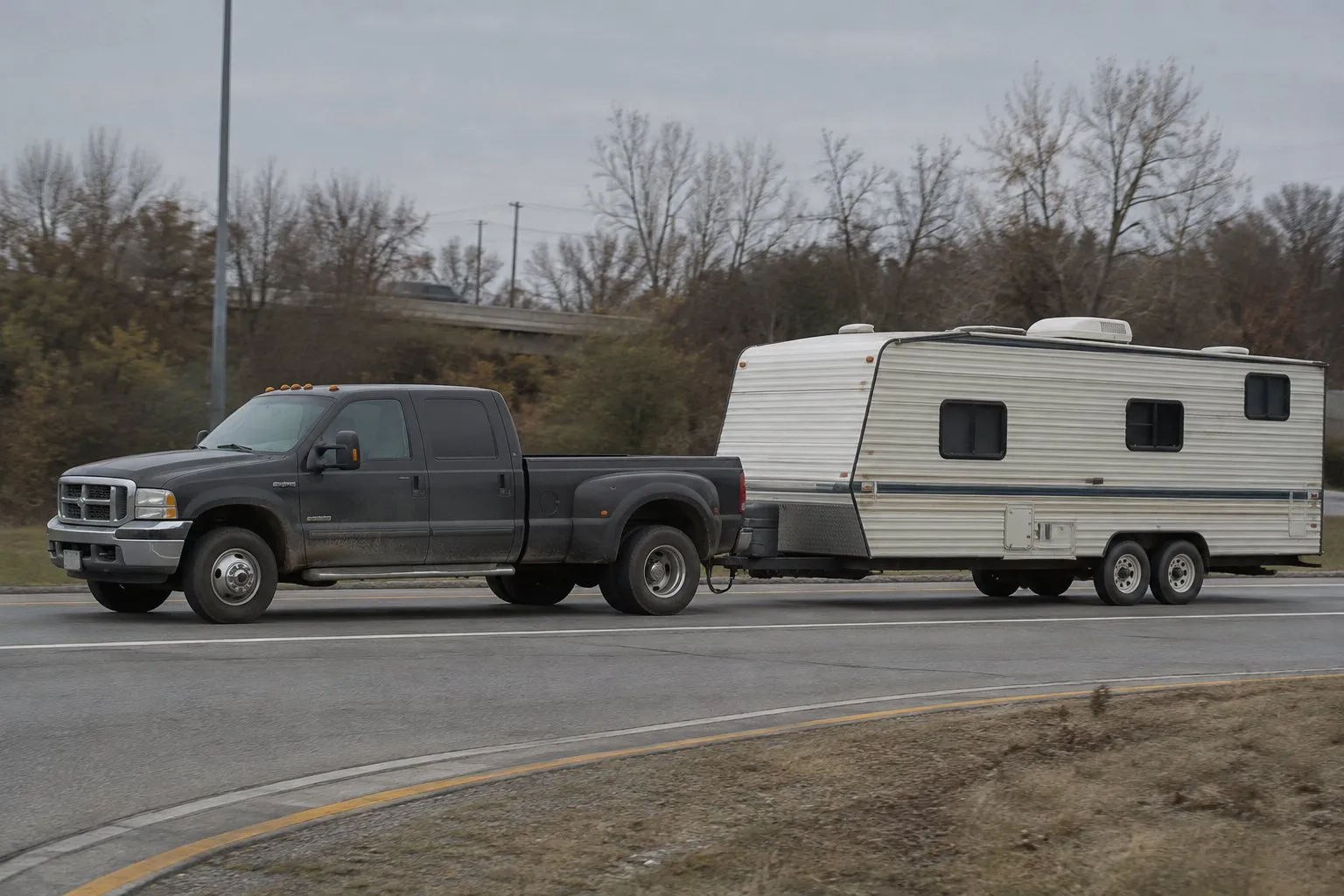
Where heavy duty starts
Most weight distribution hitches stop at 1,000 lb of tongue weight and 10,000 lb of trailer. The CURT 17062 and the Equal-i-zer 10K both end there. Once your weighed tongue passes that line, the 10K class is the wrong tool, however close the number looks. If your tongue stays at or under 1,000 lb, the best weight distribution hitch page is the place to start.
Weigh first, then shop. Add what rides in the truck bed behind the rear axle to the tongue reading, because Equal-i-zer counts that toward the hitch's tongue rating. The hitch size guide shows how the classes step up.
The heavy classes side by side
The search terms say 12K, 14K or 15K. Behind each number sits a tongue rating, and that is the figure to match.
| Class | Tongue weight | Trailer weight | Examples (maker or listing figures) |
|---|---|---|---|
| 12K | 1,200 lb | 12,000 lb | Equal-i-zer 90-00-1200 |
| 14K | 1,400 lb | 14,000 lb | Equal-i-zer 90-00-1400, Andersen (chain-free) |
| 15K | 1,500 lb | 15,000 lb | CURT 17422, VEVOR 15K weight distribution hitch (VEVOR product page) |
| 20K | 2,000 lb | 20,000 lb | Blue Ox BXW2000 (SwayPro manual and listing), 2-1/2 inch receiver |
The lowest rating wins. A 15K hitch on a receiver labeled for less, or behind a truck with a lower rating, is limited to the smaller number.
Our pick: CURT 17422, 15,000 lb and 1,500 lb
The CURT 17422 uses short 28-3/8 inch forged trunnion bars that enter the head from the side, rated to 15,000 lb of trailer and 1,500 lb of tongue. CURT puts the sway control unit, hook-up brackets, safety chains for the bars and a pre-torqued 2-5/16 inch ball in the box. CURT names class 3, 4 and most class 5 receivers as compatible, including its Xtra Duty and Commercial Duty hitches, and gives a limited lifetime warranty (one year on finish and parts). More on the bar style is on the trunnion bar hitch page.
What to plan for:
- Shank size. The 17422 ships with a 2 inch shank that flips for drop or rise. CURT notes that its Xtra Duty and Commercial Duty hitches may need a 2-1/2 inch replacement shank. CURT sells those separately; the drop hitch page covers the deep-drop version.
- Sway control. It is the bolt-on friction unit, not built into the head. You hook it up and take it off like any trailer sway bar.
- No lower limit stated. CURT gives no minimum tongue weight. If your tongue sits near 1,000 lb, compare it with a 12K hitch.
Built-in sway control up to 1,400 lb: Equal-i-zer 14K
The Equal-i-zer 14K is rated 14,000 lb and 1,400 lb and builds 4-point sway control into the hitch, so there is no separate bar to hook up. Equal-i-zer also says its hitch is compatible with surge brakes, which matters for a heavy boat trailer. Its spring arms are sized to the head: the manual says arms will not fit a head of a different rating, and the 12K and 14K arms are side specific. The Amazon listing is without shank and ball.
Equal-i-zer 14K
The bigger Equal-i-zer: 14,000 lb trailer weight and 1,400 lb tongue weight with the same 4-point sway control.
Why it's on this ticket: Sway control built into the hitch for heavy trailers with up to 1,400 lb on the tongue, and its maker allows surge brakes.
Fits: Heavier travel trailers with up to 1,400 lb of tongue weight

- Tongue weight (decides it)
- Up to 1,400 lb
- Max trailer weight
- 14,000 lb
- Sway control
- Integrated, 4 points
- Surge brakes
- Compatible (Equal-i-zer FAQ)
- Rated 14,000 lb / 1,400 lb
- 4-point sway control built in
- Same surge-brake statement as the 10K model (Equal-i-zer FAQ)
- Shank and ball not included (listing)
- Model data sheet not read; figures from the listing and the FAQ
Over 1,500 lb on a 2-1/2 inch receiver: Blue Ox BXW2000
The Blue Ox SwayPro BXW2000 is listed for 2,000 lb of tongue weight and 20,000 lb of trailer, with a 9-hole shank for a 2-1/2 inch receiver. The SwayPro owner's manual confirms 2,000 lb of maximum tongue weight for the BXW2000 and lists the 2-1/2 inch receiver mount for it; the 20,000 lb comes from the listing. Before you buy at this weight, check the receiver label and your truck's tow rating line by line. The Blue Ox page has the rest of the SwayPro range.
Blue Ox SwayPro BXW2000
The heavy SwayPro: 2,000 lb tongue weight and 20,000 lb towing on a 2-1/2" receiver.
Why it's on this ticket: Listed for 2,000 lb of tongue weight on a 2-1/2 inch receiver, for tongues above the 15K class.
Fits: Very heavy bumper-pull trailers on a 2-1/2" receiver

- Tongue weight
- Up to 2,000 lb
- Max trailer weight
- 20,000 lb
- Shank (decides it)
- 2-1/2" receiver, 9-hole shank
- Listed for 2,000 lb tongue weight and 20,000 lb towing
- 9-hole shank
- Needs a 2-1/2" receiver
- The SwayPro manual asks for a minimum tongue weight of 200 lb and greased bar pivots
Pick by your numbers
If your loaded tongue is between 1,000 and 1,500 lb → CURT 17422 Trunnion 15K
Amazon price: View(paid link to Amazon, opens in a new tab)Ad · paid link · check price & delivery on AmazonAd · paid link · price as of ·If you want sway control built into the hitch, up to 1,400 lb → Equal-i-zer 14K
Amazon price: View(paid link to Amazon, opens in a new tab)Ad · paid link · check price & delivery on AmazonAd · paid link · price as of ·If your tongue is over 1,500 lb and the truck has a 2-1/2 inch receiver → Blue Ox SwayPro BXW2000
Amazon price: View(paid link to Amazon, opens in a new tab)Ad · paid link · check price & delivery on AmazonAd · paid link · price as of ·
Heavy-duty trucks: the receiver and the set-up target
On a 3/4-ton or 1-ton pickup the receiver is often not the bottleneck. Ford's 2026 guide lists a 2.5 inch receiver as standard on most Super Duty pickups (a few F-350 and F-450 versions get a 3 inch one) and rates the F-250 receiver at 22,000 lb and 2,200 lb of tongue, the same figure for weight-carrying and weight-distributing use. On those trucks a WD hitch does not unlock a higher receiver rating. It still moves part of the tongue load forward to the front axle and back to the trailer axles. For trailers over 5,000 lb, Ford's class table says most applications require a weight-distributing or fifth-wheel hitch.
The set-up target still comes from the truck maker. Ford lists a 50 % correction factor for the F-250 and F-350 Super Duty pickups, 25 % for the F-450 Regular Cab and 50 % for the F-450 Crew Cab. Ram's 2022 2500 and 3500 manual sets the front fender target at (H2 − H1) ÷ 2 + H1. Equal-i-zer calls 50 to 100 % good and never over 100 %. The set-up guide shows the measuring steps, and the hitch tongue weight rating page explains the receiver label.
CURT 17422 Trunnion 15K: hitch it or leave it?
TKT 03+ Hitch it if …
- If your loaded tongue weight is over 1,000 lb and up to 1,500 lb
- If you want square trunnion bars that sit close under the head
- If your receiver is rated for the weight-distributing load you plan to tow
− Leave it if …
- If your loaded tongue weight stays under 1,000 lb
- If your truck has a 2-1/2" receiver and you don't want to buy a second shank
- If you want integrated sway control
Numbers match? Check the CURT 17422 Trunnion 15K listing for the exact rating and what is in the box.
Amazon price: View on Amazon(paid link to Amazon, opens in a new tab)Ad · paid link · check price & delivery on AmazonAd · paid link · price as of ·Questions at the scale house
Q01What size weight distribution hitch does a 3/4 ton truck need?
The truck does not set the size; the loaded tongue does. Pick spring bars rated for the tongue you weighed, then check the receiver. Ford's 2026 guide lists a 2.5 inch receiver as standard on most F-250 and F-350 pickups, so a hitch that ships with a 2 inch shank needs a 2-1/2 inch shank on those trucks.
Q02Is a 14,000 lb weight distribution hitch enough for a 12,000 lb trailer?
On trailer weight, yes, but the tongue decides. The Equal-i-zer 14K is rated 1,400 lb of tongue weight. Weigh the loaded tongue and cargo behind the truck's rear axle; if that total stays at or under 1,400 lb and the receiver label allows it, the 14K fits. Over 1,400 lb, step up a class.
Q03Do the spring bars of a 14K hitch fit a 10K head?
Not on an Equal-i-zer. Its manual says each hitch has two spring arms sized for a head of the same rating, and that they will not fit a head of a different rating. The 12K and 14K arms are also side specific, so each goes on its own side.
Weighed against
- [1]CURT, part 17422 short trunnion bar weight distribution hitch
- [2]Equal-i-zer 6K–14K owner's manual, ratings index
- [3]Equal-i-zer 4K owner's manual (PDF): spring arm sizing, hitching steps
- [4]Ford, 2026 RV & Trailer Towing Guide (Super Duty receivers, set-up table)
- [5]Equal-i-zer, frequently asked questions (cargo behind the rear axle)
- [6]Ram 2022 2500/3500 owner's manual, recommended distribution hitch adjustment
- [7]Blue Ox, SwayPro owner's manual and installation instructions, 405-0120 Rev AR (PDF via SEMA Data)
Next stop
- Trunnion bar hitchesBuying sheetTrunnion bar weight distribution hitch: what square side-entry bars change, the CURT 17422 we pick for 1,000 to 1,500 lb tongues, and the fit.
- What size weight distribution hitch do I need?Straight answerWhat size weight distribution hitch do I need? Size the bars by loaded tongue weight plus rear cargo, then check trailer GVWR and the receiver label.
- Blue OxMaker fileBlue Ox weight distribution hitch guide: SwayPro sizes from 350 to 2,000 lb, shanks, how its sway control works and which size fits a 2 inch receiver.
- Best hitchesBuying sheetBest weight distribution hitch for your trailer: four picks sorted by loaded tongue weight, surge brakes and sway control, with stated limits.
- Drop shankBuying sheetA drop hitch for weight distribution is a taller shank under the hitch head. Measure the drop, match the receiver size, and keep every rating in mind.
- Hitch tongue ratingHow it worksTrailer hitch tongue weight rating explained: the two limits on the receiver label, why the truck and the ball have their own, and which one wins.
Who weighs it up
weightdistributionhitch.com Editorial Desk
Towing set-up & hitch picks
We are the editorial desk at weightdistributionhitch.com. For every hitch we pull the tongue weight and trailer weight ratings, the shank and ball size, the bracket spacing and the torque values out of the maker's install sheet, then set them against the receiver label and the tow vehicle's own towing guide.
- — Ratings copied from the install sheet or part page, with document name
- — Set-up targets taken from the truck maker's towing guide, not a rule of thumb
- — "Not stated by maker" wherever a rating, surge-brake note or warranty term is missing