How does a weight distribution hitch work? Spring bars explained
How it worksReading span: 4 minchecked November 28, 2026by the editorial desk
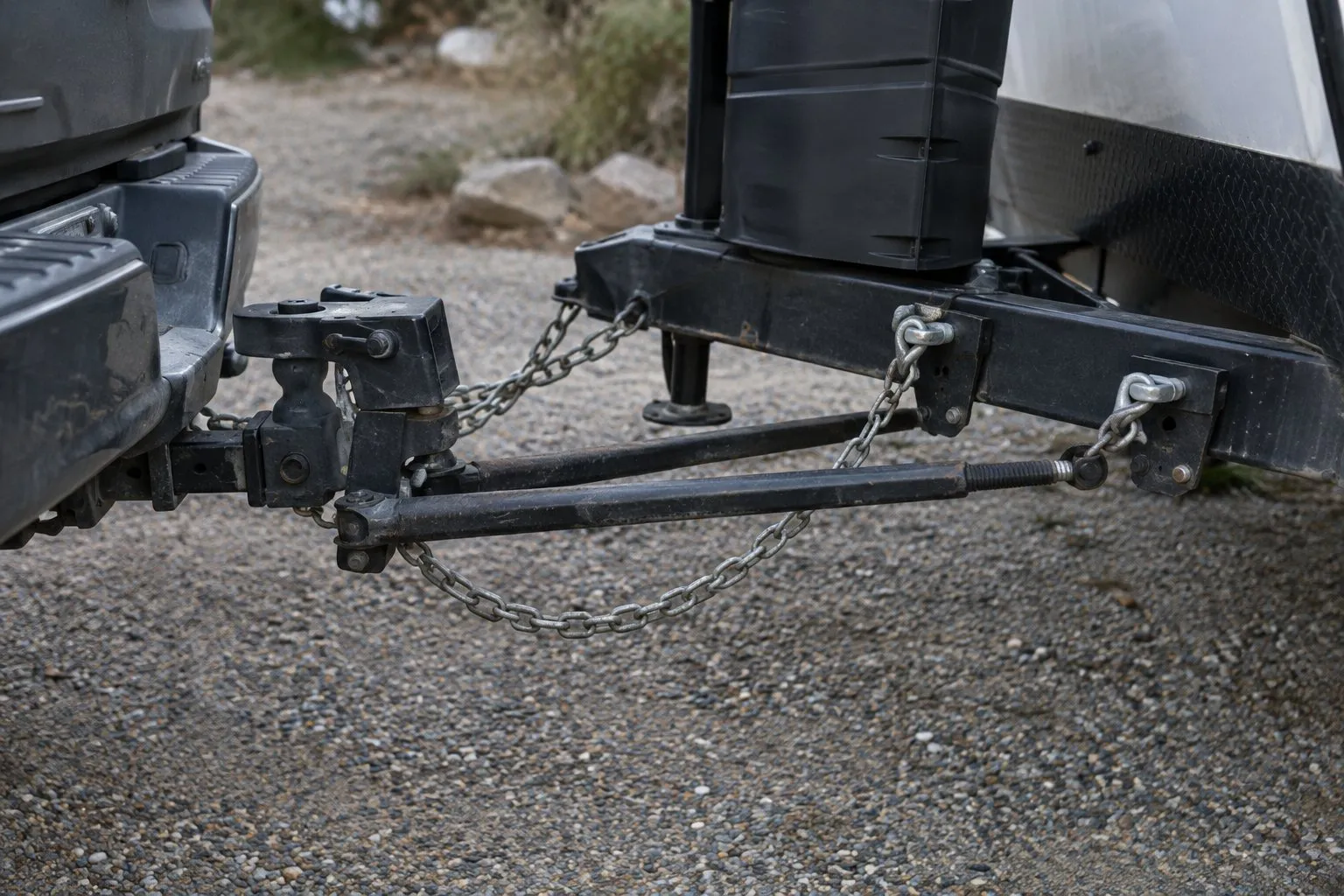
How does a weight distribution hitch work? Two spring bars run from the hitch head to the trailer frame. Chains or brackets bend them upward, and that tension levers part of the tongue load off the truck's rear axle, forward to the front axle and back to the trailer's axles. The tongue weight itself stays the same.
On the ticket
A weight distribution hitch is a lever. The tongue pushes the truck's rear down and lifts the front. Spring bars, bent upward by chains or brackets on the trailer frame, push back up on the hitch head. That moves part of the load to the truck's front axle and the trailer's axles, so steering and braking grip return.
Stops on this page
The problem it solves: a seesaw over the rear axle
Drop a loaded trailer tongue on a plain ball mount and the truck behaves like a seesaw. The ball sits behind the rear axle, so the tongue load pushes the rear down and the front of the truck rises a little. Equal-i-zer calls it a teeter-totter effect over the rear axle, and points out that heavy cargo in the bed behind the axle does the same.
The front wheels are the ones that steer and do much of the braking. Ford's guide describes what too much tongue load can do: press the vehicle down in back until the front wheels lift to the point where traction, steering response and braking are severely decreased. A weight distribution hitch exists to push that front end back down.
What the spring bars do, step by step
- 1tongue load
- 2hitch head
- 3spring bar under tension
- 4chain + bracket
- 5front axle
- 6trailer axle
Schematic, not to scale. Chains pull the bar ends up; the bent bars push the hitch head up and lever load toward the truck's front axle and the trailer's axles.
- The head on the shank. The hitch head slides into your receiver on its own shank, in place of a ball mount. The ball sits on the head.
- Two bars into the head. A spring bar plugs into each side of the head and runs back along the trailer's A-frame.
- Tension at the frame. Near the end of each bar, a chain or bracket on the A-frame lifts the bar's tip. Ford's guide puts it simply: lengths of chain are pulled up and tightened to bend the spring bars upward.
- The lever pushes back. A bent spring bar works like a lever on the head. In Ford's words, bending the bars lifts some of the weight from the rear wheels and transfers it to the other wheels of the vehicle and trailer.
The result: part of the tongue load moves forward onto the tow vehicle's front axle and rearward to the trailer's axles. The truck sits closer to level, and the front tires press on the road again.
The tongue weight does not change
The load moves; it does not disappear. The trailer still presses the same weight down at the coupler, and you still size the hitch by that number. That is why a hitch that "takes tongue weight off" is a misleading picture: the tongue weight question page goes through it. For the number itself, start with tongue weight.
How much load moves is set by you, not the hitch
More bar tension moves more load forward. How much is right comes from your tow vehicle's maker. Ford recommends 50 % front axle load restoration for the F-150 and Super Duty, Ram's 2500/3500 manual uses a fender-height formula, and Equal-i-zer calls 50 to 100 % good and says never exceed 100 %.
Too little and too much both cause trouble. Equal-i-zer's manual ties under-distribution to a loss of steering and braking control with reduced resistance to sway, and over-distribution to a loss of traction that can lead to jack-knifing, especially on slick roads. You tune the tension with spacer washers in the head and the height of the brackets on the frame. The procedure is on how to set up a weight distribution hitch.
Same job, three ways to build it
| Design | How the bars meet the trailer | Example |
|---|---|---|
| Round bar | Round forged bars; chains on hookup brackets lift them | CURT 17062 |
| Trunnion bar | Short square bars, 28-3/8 inches on the CURT kit; chains lift them | CURT 17422 |
| Bracket instead of chain | Adjustable brackets hold the bars in place sideways and up and down | CURT TruTrack 4P |
| Chain-free | No steel bars; chains with urethane springs and a friction cone at the ball | Andersen |
The parts in each design have names worth knowing before you shop; they are on parts of a weight distribution hitch. The designs side by side are on types of weight distribution hitches, and what the rig looks like with and without the bars is on before and after.
Sway control rides along, but it is a second job
Most hitches pair the spring bars with sway control: a bolt-on friction bar, friction brackets like on CURT's TruTrack, or a friction cone like Andersen's. The spring bars on their own do not hold the trailer straight. CURT says as much: a weight distribution hitch is not an ideal solution for trailer sway on its own. The choices are on weight distribution hitch with sway control.
Does your rig need one?
That depends on your vehicle guide, not on the hitch. Ford's 2026 guide says not to tow over 5,000 lb with an F-150 without a weight-distribution system, and the receiver label adds a tongue weight limit of its own. How to find the line for your own vehicle is on when you need a weight distribution hitch. If you already know you do, the best weight distribution hitch page sorts the picks by tongue weight.
Questions at the scale house
Q01What is a weight distribution hitch?
It is a hitch system for bumper-pull trailers that slides into the receiver like a ball mount but adds two spring bars. Ford's guide says it distributes tongue load to all towing vehicle and trailer wheels: part of the load leaves the truck's rear axle and goes forward to the front axle and back to the trailer's axles.
Q02Do weight distribution hitches work?
They do what the vehicle makers describe: move part of the tongue load to the front axle and the trailer's axles. Whether yours does it well depends on the set-up. Equal-i-zer's manual calls 50 to 100 % weight distribution good, warns that less leaves you with reduced steering and braking control, and that more than 100 % costs traction.
Q03What does a weight distribution hitch not do?
It does not change the trailer's tongue weight or raise the truck's tow rating. Ford's guide states that trailer towing values are the same for weight-carrying and weight-distributing hitches on its Super Duty pickups. It also does not replace sway control on its own; CURT writes that a weight distribution hitch is not an ideal solution for trailer sway by itself.
Weighed against
Next stop
- Parts explainedHow it worksParts of a weight distribution hitch, from shank and head to spring bars, brackets, pins and sway control: what each one does and where you adjust it.
- Hitch typesHow it worksWeight distribution hitch types compared: chain style, fixed bracket, cam, chain-free cone and projection hitches, plus round vs trunnion bars.
- Before and afterHow it worksWeight distribution hitch before and after: why the rear squats and the front rises, what a good set-up brings back, and how to measure it.
- Does a weight distribution hitch reduce tongue weight?Straight answerDoes a weight distribution hitch reduce tongue weight? No. The trailer still puts the same load on the ball; the spring bars move where it ends up.
- Do I need a weight distribution hitch?Straight answerDo I need a weight distribution hitch? Your vehicle guide and receiver label decide. Ford sets the F-150 line at 5,000 lb; here is how to find yours.
Who weighs it up
weightdistributionhitch.com Editorial Desk
Towing set-up & hitch picks
We are the editorial desk at weightdistributionhitch.com. For every hitch we pull the tongue weight and trailer weight ratings, the shank and ball size, the bracket spacing and the torque values out of the maker's install sheet, then set them against the receiver label and the tow vehicle's own towing guide.
- — Ratings copied from the install sheet or part page, with document name
- — Set-up targets taken from the truck maker's towing guide, not a rule of thumb
- — "Not stated by maker" wherever a rating, surge-brake note or warranty term is missing