Weight distribution hitch adjustment: washers, brackets, head tilt
Shop stepsReading span: 5 minchecked November 28, 2026by the editorial desk
Weight distribution hitch adjustment is the fine-tuning after the first set-up: you change spring bar tension until the front fender sits at your truck maker's target, then level the trailer. On an Equal-i-zer, more spacer washers or higher L-brackets add tension; fewer washers or lower brackets take it off. Every change means unhooking the bars, adjusting and measuring again.
On the ticket
Measure the fender with the bars hooked up and compare it with your target. Too high, so too little load back on the front axle: add tension with more spacer washers, higher brackets or a lower ball. Too low, past 100 %: take tension off. Change one thing at a time, re-measure, then level the trailer and torque every bolt.
What you are adjusting toward
Adjustment needs a target, and the target comes from your truck maker. Ford's 2026 guide uses a 50 % correction for the F-150, Expedition and most Super Duty trucks: the front fender comes back half of the way it rose when the tongue went on the ball. Equal-i-zer's manual calls 50 to 100 % good weight distribution, refers you to your owner's manual for the exact figure, and says never exceed 100 %. How to take the first H1 and H2 readings and work out the target is on how to set up a weight distribution hitch; this page starts once you have a reading with the bars on.
Equal-i-zer works out the percentage from three front wheel well heights: A unhitched, B hitched without bars, C hitched with bars. Weight distribution = 100 × (B − C) ÷ (B − A). The manual's example: A 30 inches, B 31 inches, C 30-1/4 inches gives 75 %.
Reading the result: under, over or right
| Reading | What it means | What Equal-i-zer's manual warns about | Change |
|---|---|---|---|
| Under target, below 50 % | Too much weight stays on the truck's rear axle | Loss of steering and braking control, reduced resistance to sway | Add tension |
| Inside your maker's target | Done with tension | – | Level the trailer, torque |
| Over 100 % | Too much weight comes off the rear axle | Loss of traction and control, jack-knifing on slick roads | Remove tension |
More tension is not more safety. The aim is the number in your vehicle guide, not the stiffest ride.
Which part changes the tension
Each hitch design has its own adjusters. Use the one your manual names.
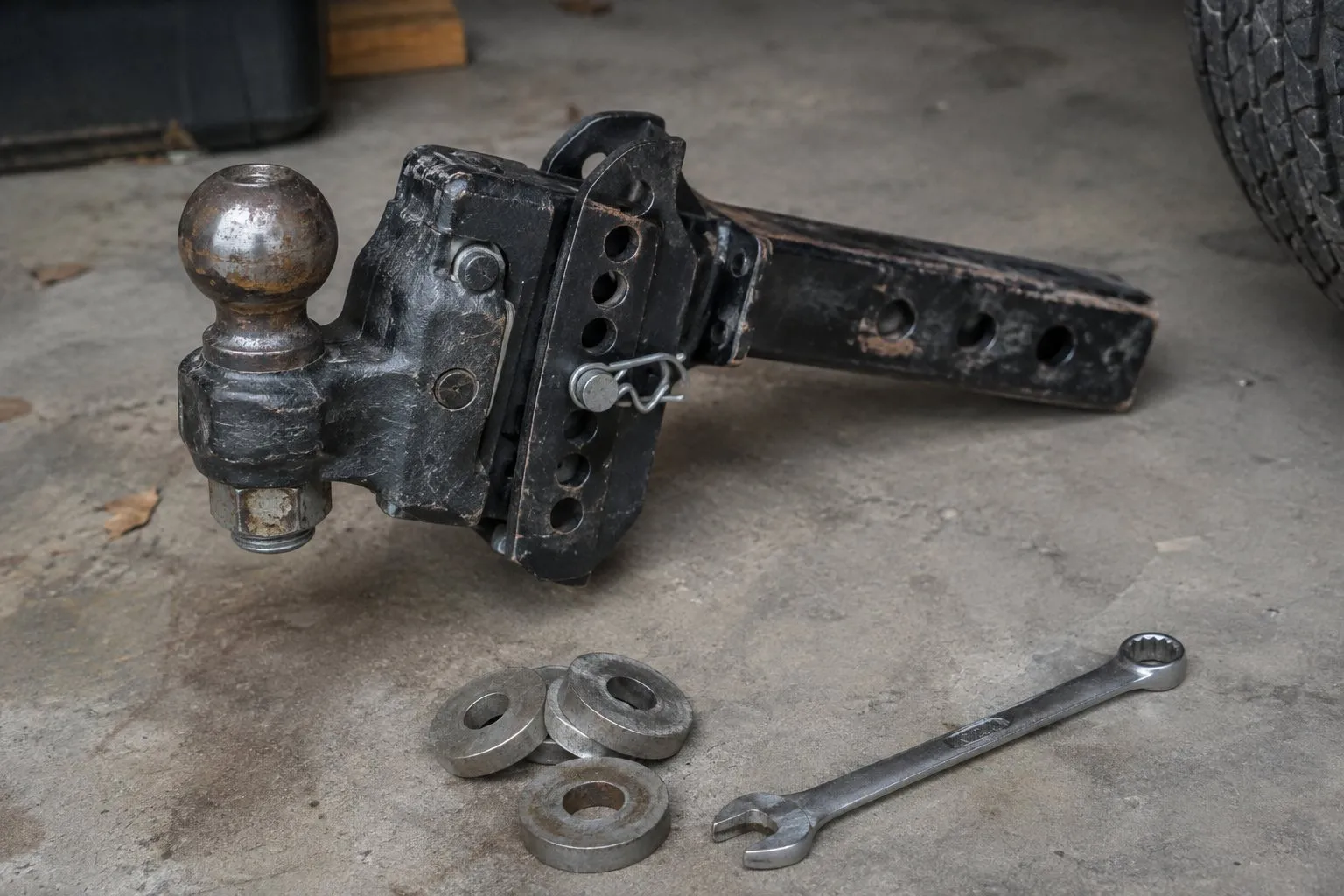
- Spacer washers (Equal-i-zer and similar heads). The washers sit on a spacer rivet in the back of the head. The manual starts most set-ups with 5 washers. More washers add tension; fewer take it off.
- L-bracket or chain bracket height. Raising the brackets on the trailer frame adds tension, lowering them reduces it.
- Ball height. Equal-i-zer's FAQ lists lowering the hitch ball as a third way to move more weight back to the front axle, next to washers and brackets.
- Preset tilt holes (CURT TruTrack 4P). No loose washers: interlocking nuts and six preset holes on the outside of the head give fixed tilt angles, so you do not take the head apart.
- Tension nuts (Andersen). Andersen's FAQ has you hand-tighten the tension nuts, then turn them 3 to 4 more threads with a wrench, and adjust both nuts half a turn at a time. Its red urethane springs should show a little bulge, never be mashed flat.
Equal-i-zer's manual also asks for at least 3 inches between the end of each spring arm and the center of its L-bracket once the jack is retracted. With less, the brackets have to move forward on the frame.
The adjustment loop
Read the current setting
Rig loaded for the trip, hitched, bars engaged, jack fully retracted. Measure the front fender and work out the percentage or compare it with your target height.Decide the direction
Below target: add tension. Above 100 % or past your maker's figure: remove tension.Take the load off
Chock the trailer. Raise the tongue with the jack until the bars are free, remove them and unhitch. Equal-i-zer warns never to loosen or remove any part of the hitch while it is under load.Change one thing
Washers, bracket height or tilt hole. One change per round, so you know what moved the reading.Hitch up and measure again
Couple, engage the bars, retract the jack and take a new C reading. Keep the old A and B values. Repeat until you hit the target.Level the trailer
Measure the trailer frame at front and rear. Equal-i-zer's limit is 1-1/4 inches of difference; more than that, move the head up or down on the shank, then measure the fender again, since ball height changes the distribution too.Torque and test
Tighten every bolt to the hitch maker's values, then tow a short distance before you change anything else.
For the 4K model the manual gives 180 ft-lbs on the shank bolts, 27 on the link plate bolts, 45 on the L-bracket bolts and 60 to 100 on the socket bolts. Other models and makers use other values, so read your own manual.
When the rig still feels wrong
Sway after adjustment usually points back at tension. Equal-i-zer's FAQ names too little spring arm tension, or too little weight back on the front axle, as the most likely cause, and asks you to recheck all three front measurements before you change anything. Loading and speed come next; both are on what causes trailer sway. Noise is a different matter: Equal-i-zer's manual says a clean, lubricated hitch reduces wear and towing noise. More on weight distribution hitch noise.
Once the numbers are right, the daily routine is short and keeps the setting: how to hook up a weight distribution hitch.
Questions at the scale house
Q01Can you have too much weight distribution hitch?
Yes, in two ways. Too much bar tension over-distributes: Equal-i-zer's manual says going past 100 % takes too much weight off the truck's rear axle and can cause a loss of traction and control, ending in a jack-knife on slick roads.
Q02How do I know if my weight distribution hitch is under-distributed?
The front fender sits well above your vehicle maker's target after you hook up the bars, or Equal-i-zer's formula gives less than 50 %. The manual says too much weight stays on the rear axle, with a loss of steering and braking control and less resistance to sway. Add spacer washers or raise the L-brackets.
Q03Do I need to readjust the hitch for every trip?
Check it every trip, adjust when the load changes. Equal-i-zer's manual asks you to verify the adjustment after loading truck and trailer for each trip, and to run the full set-up again with a different tow vehicle or trailer. Water, propane and cargo all count in that check.
Weighed against
- [1]Equal-i-zer 4K owner's manual (PDF), steps 6 to 9 and appendix
- [2]Equal-i-zer, frequently asked questions (why am I feeling sway?)
- [3]CURT, part 17500 TruTrack 4P weight distribution hitch
- [4]Andersen, weight distribution hitch FAQ
- [5]Ford, 2026 RV & Trailer Towing Guide (weight distribution hitch setup, p. 8)
Next stop
- Set-upShop stepsHow to set up a weight distribution hitch: measure H1 and H2 at the front fender, find your truck maker's target, then tension the bars.
- Hook-up routineShop stepsHow to use a weight distribution hitch on every trip: couple, lift with the jack, hook the bars, lower, connect chains and wiring. Unhooking too.
- Causes of swayFault and fixWhat causes trailer sway: too little tongue weight, a tail-heavy load, speed, wind and loose bar tension. How to stop it and fix the cause.
- Hitch noiseFault and fixWeight distribution hitch noise usually means dry friction points or binding chains. Where each squeak comes from and what to grease, or never grease.
- Air suspensionWill it fit?Air suspension towing with a weight distribution hitch works, but the set-up changes: what Ram, Equal-i-zer and CURT say for auto-leveling.
Who weighs it up
weightdistributionhitch.com Editorial Desk
Towing set-up & hitch picks
We are the editorial desk at weightdistributionhitch.com. For every hitch we pull the tongue weight and trailer weight ratings, the shank and ball size, the bracket spacing and the torque values out of the maker's install sheet, then set them against the receiver label and the tow vehicle's own towing guide.
- — Ratings copied from the install sheet or part page, with document name
- — Set-up targets taken from the truck maker's towing guide, not a rule of thumb
- — "Not stated by maker" wherever a rating, surge-brake note or warranty term is missing