Weight distribution hitch for a horse trailer: bumper pull and V-nose
Buying sheetReading span: 5 minchecked November 28, 2026by the editorial desk
A weight distribution hitch for a horse trailer only fits bumper pull and V-nose trailers that hitch to a ball on the receiver; a gooseneck rides in the truck bed. Weigh the trailer with the horses you actually haul, then pick by loaded tongue weight. Up to 1,000 lb, start with the Equal-i-zer 10K.
On the ticket
Bumper pull or V-nose horse trailer? Weigh it loaded with your horses, hay and tack. Up to 1,000 lb on the tongue, take the Equal-i-zer 10K: sway control built in, rated 10,000 lb. Over 1,000 lb, step up to the CURT 17422, rated to 1,500 lb. A gooseneck needs no weight distribution hitch.
Paid links on this sheet: Links with a * go to Amazon, and a purchase through them pays this site a commission; your price stays the same. As an Amazon Associate I earn from qualifying purchases. How the links pay
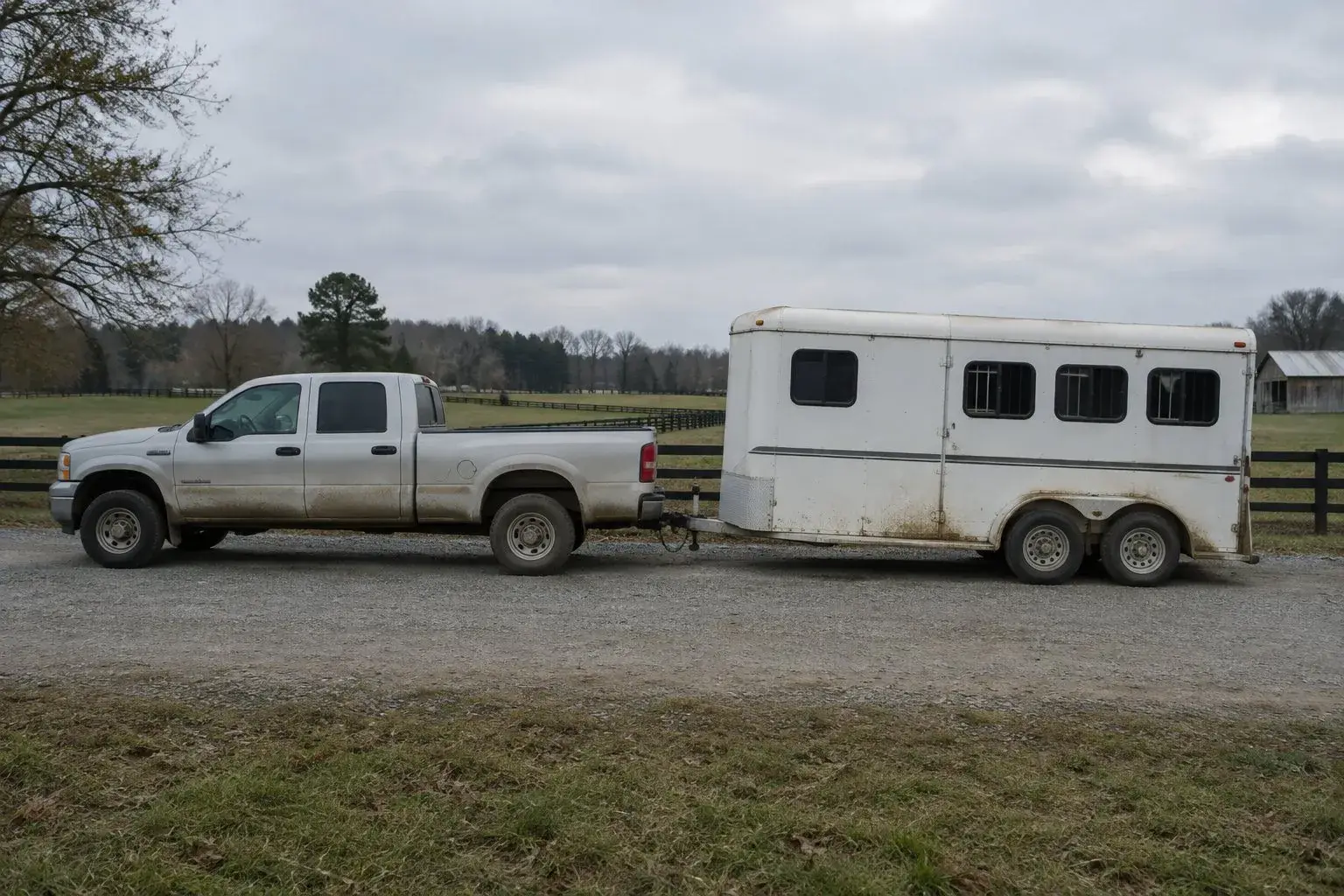
Bumper pull and V-nose: yes. Gooseneck: no
Horse trailers come in two hitch styles, and only one of them takes a weight distribution hitch. A bumper pull, often with a V-shaped nose that holds a tack or dressing room, hitches to a ball on a ball mount in your receiver. That is the set-up a weight distribution hitch is made for: its spring bars run from a head on the receiver back to the trailer's A-frame.
A gooseneck couples to a ball in the truck bed. Featherlite's owner's manual shows why it needs no help: it plans with 20 to 25 % of the loaded trailer on a gooseneck hitch, against 10 to 15 % on a ball hitch for large trailers. The bed takes that load directly, so there is nothing to spread.
If your bumper pull is light, you may not need one at all. Where truck guides draw the line is explained on do you need a weight distribution hitch.
A live load changes the tongue
A horse trailer is not a camper with a fixed load. Horses go in and come out, you haul one or two, and hay, water and tack ride wherever there is room. Each change moves weight between the trailer axles and the ball.
Carry-On's horse trailer manual is clear about two things. Tongue weight must push down on the hitch: too little and the trailer can become unstable at speed, too much and the truck's front wheels get too light for good steering. And the first horse always goes into the forward-most stall, because weight that is not distributed properly makes an unstable trailer.
What that means for the hitch:
- Weigh it the way you haul it. Carry-On's method uses a certified scale at a truck stop or grain elevator: weigh the whole trailer, then only its axles, and the difference is the tongue. The steps are on how to weigh your truck and trailer.
- Size for the heaviest load you haul, two horses plus hay and water, not the empty trailer. Equal-i-zer's sizing rule asks for a tongue rating above your loaded tongue weight and a trailer rating above the trailer's GVWR.
- Re-check after a big change. Husky notes that adding, moving or unloading cargo may require a new set-up. Equal-i-zer asks you to verify the adjustment after loading for each trip.
Carry-On's rule of thumb is 10 to 15 % of the loaded trailer on the tongue for large trailers and 6 to 10 % for small ones, with the trailer maker's figure taking priority. The tongue weight percentage page explains where those numbers come from.
Two hitches for horse trailers
| Equal-i-zer 10K | CURT 17422 | |
|---|---|---|
| Tongue weight | Up to 1,000 lb | Up to 1,500 lb |
| Max trailer weight | 10,000 lb | 15,000 lb |
| Sway control | Built in, 4 points | Friction unit #17200, included |
| Shank and ball | Not included on the listing we link | 2 in shank and 2-5/16 in ball included |
| Surge brakes | Compatible, says Equal-i-zer | Not stated by CURT |
Equal-i-zer 10K for tongues up to 1,000 lb
If your scale ticket shows up to 1,000 lb on the tongue, the Equal-i-zer 10K fits. The sway control sits in the hitch itself, at four friction points, so there is no separate bar to hook up while a horse waits in the trailer. Equal-i-zer rates it 10,000 lb and 1,000 lb and says it is compatible with surge brakes. Shank and ball are not in the listing's box, so plan a ball rated for your loaded trailer. Its brand page is Equal-i-zer.
CURT 17422: when the tongue goes past 1,000 lb
If the loaded tongue comes in over 1,000 lb, a bigger class is needed. CURT rates the 17422 to 1,500 lb tongue and 15,000 lb trailer, and puts the friction sway unit, a 2 inch shank and a pre-torqued 2-5/16 inch ball in the box. It fits class 3, class 4 and most class 5 receivers; check that your receiver label allows the weight-distributing load you plan.
CURT 17422 Trunnion 15K
Short 28-3/8" trunnion bars rated to 1,500 lb tongue weight, with friction sway unit and ball included.
Why it's on this ticket: For heavier bumper pull horse trailers: rated to 1,500 lb tongue and 15,000 lb trailer, with friction sway control, shank and ball in the box.
Fits: Heavier bumper-pull trailers up to 15,000 lb and 1,500 lb tongue weight

- Tongue weight (decides it)
- 1,000–1,500 lb
- Max trailer weight
- 15,000 lb
- Spring bars
- Trunnion, 28-3/8", square
- Sway control
- Friction unit #17200 (included)
- Shank
- 2" (2-1/2" sold separately)
- Ball
- 2-5/16", pre-torqued, included
- Surge brakes
- Not stated
- Rated to 15,000 lb trailer weight and 1,500 lb tongue weight
- Sway control unit #17200 and a pre-torqued 2-5/16" ball included
- Fits class 3, class 4 and most class 5 receiver hitches
- Comes with a 2" shank; the 2-1/2" shank is sold separately
- Sway control is a bolt-on friction unit
- Built for 1,000 to 1,500 lb of tongue weight; lighter tongues sit below its range
Pick by your numbers
If your loaded tongue stays at or under 1,000 lb → Equal-i-zer 10K
Amazon price: View(paid link to Amazon, opens in a new tab)Ad · paid link · check price & delivery on AmazonAd · paid link · price as of ·If your trailer has surge brakes → Equal-i-zer 10K
Amazon price: View(paid link to Amazon, opens in a new tab)Ad · paid link · check price & delivery on AmazonAd · paid link · price as of ·If your loaded tongue is between 1,000 and 1,500 lb → CURT 17422 Trunnion 15K
Amazon price: View(paid link to Amazon, opens in a new tab)Ad · paid link · check price & delivery on AmazonAd · paid link · price as of ·If you are still weighing the trailer
Blue Ox also sells a SwayPro hitch rated for 10,000 lb trailers. We could only read its Amazon listing, not Blue Ox's own pages; what is known is on the Blue Ox page.
Farm roads, gates and pasture
Farm roads and field entrances are hard on a hitch, and the hitch makers have rules for them. Equal-i-zer's manual says never to tow with the hitch engaged on rough roads or through deep ditches and dips, because the strain on the arms and head can cause fatigue or failure. It also asks you to disengage the weight distribution before you tow or back across a big change in grade, such as from a level road onto a steep driveway or field entrance.
Two more checks before you drill or clamp anything:
- Bracket position. Equal-i-zer places its frame brackets 27 to 32 inches from the center of the coupler, with room behind them for the arms to move. On a V-nose, make sure that stretch of A-frame is free of the jack, battery box or propane bottles.
- Turning clearance. Husky asks you to measure truck and trailer before installing to be sure there is room at the bumper for turns.
What a hitch will not do for the horses
A weight distribution hitch levels the truck and gives back steering load at the front axle; it does not make a trailer immune to wind or speed. Equal-i-zer's manual says no hitch set-up guarantees that sway will be avoided. Carry-On reminds you that the faster you go, the more likely the trailer is to sway. What causes it, and what to do when it starts, is on what causes trailer sway.
Hauling something else as well? The utility trailer weight distribution hitch page covers car haulers and enclosed trailers, and heavy duty weight distribution hitches go above 1,500 lb.
Equal-i-zer 10K: hitch it or leave it?
TKT 04+ Hitch it if …
- If you tow a bumper pull or V-nose horse trailer with up to 1,000 lb on the tongue
- If you want sway control built into the hitch, with no separate bar to hook up
- If your trailer has surge brakes
− Leave it if …
- If your trailer is a gooseneck
- If your loaded tongue is over 1,000 lb (look at the CURT 17422)
- If you want shank and ball in the box
Numbers match? Check the Equal-i-zer 10K listing for the exact rating and what is in the box.
Amazon price: View on Amazon(paid link to Amazon, opens in a new tab)Ad · paid link · check price & delivery on AmazonAd · paid link · price as of ·Questions at the scale house
Q01Does a gooseneck horse trailer need a weight distribution hitch?
No. A weight distribution hitch works with a ball mount in the receiver at the rear of the truck. A gooseneck couples to a ball in the truck bed and puts much more of its weight there: Featherlite's owner's manual plans with 20 to 25 % of the loaded trailer on a gooseneck hitch, against 10 to 15 % on a ball hitch for large trailers.
Q02Do I readjust the hitch when I haul one horse instead of two?
Check it. Husky notes that adding, moving or unloading cargo may change how the weight distribution must be set, and Equal-i-zer asks you to verify the adjustment after loading for each trip. Carry-On's horse trailer manual adds a loading rule: always put the first horse in the forward-most stall.
Q03How much tongue weight should a bumper pull horse trailer have?
Carry-On's bumper pull horse trailer manual gives a rule of thumb of 10 to 15 % of the loaded trailer for large trailers and 6 to 10 % for small ones, and says to ask the trailer maker for the figure that fits your model. Weigh it rather than guess, because hay, water and tack in the front add to the tongue.
Weighed against
- [1]Carry-On Trailer, bumper pull horse trailer owner's manual (PDF)
- [2]Featherlite Trailers, enclosed trailers owner's manual (PDF)
- [3]Equal-i-zer, frequently asked questions
- [4]Equal-i-zer 4K owner's manual (PDF)
- [5]Husky Towing, round bar kits 31421 to 31425 instructions, REV. 10 (PDF on SEMA Data)
- [6]CURT, part 17422 trunnion bar weight distribution hitch
Next stop
- Best hitchesBuying sheetBest weight distribution hitch for your trailer: four picks sorted by loaded tongue weight, surge brakes and sway control, with stated limits.
- Heavy dutyBuying sheetHeavy duty weight distribution hitch for tongues over 1,000 lb: 12K, 14K, 15K and 20K classes, the 2-1/2 inch shank question and the kit to start with.
- What size weight distribution hitch do I need?Straight answerWhat size weight distribution hitch do I need? Size the bars by loaded tongue weight plus rear cargo, then check trailer GVWR and the receiver label.
- Blue OxMaker fileBlue Ox weight distribution hitch guide: SwayPro sizes from 350 to 2,000 lb, shanks, how its sway control works and which size fits a 2 inch receiver.
- Weigh truck and trailerShop stepsHow to weigh your truck and trailer on a three-platform truck-stop scale: where each axle goes, what the ticket shows, which label to check.
- For work trailersBuying sheetWeight distribution hitch for a dump trailer, utility, cargo or car hauler: size it on the loaded tongue, check the frame, and know when to unhook it.
Who weighs it up
weightdistributionhitch.com Editorial Desk
Towing set-up & hitch picks
We are the editorial desk at weightdistributionhitch.com. For every hitch we pull the tongue weight and trailer weight ratings, the shank and ball size, the bracket spacing and the torque values out of the maker's install sheet, then set them against the receiver label and the tow vehicle's own towing guide.
- — Ratings copied from the install sheet or part page, with document name
- — Set-up targets taken from the truck maker's towing guide, not a rule of thumb
- — "Not stated by maker" wherever a rating, surge-brake note or warranty term is missing