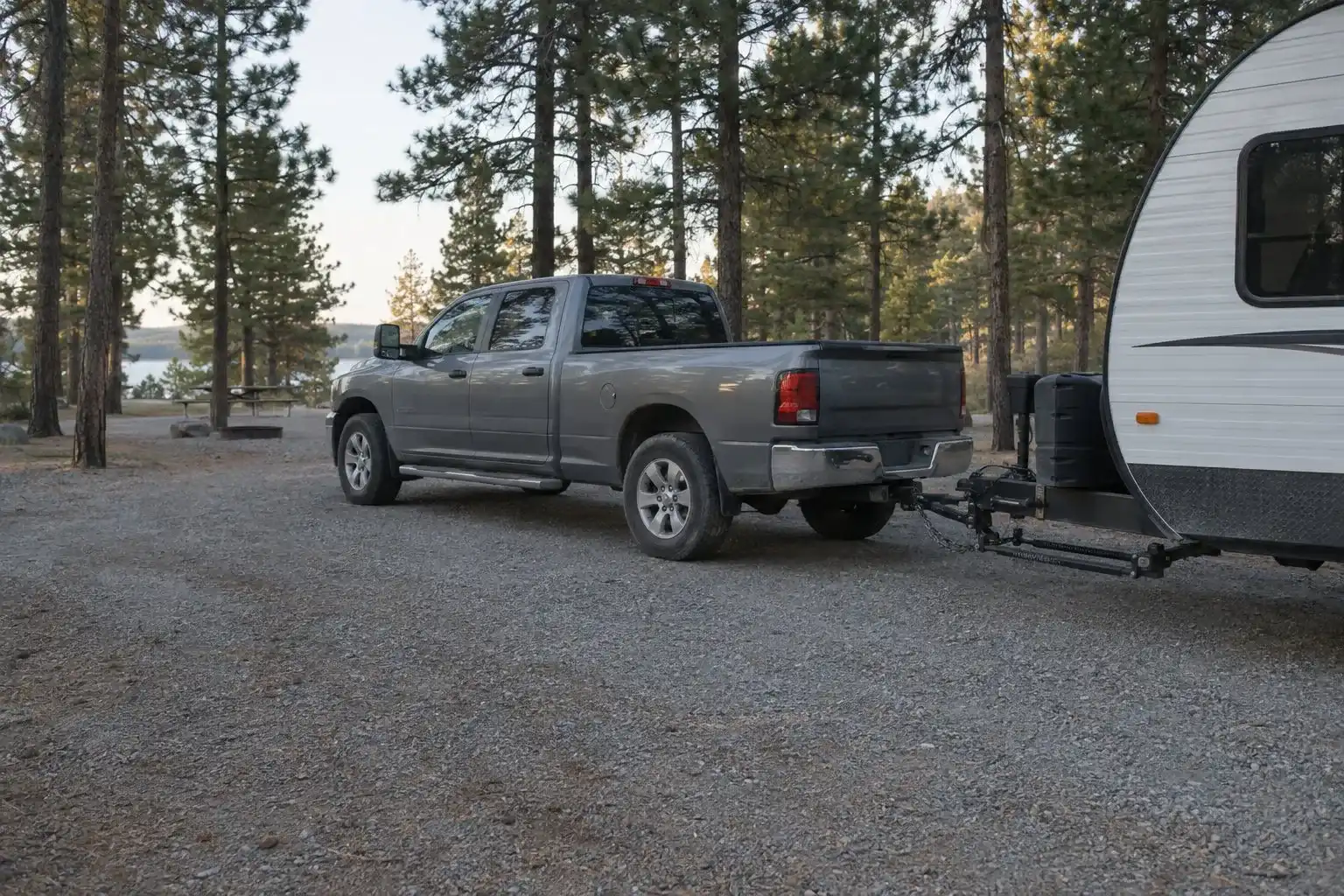
Weight distribution hitch: weigh it, size it, set it level
A weight distribution hitch moves part of the tongue load back onto your truck's front axle. Pick it by loaded tongue weight, set it to your vehicle's own target, and the rig sits level.
See the picks— Sized by tongue weight— Set-up targets from truck guides— Ratings only as stated
On the ticket· · ·
Weigh the loaded tongue first: it is usually 10 to 15 % of the trailer. Then pick a weight distribution hitch whose stated tongue weight range covers that number. For 800 to 1,000 lb, the CURT 17062 round-bar kit is our pick. Set it up to your truck's own target – Ford says 50 % – and never past 100 %.
Paid links on this sheet: Links with a * go to Amazon, and a purchase through them pays this site a commission; your price stays the same. As an Amazon Associate I earn from qualifying purchases. How the links pay
Tongue weight picks the hitch, not the truck
A weight distribution hitch is rated twice: for the trailer it can pull and for the tongue weight its spring bars can carry. The tongue rating is usually the one you hit first, because the tongue carries 10 to 15 % of the loaded trailer, and cargo behind your truck's rear axle counts toward it as well. So the first job is a number, not a brand: the loaded tongue weight of your trailer. Ford plans with 10 % for conventional trailers over 2,000 lb; the tongue weight calculator gives you the 10 to 15 % span, and a scale gives you the real figure.
For the most common case – a travel trailer packed for a trip with 800 to 1,000 lb on the tongue – this is the hitch we pick:
TKT 01 · CURTTicket pick
CURT 17062 Round Bar
Round-bar hitch, friction sway unit and a pre-torqued 2-5/16" ball in one box, for 800 to 1,000 lb of tongue weight.
Why it's on this ticket: CURT states 800 to 1,000 lb tongue weight and 8,000 to 10,000 lb trailers, and the box holds hitch, ball and the friction sway unit.
Fits: Travel and utility trailers with a loaded tongue weight of 800 to 1,000 lb and a 2" receiver
Tongue weight (decides it)
800–1,000 lb
Max trailer weight
8,000–10,000 lb
Spring bars
Round bar
Sway control
Friction unit #17200 (included)
Shank
2" (flips for drop or rise)
Ball
2-5/16", pre-torqued, included
Surge brakes
No (listing)
+Hitch, sway control unit #17200 and a pre-torqued 2-5/16" ball come in the box
+Grease zerk in the head for the spring bar sockets
+2" shank flips for drop or rise; the head also takes CURT's 2-1/2" shank
−Sway control is a bolt-on friction unit, not built into the head
−Tongue weight range stops at 1,000 lb
−Not for surge brakes (stated in the listing); the hitch needs no drilling, but the included sway unit's plate is drilled into the A-frame
Size it with your own numbers
Type in the loaded trailer weight. If you have weighed the tongue, add that number; if not, the sizer works with the 10 to 15 % span and tells you so. It only lists hitches whose stated rating covers your number.
Hitch sizer
TKT 01
Enter your loaded numbers. We estimate tongue weight only if you leave it blank, and we show only hitches whose stated rating covers it.
Type your loaded trailer weight to start.
Estimate rule: Equal-i-zer and Reese (10–15 %), Ford 2026 guide (10 %). Ratings: maker pages or listing titles.
Read your ticket: three numbers on three labels
GTWLoaded trailer weightWhat the trailer weighs packed for a trip, with water, gear and propane. The brochure's dry weight is lower.Read: a truck-stop scale with the rig loaded
TWTongue weightThe part of the trailer that presses down on the ball. Usually 10 to 15 % of the loaded trailer; Ford plans with 10 %.Read: a tongue scale at the coupler
WC / WDReceiver labelTwo pairs of limits: weight-carrying and weight-distributing. On the 2026 F-150 that is 5,000 / 500 lb and 13,500 / 1,400 lb.Read: the label on the receiver hitch
The CURT is the all-round pick for 800 to 1,000 lb. The Eaz-Lift Elite comes ready to tow with the ball already installed – the camper hitch page explains when that matters. The Equal-i-zer is the one for trailers with surge brakes: Equal-i-zer says its hitch works with them, while CURT's listing rules them out for the 17062. All four-plus options sit side by side on the best weight distribution hitch page.
Four fields, one hitch
Not sure which of the three fits? Answer with your trailer's numbers.
Hitch finder
Field 1 of 4
What does your trailer weigh when it's packed for a trip?
Loaded, with water, gear and propane – not the dry weight from the brochure.
What the spring bars actually do
When you drop the coupler on the ball, the tongue load pushes the truck's rear down and lifts the front a little. The front wheels lose some of their grip for steering and braking. A weight distribution hitch fights that with leverage: chains or brackets bend the spring bars upward, the bars push up on the hitch head, and part of the load moves forward to the front axle and back to the trailer's axles. The trailer's tongue weight stays the same; only where it ends up changes.
How spring bars move tongue load
1tongue load
2hitch head
3spring bar under tension
4chain + bracket
5front axle
6trailer axle
Schematic, not to scale. Chains pull the bar ends up; the bent bars push the hitch head up and lever load toward the truck's front axle and the trailer's axles.
There is no single right fender height. The target comes from your tow vehicle's maker, and the makers disagree with the common advice to bring the front all the way back up.
Measure H1
Truck loaded for the trip, trailer not hitched. Measure the front fender height from the ground to the top of the wheel opening.
Hitch up, bars off, measure H2
Lower the coupler onto the ball without the spring bars. The front rises; measure the same spot again.
Work out your target
Use your guide: Ford recommends 50 % front axle load restoration, Ram's 2500/3500 manual uses (H2 − H1) ÷ 2 + H1. Other trucks: the set-up section of your owner's manual.
Tension the bars and check
Add tension until the fender reaches the target, then measure again. Equal-i-zer calls 50 to 100 % good.
Three fender heights
1H1 · unhitched
2H2 · hitched, bars off
3target · bars on
4Ford: 50 % front axle load restoration
5Ram 2500/3500: (H2 − H1) ÷ 2 + H1
6Equal-i-zer: 50–100 %, never over 100 %
Measure the front fender height from the ground to the top of the wheel opening. Targets from the 2026 Ford towing guide, the 2022 Ram 2500/3500 owner's manual and the Equal-i-zer manual.
Many hitches include sway control. On the CURT 17062 and 17422 it is a bolt-on friction bar, unit 17200, with an on/off handle. On the CURT TruTrack 4P and the Equal-i-zer it sits in the hitch at four points; Andersen uses cone friction. Equal-i-zer's own manual says there is no complete measurement of sway control, so nobody can rank one design as best for every trailer. The trade-offs are on built-in vs friction sway control, and the bolt-on bars on trailer sway bars.
If a trailer starts to sway, Ford's guide says to work the trailer brakes by hand, not the truck's brakes. Why it happens in the first place is on what causes trailer sway.
Q01What is the downside of a weight distribution hitch?
It needs set-up and checking. Too little bar tension leaves the front axle light; Equal-i-zer's manual ties under-distribution to a loss of steering and braking control and calls anything over 100 % over-distributed. Some models also rule out surge brakes – Andersen says its hitch cannot be used with them.
Q02Does a weight distribution hitch increase towing capacity?
No. Ford writes that trailer towing values are the same for weight-carrying and weight-distributing hitches on its Super Duty pickups. What changes is the receiver's limit: on the 2026 F-150 it goes from 5,000 lb and 500 lb tongue weight to 13,500 lb and 1,400 lb.
Q03Do I need one for a 5,000 lb trailer?
Check your vehicle guide. Ford's 2026 guide says not to tow over 5,000 lb with an F-150 without a weight-distribution system. The tongue weight limit on your receiver label counts too, and Equal-i-zer notes that most owners reach it before the trailer limit.
Q04Can you back up with a weight distribution hitch?
Yes. Equal-i-zer says you can back up with its hitch and places the brackets 27 to 32 inches from the coupler so there is room in turns. Andersen says its hitch stays connected when backing up.
Q05Does air suspension change the set-up?
Yes. Equal-i-zer's manual says auto-leveling and air suspension reduce the weight distribution after set-up, by 20 to 25 % on 4-corner systems. Ram's 2500/3500 manual adds its own hitching steps for trucks with air suspension.
We are the editorial desk at weightdistributionhitch.com. For every hitch we pull the tongue weight and trailer weight ratings, the shank and ball size, the bracket spacing and the torque values out of the maker's install sheet, then set them against the receiver label and the tow vehicle's own towing guide.
— Ratings copied from the install sheet or part page, with document name
— Set-up targets taken from the truck maker's towing guide, not a rule of thumb
— "Not stated by maker" wherever a rating, surge-brake note or warranty term is missing
May we count page views? No cookies, via Cloudflare (USA). Privacy policy
Privacy settings: This website sets no cookies. May we count page views with Cloudflare Web Analytics? It works without cookies and without advertising profiles. We store your choice in your browser. You can withdraw your consent at any time in the page footer. Privacy policy
Product prices and availability are accurate as of the date/time indicated and are subject to change. Any price and availability information displayed on Amazon.com at the time of purchase will apply to the purchase of this product.