Weight distribution hitch with built-in sway control vs a friction bar
How it worksReading span: 5 minchecked November 28, 2026by the editorial desk
A weight distribution hitch with built-in sway control resists sway inside the hitch itself, through friction at the head, the bar brackets or a cone. A friction bar does the same job as a separate unit beside the hitch. No maker has published a measurement that ranks one above the other, so the choice comes down to hook-up, brakes, upkeep and weather.
On the ticket
Built-in sway control works through friction in the hitch head, brackets or a cone, so there is nothing extra to hook up. A friction bar bolts between ball mount and A-frame, can be switched off, and has to come off on slippery roads. Equal-i-zer's manual says there is no 100 % qualitative measurement of sway control, so neither design is proven better.
Stops on this page
- 01Four ways to put friction against sway
- 02Bolt-on friction bar: a second part you control
- 03Equal-i-zer: friction built into head and brackets
- 04CURT TruTrack 4P: brackets, spring and cam
- 05Andersen: a cone instead of spring bars
- 06What the "points" do and don't tell you
- 07Side by side: what you live with
- 08Built-in or bolt-on: how to decide
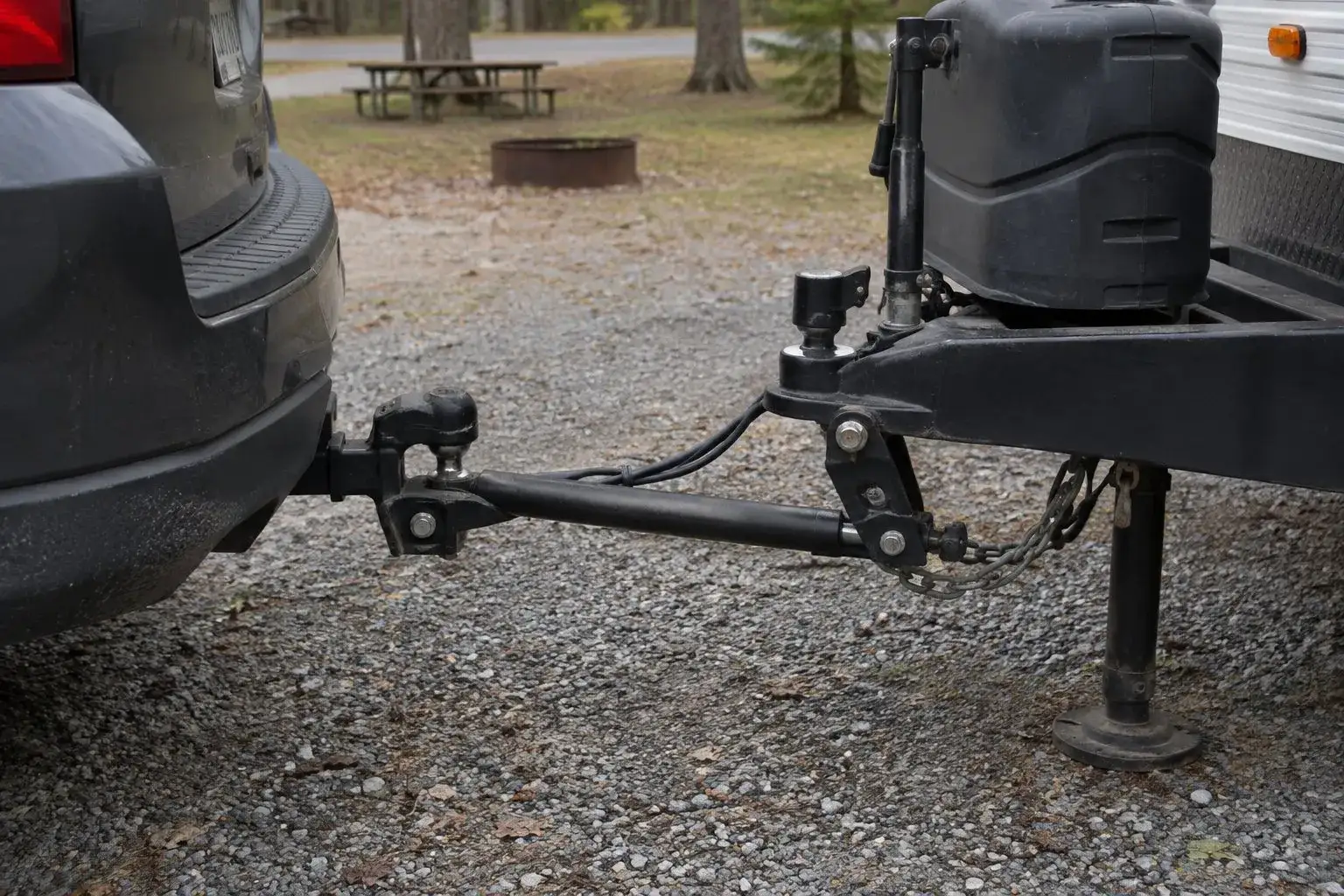
Four ways to put friction against sway
Every design here does the same basic thing: it makes it harder for the trailer to swing sideways around the hitch ball. What differs is where the friction sits.
| Design | Where the friction sits | Examples |
|---|---|---|
| Bolt-on friction bar | A sliding bar in a housing, between a small ball on the ball mount and a ball on the A-frame | CURT 17200, Reese friction bars |
| Friction at head and brackets | Arm sockets rubbing on the head plates; spring arms resting on rigid brackets instead of chains | Equal-i-zer 4-point |
| Brackets plus spring and cam | Support brackets that hold the bars rigidly and use friction, plus a spring-loaded cam in the head | CURT TruTrack 4P |
| Cone friction | The tongue weight presses the ball into a friction liner inside the ball housing | Andersen |
The first is a separate part. The other three are what people mean by integrated or built-in sway control: the same parts that carry the spring bars also resist the swing.
Bolt-on friction bar: a second part you control
CURT describes its 17200 as a unit that uses a brake-pad-like material to resist sideways movement. It clips onto a small sway ball on the ball mount and onto a ball bolted to the trailer frame, 24 inches back from the coupler. An on/off handle sets the tension, and an adjustment bolt fine-tunes it.
The bar's strength is that you control it. You can tighten it, loosen it or take it off. Its weak spots come from the same fact:
- It is one more thing to hook up and unhook every trip.
- CURT's sheet says it must be removed on wet, icy, gravel or snow-covered roads, and cannot be used on trailers with surge brakes.
- If it hits the bumper, bottoms out or pulls apart when you back into a jackknife, it must come off for backing.
- Larger, heavier or broad-sided trailers may need two units.
Fitting and care are on the trailer sway bar page.
Equal-i-zer: friction built into head and brackets
Equal-i-zer calls its design Integrated 4-Point Sway Control, a system that combines sway control and weight distribution in one unit. The spring arms rest on rigid L-brackets on the A-frame instead of hanging from chains. The manual asks you to clean and grease the friction surfaces of the head and the arm sockets before each trip, and not to grease the swing arms or L-brackets. That routine is the price of the design.
The rigid brackets also explain the surge brake answer. Equal-i-zer says they let the spring arms slide back and forth freely, so the hitch is compatible with surge brakes. More on the Equal-i-zer page.
CURT TruTrack 4P: brackets, spring and cam
The TruTrack also drops the chains. CURT says its adjustable support brackets hold the trunnion bars rigidly and use friction to resist sideways movement in place of a separate sway control. A spring and cam system with hardened parts in the head adds resistance beyond friction alone, for four points of sway control in CURT's count. CURT asks for grease on all lubrication points before first use. The TruTrack is the pick on our weight distribution hitch with sway control page, and the rest of the CURT range is on the CURT brand page.
Andersen: a cone instead of spring bars
Andersen's hitch has no spring bars at all. Andersen explains that the tongue weight pushes the ball into a friction liner between ball and ball housing, and that the pad gives friction only during turns, which keeps wear down when you drive straight. It needs no grease and stays connected when backing up. It also cannot be used with surge brakes: Andersen says the forward pressure of the weight distribution leverage would permanently engage them. Details on the Andersen page.
What the "points" do and don't tell you
You will see "2-point" and "4-point" in shop listings. The maker sources we read only define their own count: Equal-i-zer's 4-point is a trademark, and CURT's "4P" stands for the four points in its TruTrack. Neither gives a figure for how much sway any point removes. Equal-i-zer's manual puts it plainly: "There is no 100% qualitative measurement of trailer sway or sway control."
So a higher point count is a description of the design, not a measured grade. Compare what you can check instead.
Side by side: what you live with
| Friction bar (CURT 17200) | Equal-i-zer 4-point | CURT TruTrack 4P | Andersen cone | |
|---|---|---|---|---|
| Extra hook-up | Yes, a second bar | No | No | No |
| Switch off or remove | Handle, or unclip | No | No | No |
| Surge brakes | Cannot be used | Compatible | Not stated | Cannot be used |
| Grease | Never on the slide bar | Head and sockets before each trip | All points before first use | None needed |
| Slippery roads | Must be removed | Follow the manual | Follow the manual | Follow the manual |
Built-in or bolt-on: how to decide
- Your trailer has surge brakes: a built-in design that its maker clears for surge brakes. Of the four above, only Equal-i-zer says yes. Our surge brake page is weight distribution hitch with surge brakes.
- You already own a WD hitch with sway tabs: a friction bar is the simple add-on.
- You want fewer parts to handle at the campsite: built-in.
- You tow often in rain or snow: remember the friction bar comes off then, and a built-in design does not.
None of them makes a badly loaded trailer safe. Equal-i-zer's manual says no hitch setup guarantees that sway will be altogether avoided, and an under-distributed set-up reduces resistance to sway. Tongue weight, the 60/40 load and speed come first; see what causes trailer sway. How the two hardware jobs, weight distribution and sway control, split up is on weight distribution hitch vs sway bar.
Questions at the scale house
Q01What does 4-point sway control mean?
It is a maker's count of the places where its hitch resists sway, not a standard. Equal-i-zer uses Integrated 4-Point Sway Control as a trademark for its hitch. CURT names its TruTrack 4P after the four points of sway control in its brackets and its spring and cam system. Neither maker gives a measured figure for how much sway each point removes.
Q02Does built-in sway control work with surge brakes?
That depends on the model, not on the design. Equal-i-zer says its hitch is compatible with surge brakes because the rigid frame brackets let the spring arms slide freely. Andersen says its cone-friction hitch cannot be used with surge brakes. CURT's TruTrack page does not address them, and CURT's 17200 friction bar cannot be used on surge-braked trailers.
Q03Can I take built-in sway control off for slippery roads?
Not as a separate part, because it is part of the hitch. That is one practical difference to a friction bar: CURT's 17200 sheet says the bar must be removed on wet, icy, gravel or snow-covered roads. With a built-in design, follow the hitch maker's manual for bad weather, and slow down.
Weighed against
Next stop
- With sway controlBuying sheetWeight distribution hitch with sway control: built-in 4-point designs vs bolt-on friction bars, what each maker states, and which fits.
- Trailer sway barsBuying sheetTrailer sway bar guide: how a friction sway control bar works, the CURT 17200 we pick, where it mounts, when to take it off, and what it cannot fix.
- WD hitch vs sway barSide by sideWeight distribution hitch vs sway bar: one moves tongue load to the front axle, the other resists sideways movement. When you need both.
- AndersenMaker fileAndersen weight distribution hitch: how the chain-free cone design works, its 14,000 lb rating, set-up and care, and why surge brakes rule it out.
- Equal-i-zerMaker fileEqualizer weight distribution hitch: the six Equal-i-zer sizes, how the 4-point sway control works, what is in the box and where it fits surge brakes.
- Hitch typesHow it worksWeight distribution hitch types compared: chain style, fixed bracket, cam, chain-free cone and projection hitches, plus round vs trunnion bars.
Who weighs it up
weightdistributionhitch.com Editorial Desk
Towing set-up & hitch picks
We are the editorial desk at weightdistributionhitch.com. For every hitch we pull the tongue weight and trailer weight ratings, the shank and ball size, the bracket spacing and the torque values out of the maker's install sheet, then set them against the receiver label and the tow vehicle's own towing guide.
- — Ratings copied from the install sheet or part page, with document name
- — Set-up targets taken from the truck maker's towing guide, not a rule of thumb
- — "Not stated by maker" wherever a rating, surge-brake note or warranty term is missing