Does a weight distribution hitch reduce tongue weight?
Straight answerReading span: 3 minchecked November 28, 2026by the editorial desk
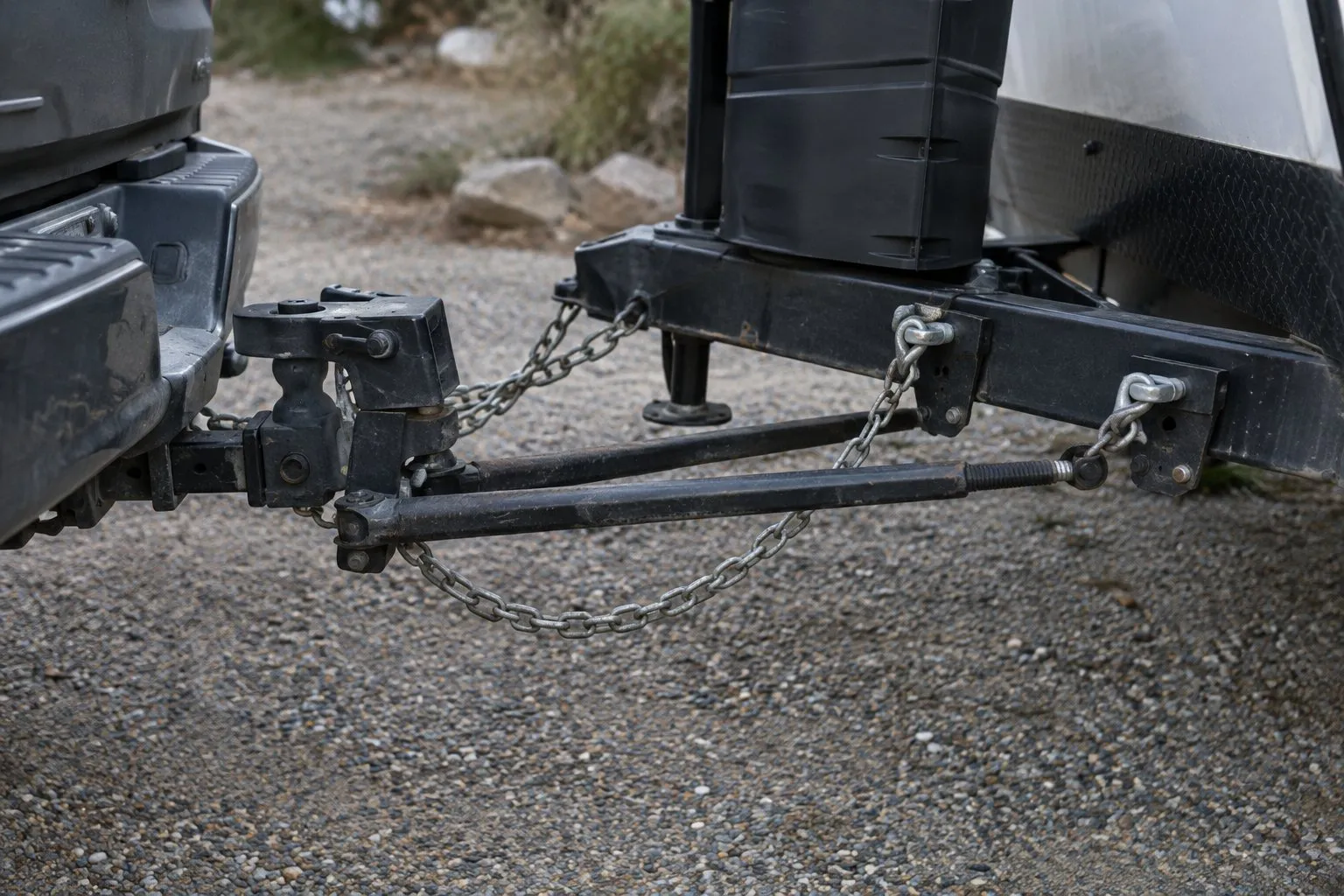
Does a weight distribution hitch reduce tongue weight? No. The trailer presses the same weight onto the ball with or without spring bars. What changes is where that load ends up: the bars move part of it off the truck's rear axle, forward to the front axle and back to the trailer's axles.
Read-out
No. Tongue weight is set by the trailer and how you load it, and the hitch does not change that number. The spring bars act as levers: they move part of the tongue load from the truck's rear axle to its front axle and to the trailer axles. You still size the hitch, the receiver and your payload by the full loaded tongue weight.
Where the myth comes from
Hitch makers describe their product as moving tongue weight. Equal-i-zer's manual calls weight distribution "the act of transferring the trailer tongue weight on the rear axle", and Andersen talks about weight being "transferred forward". Read quickly, that sounds like the tongue gets lighter. It does not. The words describe a shift of load between axles, not a smaller number at the coupler.
The tongue weight comes from the trailer: its build, its cargo and where that cargo sits. Equal-i-zer's FAQ makes the point that tongue weight grows as you load and changes with how you place the cargo. Nothing bolted to your receiver changes that.
What the spring bars actually move
Think of the truck as a seesaw with the rear axle as the pivot. The tongue pushes down behind the axle, so the rear sinks and the front rises. The spring bars push back up on the hitch head. Ford's guide describes the effect: bending the bars upward lifts some of the weight from the rear wheels and transfers it to the other wheels of the vehicle and trailer.
| Plain ball mount | Weight distribution hitch | |
|---|---|---|
| Tongue weight at the coupler | Full tongue weight | The same full tongue weight |
| Where it ends up | Pushes the truck's rear down and lifts the front | Part of it moves to the front axle and the trailer axles |
| Front wheels | Lighter, with less grip for steering and braking | Get part of their load back |
How much moves is set by you, not by the hitch. Andersen gives one example for its chain-free design: with a 900 lb tongue, roughly 30 % of the weight moves forward. Spring-bar hitches are tuned with washers and brackets toward your vehicle maker's target; the lever itself is drawn on how a weight distribution hitch works.
Why the difference matters when you buy
If the hitch shrank the tongue weight, you could size everything smaller. You can't. Three limits still apply to the full loaded tongue weight:
- The hitch. Its spring bars carry a tongue rating. Equal-i-zer says to count cargo in the truck behind the rear axle toward it as well.
- The receiver. Its label lists a weight-distributing tongue limit. On the 2026 F-150 that is 1,400 lb. How to read the label is on hitch tongue weight rating.
- The truck. Ford counts tongue load as cargo, so it uses up payload. See payload capacity and towing.
The same logic explains a second myth. Ford's guide says trailer towing values are the same for weight-carrying and weight-distributing hitches on its Super Duty pickups, so the hitch does not raise the tow rating either; that one has its own page, does a weight distribution hitch increase towing capacity.
More tension is not "less tongue weight"
Cranking the bars tighter moves more load forward, but past a point it hurts. Equal-i-zer's manual says that over 100 % weight distribution takes too much weight off the rear axle, with a loss of traction that can lead to jack-knifing on slick roads. Andersen warns the same way: taking too much off can reduce traction at the rear tires. The goal is the target in your vehicle guide, not the lightest possible rear end.
If your tongue is simply too heavy for your truck or hitch, the fix is in the trailer. Ford's advice is to move cargo rearward until the tongue is back in range; the options are on too much tongue weight. To find out where you stand, weigh it first: tongue weight explains the number and the normal range.
Questions at the scale house
Q01Should I measure tongue weight with the spring bars on?
No. Ford's guide measures the tongue on its own: disconnect the trailer and place only the tongue on a scale, at hitch ball height. That number is the trailer's tongue weight, and it is the one you compare with the hitch, receiver and vehicle ratings. The bars come into play later, when you set the front axle target.
Q02Does tongue weight still count against payload with a weight distribution hitch?
Plan as if it does. Ford's guide counts the trailer's tongue load as part of the truck's cargo weight and says payload must cover it along with passengers and cargo, without pushing the truck past its GVWR or rear axle rating. The guide makes no exception for weight-distributing hitches.
Q03Can a weight distribution hitch fix a tongue that is too heavy?
No. If the tongue is over the upper limit, Ford's advice is to move more of the trailer's contents rearward until it is back in range. Equal-i-zer's manual warns that a tongue outside 10 to 15 % of the trailer weight raises the risk of losing control or of equipment failure, with any hitch.
Weighed against
Next stop
- How it worksHow it worksHow does a weight distribution hitch work? Spring bars under tension lever part of the tongue load to the front axle and trailer axles.
- Tongue weightHow it worksTongue weight is the part of the trailer's weight that presses on the hitch ball. Normal range, what too much or too little does, where it counts.
- Payload and towingHow it worksPayload capacity and towing: tongue weight counts as cargo in your truck, so passengers, gear, hitch and tongue all share one payload figure.
- Does a weight distribution hitch increase towing capacity?Straight answerDoes a weight distribution hitch increase towing capacity? No. It unlocks the receiver's higher rating, while your truck's tow rating stays the same.
- Too much tongue weightFault and fixToo much tongue weight lifts the truck's front end and dulls steering and braking; too little makes the trailer wag. How to tell which and fix it.
Who weighs it up
weightdistributionhitch.com Editorial Desk
Towing set-up & hitch picks
We are the editorial desk at weightdistributionhitch.com. For every hitch we pull the tongue weight and trailer weight ratings, the shank and ball size, the bracket spacing and the torque values out of the maker's install sheet, then set them against the receiver label and the tow vehicle's own towing guide.
- — Ratings copied from the install sheet or part page, with document name
- — Set-up targets taken from the truck maker's towing guide, not a rule of thumb
- — "Not stated by maker" wherever a rating, surge-brake note or warranty term is missing