Dry weight vs GVWR: size your hitch on the loaded trailer
How it worksReading span: 4 minchecked November 28, 2026by the editorial desk
Dry weight vs GVWR is the gap between a trailer as it left the factory and the most it may weigh loaded. Dry weight, or UVW, leaves out water, propane, gear and dealer add-ons. GVWR is the ceiling with everything on board. Compare your truck and your hitch with the GVWR or the scale weight, never with the dry weight.
On the ticket
Dry weight (UVW) is the trailer as built, without cargo, water, propane or dealer options. GVWR is the maximum it may weigh fully loaded. The difference is the cargo carrying capacity (CCC): UVW plus CCC equals GVWR. Use the GVWR, or your weighed trip weight, against the truck's rating and the hitch's trailer rating.
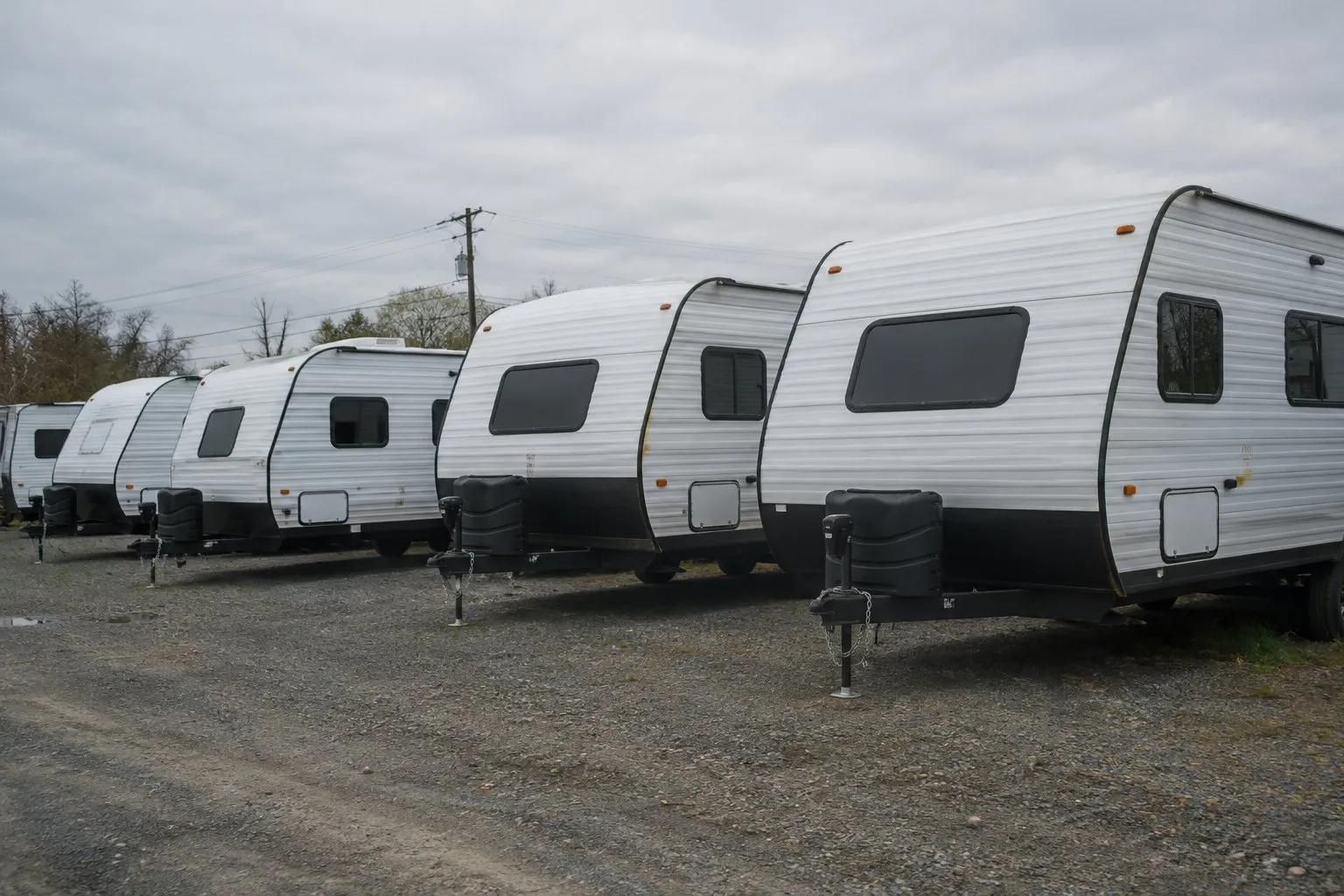
Four numbers on the trailer label
The weight label of a new travel trailer lists a handful of figures. Jayco's label, for example, shows the actual UVW of that unit including factory-installed options, the GVWR and the cargo capacity.
- UVWDry weightThe trailer as built at the factory. No cargo, fresh water, propane, occupants, options or dealer add-ons.Weight label, brochure
- CCCCargo capacityWhat you may add: water, propane, gear, batteries, dealer accessories. Equals GVWR minus UVW.Weight label
- GVWRLoaded maximumThe most the trailer may weigh with everything on board.Weight label
- HWHitch weightThe part of the trailer's weight carried on the hitch. Brochure values are usually dry.Brochure; weigh it loaded
The names vary by maker. Jayco calls the cargo figure GCCC, gross cargo carrying capacity; other makers write CCC. "Dry weight" and UVW mean the same thing in Jayco's definition.
What dry weight leaves out
Jayco's definition of UVW excludes cargo, fresh water, propane, occupants, options and dealer-installed accessories. It does include so-called forced options, packages every unit of a model gets at the factory. Everything you add after that comes out of the cargo capacity: Jayco names water, waste water, propane, people, personal items and dealer accessories as things that use it up.
Those are not small items on a camper. Equal-i-zer's installation steps list what has to be on board when you set up the hitch: propane, water, ATVs, generators and any other cargo. A trailer packed for a trip is a different trailer from the one in the brochure. Equal-i-zer makes the same point about tongue weight: the brochure figure is usually dry and leaves out batteries and propane tanks.
GVWR: the ceiling, not an estimate
GVWR is a limit, not a measurement. Jayco defines it as the maximum permissible weight of the RV, UVW plus passengers, personal items, cargo, fluids, options and dealer accessories. Jayco's advice is to not exceed it and to weigh the trailer after loading for camping to make sure.
Two more limits sit underneath it. Each axle has its own rating (GAWR), and Jayco notes you can be under the GVWR and still over an axle rating, depending on how you load. The tow vehicle has its own GVWR too; Ford counts the trailer's tongue load as part of the truck's cargo weight. Both are covered on GVWR and GCWR.
Which number goes where
| You are checking | Use | Source |
|---|---|---|
| Truck's towing capacity | Trailer GVWR, or the weighed trip weight | Jayco; Ford's maximum loaded trailer weight is the weight of a fully loaded trailer |
| Hitch's maximum trailer weight | Trailer GVWR; if only UVW and CCC are listed, add the two | Equal-i-zer FAQ |
| Hitch's tongue weight rating | Loaded tongue weight, plus cargo behind the truck's rear axle | Equal-i-zer FAQ |
| Expected tongue weight before weighing | 10 % of the loaded trailer (Ford) or 10–15 % (Equal-i-zer), on the loaded weight | Ford 2026 guide; Equal-i-zer FAQ |
Ford's own example: a 5,000 lb conventional trailer times 0.10 gives 500 lb of tongue load. That 5,000 lb is the loaded trailer. Run the same rule on the dry weight and every number downstream comes out too low, from the spring bar rating to the receiver check.
How heavy travel trailers get
There is no average that fits your trailer, so we give classes instead of a guess. Ford's 2026 guide groups trailers by gross trailer weight:
- Class II, 2,001 to 3,500 lb: large folding camping trailers and single-axle trailers up to about 18 feet.
- Class III, 3,501 to 5,000 lb: dual-axle or large single-axle travel trailers.
- Class IV, over 5,000 lb: the largest travel trailers and fifth wheels made for recreation.
Ford adds that conventional travel trailers usually run 12 to 35 feet long and are normally towed with a weight-distributing hitch, depending on weight. For the trailer you own, read the label and then weigh it packed. How to do that at a truck stop is on how to weigh your truck and trailer.
What this means for the hitch
Size the weight distribution hitch on the loaded trailer. The tongue rating has to cover the packed tongue plus anything heavy in the truck bed behind the rear axle; the trailer rating has to cover the GVWR. The hitch size guide shows how the classes step up, and the camper weight distribution hitch page has our kit picks for campers up to 1,000 lb of tongue weight. Brochure numbers are a starting point for the first conversation at the dealer, nothing more; the trip to the lake is covered on towing a travel trailer.
Questions at the scale house
Q01What is the difference between UVW and GVWR?
UVW, the unloaded vehicle weight, is the trailer as built at the factory. Jayco's definition leaves out cargo, fresh water, propane, occupants, options and dealer-installed accessories. GVWR is the maximum permissible weight with all of that on board. The room between the two is the cargo carrying capacity.
Q02How much does a travel trailer weigh?
There is no single number, which is why the label matters. Ford's 2026 guide sorts trailers by gross trailer weight: dual-axle or large single-axle travel trailers fall in its 3,501 to 5,000 lb class, and the largest travel trailers sit over 5,000 lb. Your trailer's own weight label lists its UVW and GVWR.
Q03Is the hitch weight on the brochure the loaded tongue weight?
Usually not. Equal-i-zer notes that the tongue weights trailer makers list are typically dry values that leave out items like batteries and propane tanks. The real tongue weight rises as you load and depends on where the cargo sits, so weigh it loaded before you pick spring bars.
Q04Is towing capacity compared with the dry weight or the GVWR?
With the GVWR. Jayco tells you to compare your tow vehicle's towing capacity with the trailer's GVWR and to make sure the vehicle is adequately sized and equipped for it. Ford's maximum loaded trailer weight is, by its own definition, the weight of a fully loaded trailer.
Weighed against
Next stop
- GVWR and GCWRTermsGVWR, GCWR and GAWR explained: what each towing weight rating limits, where the door label lists them, and how tongue weight counts against them.
- What size weight distribution hitch do I need?Straight answerWhat size weight distribution hitch do I need? Size the bars by loaded tongue weight plus rear cargo, then check trailer GVWR and the receiver label.
- For campersBuying sheetWeight distribution hitch for a camper or travel trailer: size it on the packed tongue, not the brochure, and pick a kit that comes ready to tow.
- Towing a travel trailerHow it worksTowing a travel trailer for the first time: the weights that must fit, how to load, brakes and chains, and how to drive, back up and park the rig.
- Weigh truck and trailerShop stepsHow to weigh your truck and trailer on a three-platform truck-stop scale: where each axle goes, what the ticket shows, which label to check.
- Eaz-LiftMaker fileEaz-Lift weight distribution hitch from Camco: how the Elite and the ReCurve R3 differ, what the R3 ratings mean, and how to grease and store it.
Who weighs it up
weightdistributionhitch.com Editorial Desk
Towing set-up & hitch picks
We are the editorial desk at weightdistributionhitch.com. For every hitch we pull the tongue weight and trailer weight ratings, the shank and ball size, the bracket spacing and the torque values out of the maker's install sheet, then set them against the receiver label and the tow vehicle's own towing guide.
- — Ratings copied from the install sheet or part page, with document name
- — Set-up targets taken from the truck maker's towing guide, not a rule of thumb
- — "Not stated by maker" wherever a rating, surge-brake note or warranty term is missing