Weight distribution hitch for dump, utility and enclosed trailers
Buying sheetReading span: 5 minchecked November 28, 2026by the editorial desk
A weight distribution hitch for a dump trailer, utility trailer, cargo trailer or car hauler is sized on the loaded tongue, and on work trailers that number swings from trip to trip. Up to 1,500 lb on the tongue, the CURT 17422 trunnion hitch handles the range; for tongues of 800 to 1,000 lb, the CURT 17062 round bar.
On the ticket
Weigh the trailer loaded the way you haul it. Over 1,000 lb on the tongue, take the bigger class: the CURT 17422 is rated to 1,500 lb tongue and 15,000 lb trailer. Lighter utility and enclosed trailers with 800 to 1,000 lb on the tongue fit the CURT 17062. Both come with sway unit, shank and ball.
Paid links on this sheet: Links with a * go to Amazon, and a purchase through them pays this site a commission; your price stays the same. As an Amazon Associate I earn from qualifying purchases. How the links pay
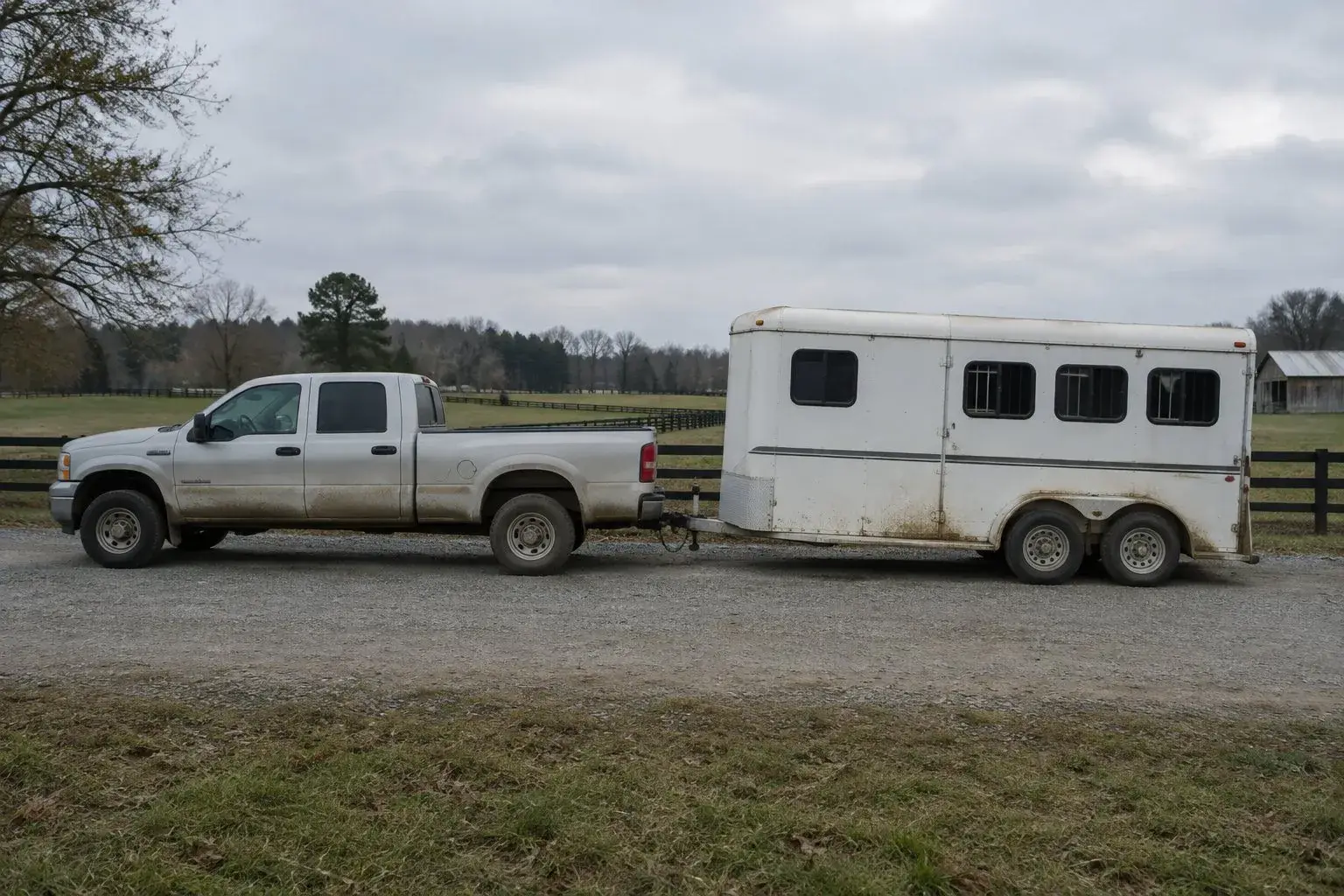
Work trailers change weight every trip
A camper leaves home loaded about the same way every time. A dump trailer does not. It runs empty to the quarry and comes back full; a car hauler carries a sedan one day and a pickup the next; an enclosed cargo trailer goes out with tools and comes back with whatever you picked up. The hitch has to fit the heaviest of those trips, and its set-up has to fit the trip you are on.
Two rules from the makers frame the choice:
- Size on the loaded tongue. Equal-i-zer asks for a tongue rating above your loaded tongue weight, plus any cargo behind the truck's rear axle, and a trailer rating above the trailer's GVWR.
- Set up for the load you carry. Husky notes that adding, moving or unloading cargo may require a new set-up, and Equal-i-zer asks you to verify the adjustment after loading for each trip.
How much tongue a work trailer puts on the ball
Featherlite's owner's manual gives rules of thumb by hitch type: 10 to 15 % of the loaded trailer on a ball hitch for large trailers, and 6 to 10 % for smaller utility and cargo trailers. A gooseneck puts 20 to 25 % on a ball in the truck bed and needs no weight distribution hitch. Featherlite also names both ends of the risk: too little tongue weight hurts sway stability, too much hurts the tow vehicle's handling.
Treat the percentages as a start, not a measurement. The tongue weight percentage page explains the range, and how to weigh your truck and trailer gets you a real number from a scale.
Loading so the tongue lands where it should
Featherlite's loading steps for enclosed trailers carry over to most work trailers:
- Couple first, then load. The tongue of a bumper pull trailer can rise during loading, before the cargo is in place.
- About 60 % of the cargo in the front half, balanced left to right, and tied down. Featherlite warns that uneven left and right loading can cause tire, wheel, axle or structural failure.
- Keep the weight low. Heavy items on the floor and over the axles.
Andersen warns about the opposite case: trailers loaded heavy at the rear, like toy haulers, can lose sway control. If your loaded tongue reads low on the scale, move the load forward before you add bar tension; the 60/40 trailer loading rule shows why.
Two CURT hitches for work trailers
| CURT 17422 | CURT 17062 | |
|---|---|---|
| Tongue weight | Up to 1,500 lb | 800–1,000 lb |
| Max trailer weight | 15,000 lb | 8,000–10,000 lb |
| Spring bars | Square trunnion, 28-3/8 in | Round, forged steel |
| Sway control | Friction unit #17200, included | Friction unit #17200, included |
| Shank | 2 in, flips for drop or rise; 2-1/2 in sold separately | 2 in, flips for drop or rise; 2-1/2 in sold separately |
| Ball | 2-5/16 in, pre-torqued, included | 2-5/16 in, pre-torqued, included |
| Receivers | Class 3, 4 and most class 5 | Most class 3, 4 and 5 |
CURT 17422: the heavy work trailer pick
If your loaded dump trailer or car hauler puts more than 1,000 lb on the ball, you need a bigger class. CURT rates the 17422 to 1,500 lb tongue and 15,000 lb trailer, with short 28-3/8 inch trunnion bars that enter the head from the side. Sway unit, 2 inch shank and ball come in the box. If your truck has a 2-1/2 inch receiver, plan the separate shank. It sits at the top of this page; the trunnion bar weight distribution hitch page explains the bar style.
CURT 17062: for lighter utility and enclosed trailers
An enclosed cargo trailer or a loaded utility trailer with 800 to 1,000 lb on the tongue fits the CURT 17062. Its round bars enter the head from below, the friction sway unit and the ball come with it, and CURT's part page says no drilling is required. Under 800 lb, the 17062 is outside its stated range; look at the lightweight weight distribution hitch page instead.
CURT 17062 Round Bar
Round-bar hitch, friction sway unit and a pre-torqued 2-5/16" ball in one box, for 800 to 1,000 lb of tongue weight.
Why it's on this ticket: Round bar hitch for utility and enclosed trailers with 800 to 1,000 lb of loaded tongue weight, with sway unit and pre-torqued ball in the box.
Fits: Travel and utility trailers with a loaded tongue weight of 800 to 1,000 lb and a 2" receiver

- Tongue weight (decides it)
- 800–1,000 lb
- Max trailer weight
- 8,000–10,000 lb
- Spring bars
- Round bar
- Sway control
- Friction unit #17200 (included)
- Shank
- 2" (flips for drop or rise)
- Ball
- 2-5/16", pre-torqued, included
- Surge brakes
- No (listing)
- Hitch, sway control unit #17200 and a pre-torqued 2-5/16" ball come in the box
- Grease zerk in the head for the spring bar sockets
- 2" shank flips for drop or rise; the head also takes CURT's 2-1/2" shank
- Sway control is a bolt-on friction unit, not built into the head
- Tongue weight range stops at 1,000 lb
- Not for surge brakes (stated in the listing); the hitch needs no drilling, but the included sway unit's plate is drilled into the A-frame
Pick by your numbers
If your loaded tongue is over 1,000 lb and up to 1,500 lb → CURT 17422 Trunnion 15K
Amazon price: View(paid link to Amazon, opens in a new tab)Ad · paid link · check price & delivery on AmazonAd · paid link · price as of ·If your loaded tongue sits between 800 and 1,000 lb → CURT 17062 Round Bar
Amazon price: View(paid link to Amazon, opens in a new tab)Ad · paid link · check price & delivery on AmazonAd · paid link · price as of ·If your loaded tongue is over 1,500 lb
If your tongue is under 800 lb
Frame, tongue and receiver checks before you buy
Work trailers are built differently from campers, so check three things on yours:
- Tongue shape. Most kits mount brackets on an A-frame. Husky needs a Pole Tongue Adapter for a straight tongue; Andersen says its hitch works on single-pole tongues without a special cross member.
- Frame size. Bracket kits are made for a range of frame heights. Husky's Center Line TS fits frames 4 to 8 inches tall, for example. Measure yours before you order.
- The receiver label. It carries separate weight-carrying and weight-distributing ratings. Featherlite's hitch class table shows the step: a class 3 weight-carrying hitch tops out at 5,000 lb, its weight-distributing rating at 7,500 lb. Your own label and vehicle guide set the real limit.
Do not adapt the hitch to fit. Equal-i-zer's manual says never to cut, weld, grind, bend or modify hitch components, and Husky says the same about its system.
When to unhook the bars
Job sites and dump sites are where a weight distribution hitch is most at risk. Equal-i-zer's manual says never to tow with the hitch engaged on rough roads or through deep ditches and dips, and to disengage it before towing or backing across a big change in grade. On a rough site road, that means unhooking the bars for that stretch. The weight distribution hitch with sway control page covers what the friction unit does at speed.
One more point for business use: some warranties change. Husky cuts its limited lifetime warranty to 90 days for commercial use. Read your hitch's warranty terms if the trailer earns money.
Towing horses instead? The horse trailer weight distribution hitch page covers bumper pull and V-nose trailers.
CURT 17422 Trunnion 15K: hitch it or leave it?
TKT 03+ Hitch it if …
- If your loaded tongue is over 1,000 lb and up to 1,500 lb
- If you want sway unit, shank and ball in one box
- If your receiver label allows the weight-distributing load you plan
− Leave it if …
- If your loaded tongue stays under 1,000 lb (the CURT 17062 fits better)
- If you need a 2-1/2 in shank and don't want to buy it separately
- If your trailer has surge brakes and you need the maker to confirm the fit
Numbers match? Check the CURT 17422 Trunnion 15K listing for the exact rating and what is in the box.
Amazon price: View on Amazon(paid link to Amazon, opens in a new tab)Ad · paid link · check price & delivery on AmazonAd · paid link · price as of ·Questions at the scale house
Q01Does a utility trailer need a weight distribution hitch?
Only when it is heavy enough for your truck guide to call for one, or when the loaded tongue goes past what your receiver allows without weight distribution. Many small utility trailers stay far below that. Featherlite's owner's manual plans with only 6 to 10 % of the loaded trailer on the tongue for smaller utility and cargo trailers.
Q02Can I use a weight distribution hitch on a trailer with a straight tongue?
Some kits need an adapter. Husky's round bar manual is drawn for an A-frame tongue and says a straight or pole tongue needs its Pole Tongue Adapter to mount the chain lift brackets. Andersen says its hitch needs no special cross member for single-pole tongues. Check your kit's manual before you buy.
Q03Should I leave the spring bars on while I dump a load or drive on a job site?
No. Equal-i-zer's manual says never to tow with the hitch engaged on rough roads or through deep ditches and dips, because the strain on the arms and head can cause fatigue or failure. It also asks you to disengage the bars before towing or backing across a big change in grade, such as a steep site entrance.
Weighed against
- [1]CURT, part 17422 trunnion bar weight distribution hitch
- [2]CURT, part 17062 round bar weight distribution hitch
- [3]Featherlite Trailers, enclosed trailers owner's manual (PDF)
- [4]Equal-i-zer 4K owner's manual (PDF)
- [5]Husky Towing, round bar kits 31421 to 31425 instructions, REV. 10 (PDF on SEMA Data)
- [6]Andersen, weight distribution hitch FAQ
Next stop
- Heavy dutyBuying sheetHeavy duty weight distribution hitch for tongues over 1,000 lb: 12K, 14K, 15K and 20K classes, the 2-1/2 inch shank question and the kit to start with.
- Round bar hitchesBuying sheetRound bar weight distribution hitch: our CURT 17062 pick, two alternatives, who round bars suit, and when trunnion bars are the better call.
- How much tongue weight should a trailer have?Straight answerHow much tongue weight should a trailer have? 10 to 15 % of its loaded weight, Ford plans with 10 %. What is acceptable and how to fix it.
- Trunnion bar hitchesBuying sheetTrunnion bar weight distribution hitch: what square side-entry bars change, the CURT 17422 we pick for 1,000 to 1,500 lb tongues, and the fit.
- For horse trailersBuying sheetWeight distribution hitch for a horse trailer: why only bumper pulls use one, how a live load changes the tongue, and the hitch for V-nose trailers.
Who weighs it up
weightdistributionhitch.com Editorial Desk
Towing set-up & hitch picks
We are the editorial desk at weightdistributionhitch.com. For every hitch we pull the tongue weight and trailer weight ratings, the shank and ball size, the bracket spacing and the torque values out of the maker's install sheet, then set them against the receiver label and the tow vehicle's own towing guide.
- — Ratings copied from the install sheet or part page, with document name
- — Set-up targets taken from the truck maker's towing guide, not a rule of thumb
- — "Not stated by maker" wherever a rating, surge-brake note or warranty term is missing