Weight carrying hitch vs weight distribution hitch: the difference
Side by sideReading span: 4 minchecked November 28, 2026by the editorial desk
Weight carrying hitch vs weight distribution hitch, in one sentence: a weight-carrying hitch puts the whole tongue load on the truck's receiver and rear axle, while a weight-distributing hitch adds spring bars that move part of it to the front axle and the trailer axles. That is why the receiver label allows more with the second, and why Ford requires it for heavier trailers.
On the ticket
A weight-carrying hitch is a plain ball mount: simple, no set-up, but the tongue load stays on the rear of the truck, so the receiver allows less. A weight-distributing hitch adds spring bars and moves part of the load forward. The receiver then takes its higher rating, 1,400 lb of tongue on the 2026 F-150 instead of 500 lb. The truck's tow rating stays the same.
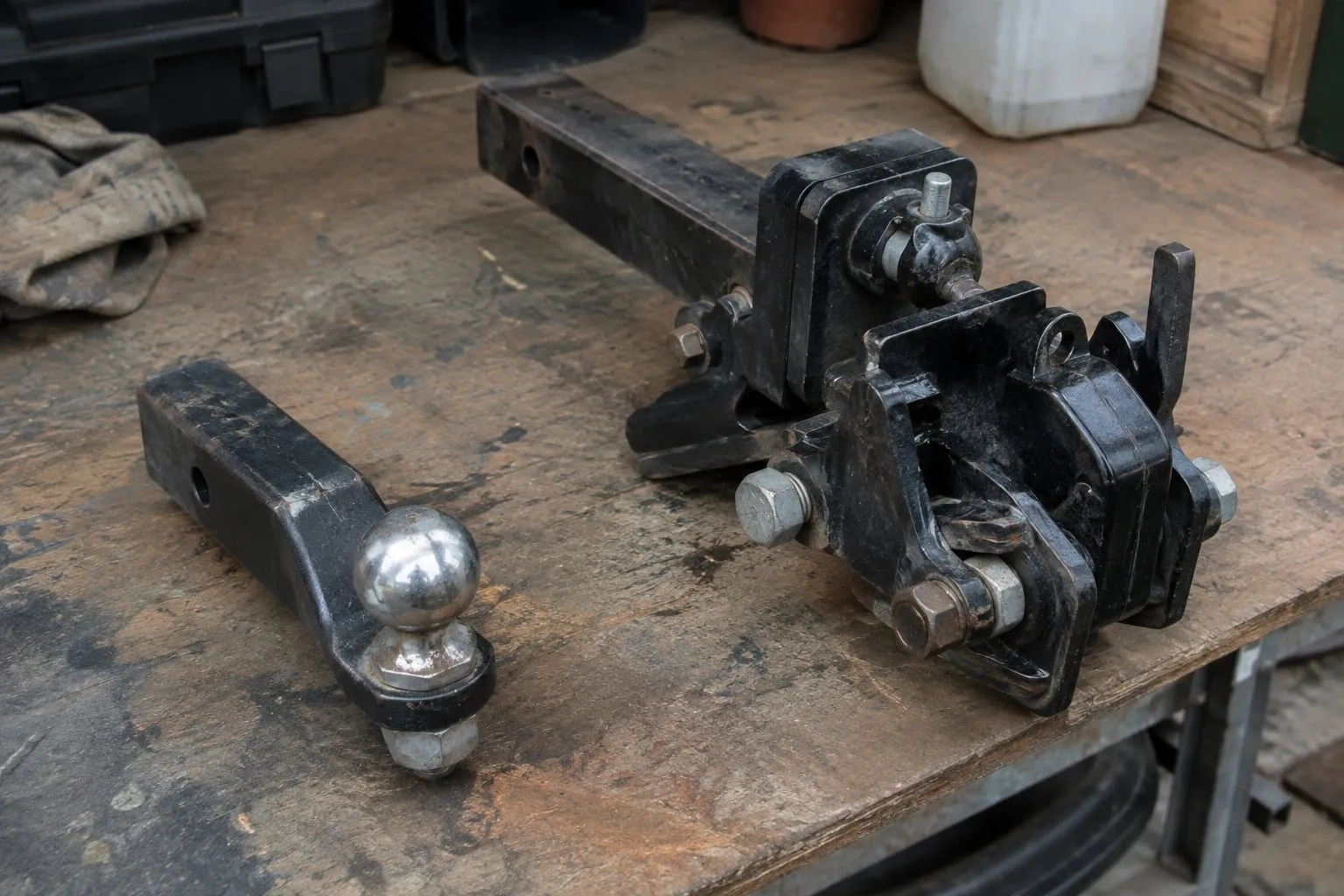
Two hitch styles, one receiver
Both hitches slide into the same square receiver tube. The difference is what happens behind it. A weight-carrying hitch is the plain ball mount most trucks come with: a shank, a platform and a ball. The trailer tongue presses down on it, and that load sits on the receiver and the truck's rear axle. Ford's guide calls it the hitch commonly used for small and medium trailers.
A weight-distributing hitch adds a bigger head and two spring bars. Ford describes chains being pulled up and tightened to bend the bars upward, which lifts some of the weight from the rear wheels and transfers it to the other wheels of the truck and trailer. Equal-i-zer's manual puts the purpose the same way: moving load back onto the front steering axle keeps that axle gripping the road. The lever is drawn on how a weight distribution hitch works.
Point by point
| Weight-carrying | Weight-distributing | |
|---|---|---|
| What it is | Ball mount: shank, platform, ball | Shank, head, ball, two spring bars, frame brackets |
| Tongue load goes to | The receiver and the truck's rear axle | Partly to the front axle and the trailer axles |
| Receiver limit, 2026 F-150 | 5,000 lb trailer, 500 lb tongue | 13,500 lb trailer, 1,400 lb tongue |
| Truck's tow rating | Same | Same |
| Set-up | Ball height only | Ball height, head tilt and bar tension to the truck maker's target |
| Hook-up each trip | Couple and go | Couple, lift the bars onto the brackets, check the hardware |
| Sway control | Not included; add-on friction bars exist | Usually included or built in |
| Typical trailers in Ford's guide | Folding campers and small trailers | Most travel trailers, depending on weight |
Two rows catch people out. The receiver limit rises with spring bars, but the truck's own rating does not: Ford's guide states that trailer towing values are the same for weight-carrying and weight-distributing hitches on its Super Duty pickups. And the receiver numbers come from the label on your own receiver, which Ford says shows both pairs. How to read it is on hitch tongue weight rating.
Where Ford draws the line
Ford's guide sorts trailers into four classes and says which hitch each needs:
| Class (Ford) | Gross trailer weight | Hitch |
|---|---|---|
| I | Up to 2,000 lb | Weight-carrying hitch |
| II | 2,001 to 3,500 lb | Weight-distributing not required unless specified for a vehicle |
| III | 3,501 to 5,000 lb | Weight-distributing not required unless specified for a vehicle |
| IV | Over 5,000 lb | Most applications require weight-distributing or 5th-wheel |
The hitch styles page of the same guide sums it up: a weight-distributing hitch is required for certain Class III and all Class IV applications. For the F-150, Ford makes it concrete: do not exceed 5,000 lb of trailer without a weight-distribution system. Class names on receivers vary between sellers, so treat them as a rough size and see hitch classes for the common ranges.
Pick weight-carrying if …
- your loaded trailer and tongue stay under the weight-carrying pair on the receiver label and under any line in your vehicle guide,
- the truck sits level enough when hitched that the front does not rise visibly,
- you tow a small, light trailer, such as a folding camper, and want to couple and go.
Pick weight-distributing if …
- your trailer or tongue goes past the weight-carrying pair, or your vehicle guide calls for it,
- the front of the truck rises when the tongue drops on the ball,
- you tow a travel trailer of the size Ford's guide normally pairs with a weight-distributing hitch.
The second choice brings a duty with it. A weight-distributing hitch has to be set to a target, and Equal-i-zer's manual warns both ways: too little tension leaves steering and braking control weak, more than 100 % costs traction. Ford recommends 50 % front axle load restoration. The routine is on how to set up a weight distribution hitch, and whether your rig needs one at all is on when you need a weight distribution hitch.
The myth to drop
Swapping a ball mount for a weight distribution hitch does not raise what your truck may tow. It lets the receiver use its higher rating, nothing more. Payload, GVWR, rear axle rating and the maximum trailer weight in the towing guide stay where they were. The full explanation is on does a weight distribution hitch increase towing capacity. For most travel trailers with 800 to 1,000 lb on the tongue, the hitch to start with is on best weight distribution hitch.
Questions at the scale house
Q01What is the difference between a weight-carrying and a weight-distributing hitch?
Where the tongue load ends up. Ford's guide describes a weight-carrying hitch as one commonly used for small and medium trailers, carrying the tongue through the bumper and frame. A weight-distributing hitch works with the receiver to distribute tongue load to all towing vehicle and trailer wheels, using spring bars bent upward by chains. Because of that, the receiver label allows a higher trailer and tongue weight with it.
Q02Is a weight distributing hitch the same as a weight distribution hitch?
Yes. Ford's towing guide uses weight-distributing hitch, while hitch makers such as Equal-i-zer and CURT mostly say weight distribution hitch. Some sellers also say load leveling hitch. All three mean a hitch with spring bars that moves part of the tongue load forward.
Weighed against
Next stop
- Hitch tongue ratingHow it worksTrailer hitch tongue weight rating explained: the two limits on the receiver label, why the truck and the ball have their own, and which one wins.
- Do I need a weight distribution hitch?Straight answerDo I need a weight distribution hitch? Your vehicle guide and receiver label decide. Ford sets the F-150 line at 5,000 lb; here is how to find yours.
- Hitch classesHow it worksClass 3 hitch, class 4 and class 5: receiver sizes, typical ratings, how weight distribution changes them, and why the label beats the class.
- How it worksHow it worksHow does a weight distribution hitch work? Spring bars under tension lever part of the tongue load to the front axle and trailer axles.
- Does a weight distribution hitch increase towing capacity?Straight answerDoes a weight distribution hitch increase towing capacity? No. It unlocks the receiver's higher rating, while your truck's tow rating stays the same.
Who weighs it up
weightdistributionhitch.com Editorial Desk
Towing set-up & hitch picks
We are the editorial desk at weightdistributionhitch.com. For every hitch we pull the tongue weight and trailer weight ratings, the shank and ball size, the bracket spacing and the torque values out of the maker's install sheet, then set them against the receiver label and the tow vehicle's own towing guide.
- — Ratings copied from the install sheet or part page, with document name
- — Set-up targets taken from the truck maker's towing guide, not a rule of thumb
- — "Not stated by maker" wherever a rating, surge-brake note or warranty term is missing