Weight distribution hitch maintenance: grease, bolts and wear parts
Shop stepsReading span: 5 minchecked November 28, 2026by the editorial desk
Weight distribution hitch maintenance is a short routine before every trip: clean and grease the friction surfaces in the head and the hitch ball, keep grease off the parts that work by friction, check every bolt, and look over bars and brackets for wear. What exactly gets grease depends on your hitch, so the maker's manual has the last word.
On the ticket
Before each trip, clean the head and grease the spots your maker names: on an Equal-i-zer the friction surfaces of the head and sockets plus the ball, on a Reese Round Bar Pro the ball and spring bars, on a CURT 17062 the grease zerk. Do not grease Equal-i-zer L-brackets or a friction sway bar. Check all bolts and look for wear.
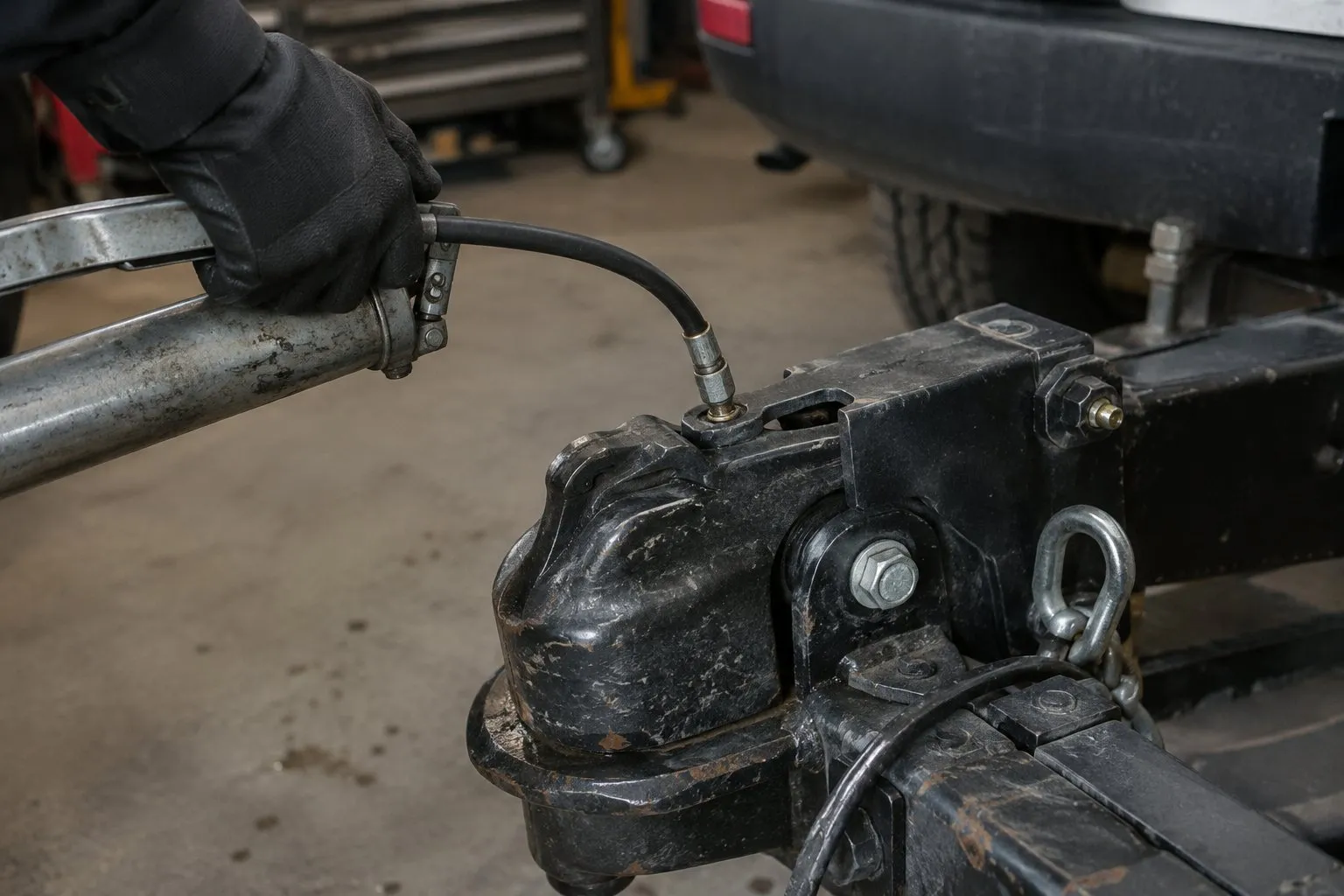
A weight distribution hitch has few moving parts. The spring bars sit in sockets in the head and rest on brackets on the trailer frame, and on many designs the friction at those points is part of the sway control. Keep the right surfaces clean and greased, keep everything else tight, and look for wear before each trip. Equal-i-zer puts it plainly: a clean, maintained hitch performs better and wears less.
Where the grease goes, maker by maker
There is no single rule, because the designs differ. Some hitches need grease in the head, some on the bars, one needs none at all.
| Hitch | Grease here | Keep grease off | How often |
|---|---|---|---|
| Equal-i-zer | Friction surfaces of head and sockets, where the sockets rub the top and bottom plates; the hitch ball | Swing arms and L-brackets | Before each trip |
| Reese Round Bar Pro | Hitch ball and spring bars; ball mount ends of the bars at hook-up | (not stated) | Every towing day |
| CURT 17062 | Grease zerk in the head, at the spring bar mounting point | (not stated) | Not stated; CURT says grease must be applied to the zerk to lubricate |
| Andersen chain-free | Nothing; lubricant only on the rub points if the chains squeal | (not stated) | Inspect the cone before each tow |
Two things stay dry. Equal-i-zer says its L-brackets need no grease on any model, and its manual tells you not to lubricate the swing arms or L-brackets. A friction trailer sway bar is its own case; that page explains what CURT asks for its slide bar.
What to use: Equal-i-zer asks for a good quality multi-purpose or bearing grease; Reese names a heavy grease such as fiber-type wheel bearing grease. Wipe the old grease off before you add new. Reese warns that old grease hardens inside the ball mount if you leave it.
The ten-minute routine before a trip
Clean the head and ball
Wipe dirt, road grit and old grease from the head, the spring bar sockets and the hitch ball. Reese asks you not to let dirt or stones lodge between the spring bar and the head.Grease the named spots
Grease the surfaces from the table above, and pump the zerk if your head has one. Leave L-brackets and friction sway bars dry.Check every bolt
Equal-i-zer says to check all nuts and bolts before each trip and tighten them if needed. Make sure the hitch pin, clips and spring bar pins are in place.Look for wear
Equal-i-zer asks you to check for damage or abnormal wear at the start of each trip; Reese names the spring bars and their brackets in particular. Replace worn parts before you tow.Hook up and look again
Hitch up as the hook-up guide shows, then check that safety chains, breakaway cable and lights are connected.
Reese adds one wear signal worth knowing: excessive wear in the head sockets can point to overload or to too little grease. If the sockets look chewed, weigh the tongue again before you blame the parts; the tongue weight measuring guide shows how.
Bolt torque: use your hitch's own table
Torque values are not universal. They change with bolt size, and even the same maker lists different values for different model ranges.
| Bolt | Equal-i-zer 4K | Equal-i-zer 6K–14K | Reese Round Bar Pro |
|---|---|---|---|
| Shank bolts (head to shank) | 180 ft-lb | 320 ft-lb (3/4 inch) | 260 ft-lb (3/4 inch head bolts) |
| Socket bolts | 60 ft-lb min, 100 max | 60 ft-lb min before each towing session | (not stated) |
| L-bracket bolts or nuts | 45 ft-lb | 70 to 75 ft-lb | 80 ft-lb |
| Frame or link plate bolts | 27 ft-lb (table), 65 ft-lb (install step) | 65 ft-lb | 130 ft-lb |
The 4K manual gives two values for the link plate bolts: 65 ft-lb in the installation step and 27 ft-lb in its torque table. Ask Equal-i-zer which applies before you tighten. Equal-i-zer also says not to use an impact wrench on the link plate or L-bracket bolts. Reese asks you to check the ball mount set screw after the first day of towing, and the 6K–14K manual says the angle set bolt can loosen during break-in, so check it before each towing day.
Paint, rust and storage
Equal-i-zer asks you to store the hitch out of the weather and touch up the finish with a rust-inhibiting spray paint, but never paint over the warning stickers; worn stickers are replaced free. Reese recommends taking the hitch out of the receiver whenever you are not towing, so the head sockets stay clean and the hitch does not strike driveway ramps. The storage page covers the off-season.
When the hitch starts talking
Noise is often the first sign that the routine slipped. Equal-i-zer says a clean, maintained hitch reduces towing noise, and offers sway bracket jackets to quiet the ride and cut wear on the L-brackets. Andersen says its hitch should not make loud noises at all, and points first to cleaning the cone and the tapered part of the ball housing. Noises that stay after cleaning and greasing are covered on the noise page; worn parts are on weight distribution hitch parts.
Questions at the scale house
Q01How often should I grease a weight distribution hitch?
Before each trip on most designs. Equal-i-zer asks for grease on the friction surfaces of the head and sockets and on the hitch ball before each trip. Reese recommends heavy grease on the ball and spring bars of its Round Bar Pro every towing day. Andersen's chain-free hitch needs no grease at all. Your hitch manual decides.
Q02What grease do I use on a weight distribution hitch?
The makers name everyday greases. Equal-i-zer asks for a good quality multi-purpose or bearing grease and sells its own lubricant. Reese names heavy lubrication such as fiber-type wheel bearing grease. Clean off the old grease first: Reese warns not to let it harden inside the ball mount.
Q03What torque do the bolts of a weight distribution hitch need?
It differs by maker and model, so use your manual's table. Equal-i-zer's 4K manual lists 180 ft-lb for the shank bolts and 60 to 100 ft-lb for the socket bolts; its 6K to 14K manual names 320 ft-lb for the 3/4 inch shank bolts. Reese torques the Round Bar Pro head bolts to 260 ft-lb.
Weighed against
- [1]Equal-i-zer 4K owner's manual (PDF): maintenance and care, torque table
- [2]Equal-i-zer 6K–14K owner's manual, regular maintenance
- [3]Equal-i-zer 6K–14K owner's manual, installation guide (torque values)
- [4]Reese, Round Bar Pro 49911/49912/49913 installation instructions (PDF)
- [5]CURT, part 17062 round bar weight distribution hitch
- [6]Andersen, weight distribution FAQ
Next stop
- Hook-up routineShop stepsHow to use a weight distribution hitch on every trip: couple, lift with the jack, hook the bars, lower, connect chains and wiring. Unhooking too.
- Hitch noiseFault and fixWeight distribution hitch noise usually means dry friction points or binding chains. Where each squeak comes from and what to grease, or never grease.
- Storing the hitchShop stepsWeight distribution hitch storage: take it off the receiver, clean and touch up the steel, unload any sway clamp and keep the bars paired and dry.
- Replacement partsBuying sheetWeight distribution hitch parts: which shank, brackets, spring bars, washers, pins and sway bar to buy, and why each part has to match your hitch.
- Parts explainedHow it worksParts of a weight distribution hitch, from shank and head to spring bars, brackets, pins and sway control: what each one does and where you adjust it.
Who weighs it up
weightdistributionhitch.com Editorial Desk
Towing set-up & hitch picks
We are the editorial desk at weightdistributionhitch.com. For every hitch we pull the tongue weight and trailer weight ratings, the shank and ball size, the bracket spacing and the torque values out of the maker's install sheet, then set them against the receiver label and the tow vehicle's own towing guide.
- — Ratings copied from the install sheet or part page, with document name
- — Set-up targets taken from the truck maker's towing guide, not a rule of thumb
- — "Not stated by maker" wherever a rating, surge-brake note or warranty term is missing