Weight distribution hitch types: chain, bracket, cam, cone and projection
How it worksReading span: 5 minchecked November 28, 2026by the editorial desk
Weight distribution hitch types differ in two things: how the spring bars meet the trailer frame, and how the hitch fights sway. The common types are chain style with lift brackets, fixed brackets with built-in friction, cam systems, chain-free cone hitches and projection hitches. All of them move part of the tongue load forward; none of them changes the tongue weight.
On the ticket
Chain style hitches bend the spring bars up with chains on lift brackets and usually add a bolt-on friction sway bar. Fixed bracket hitches such as Equal-i-zer and CURT TruTrack hold the bars in brackets that also create sway friction. Reese's Dual Cam uses cams, Andersen uses chains and a friction cone with no steel bars, and ProPride projects the pivot point forward.
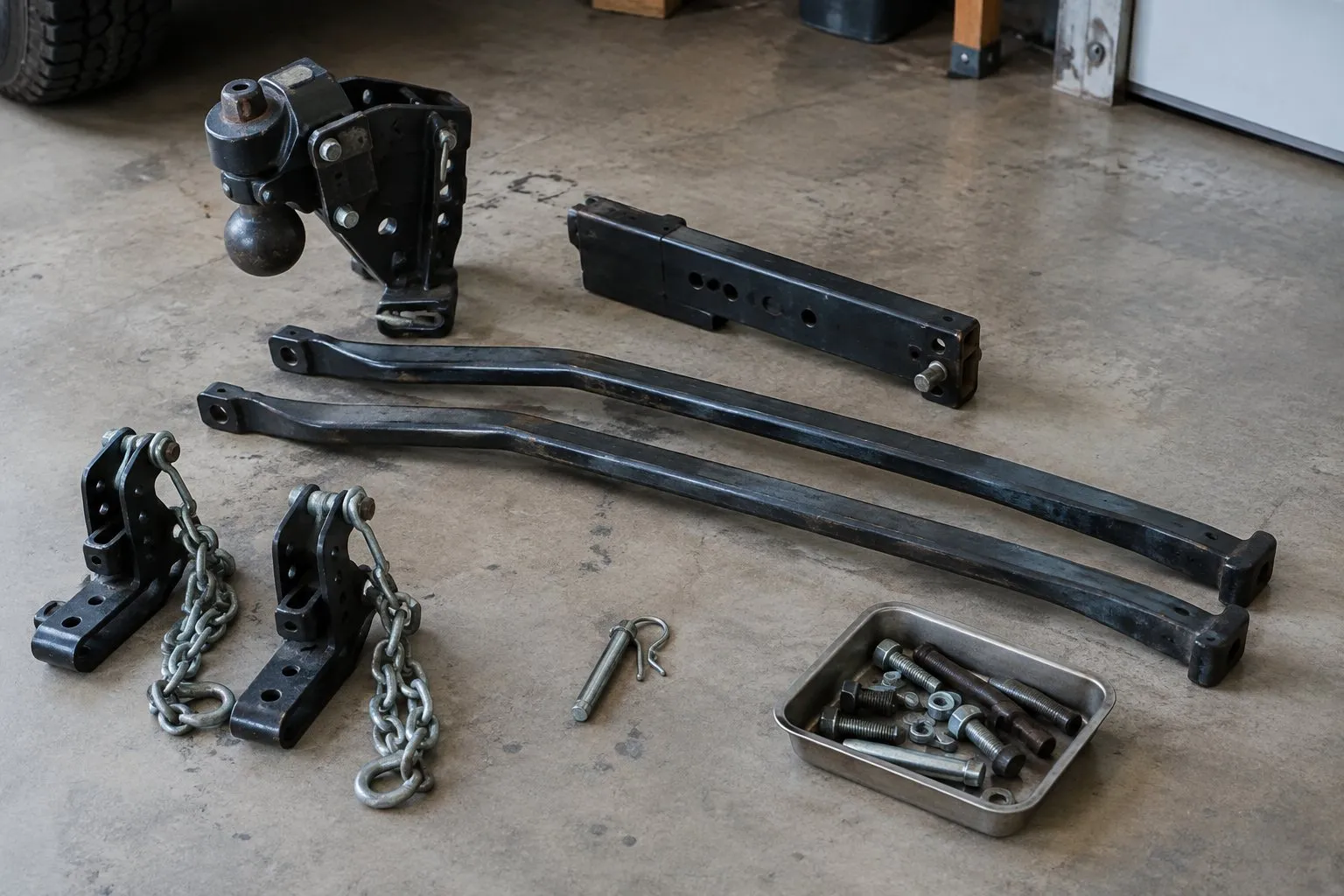
Two questions sort every hitch
Every weight distribution hitch does the same basic job: spring bars under tension lever part of the tongue load off the truck's rear axle, forward to the front axle and back to the trailer's axles. Ford's guide sums up the platform as a hitch used with a receiver to distribute tongue load to all towing vehicle and trailer wheels, required for certain Class III and all Class IV applications. The lever itself is explained on how a weight distribution hitch works.
What separates the types is two design choices:
- How the bars meet the trailer frame: chains on lift brackets, fixed brackets, cams, or no steel bars at all.
- How the hitch resists sway: a separate friction bar, friction built into the brackets, cams, a friction cone, or a projected pivot point.
The five layouts side by side
| Type | How tension is set | Sway control | Example |
|---|---|---|---|
| Chain style | Spring bars bent upward by chains on lift brackets | Usually a bolt-on friction bar | CURT 17062 (ships with the 17200 friction unit) |
| Fixed bracket | Bars rest on brackets bolted to the frame, no lift chains | Friction at the brackets, built in | Equal-i-zer 4-point, CURT TruTrack 4P |
| Cam | Spring bars hooked up to the trailer frame | Dual Cam system that hooks up with the bars | REESE Dual Cam II |
| Chain-free cone | Chains with urethane springs, no steel bars | Friction liner between ball and housing | Andersen |
| Projection | Maker's own head design | Pivot point projection | ProPride 3P, Hensley Arrow |
Chain style: the classic
Ford's description fits most hitches sold: equalizing arms run from the hitch to the A-frame, and lengths of chain are pulled up and tightened to bend the spring bars upward. You change the tension by hooking a different chain link and moving the lift bracket. Sway control is often a separate part here. The CURT 17062, for one, ships with a bolt-on trailer sway bar that mounts on tabs built into the hitch. "Chain style" says nothing about bar shape; it can be round bars or trunnion bars.
Fixed bracket: the bracket is the sway control
On fixed bracket hitches the bars sit on brackets bolted to the A-frame instead of hanging from chains. Equal-i-zer's spring arms slide onto L-brackets and are pinned with L-pins; Equal-i-zer calls the result integrated 4-point sway control, with sway control and weight distribution in one unit. CURT describes its TruTrack the same way: brackets use friction to resist lateral movement, replacing a separate sway control, and a spring and cam system builds pressure against sway and relaxes in turns. CURT also says four points of sway control work together. The trade-offs against a bolt-on bar are on integrated vs friction sway control.
Cam: sway control that hooks up with the bars
Reese's Dual Cam II pairs the spring bars with cams. Reese's product page for kit 66092 says hooking up the spring bars automatically hooks up the sway control, and that the stronger the sway force, the more the Dual Cam system works against it. Kit 66092 is listed at 8,000 lb with 800 lb tongue weight and a 28 inch bracket position.
Chain-free cone: no steel spring bars
Andersen's hitch skips the steel bars. Chains run from the hitch to the frame with red urethane springs at the ends to absorb energy, and the tongue weight pushes the ball into a friction liner inside the ball housing for sway control. Andersen says roughly 30 % of the weight moves forward and that the hitch can stay connected while backing up. It also says the hitch cannot be used with surge brakes. More on the Andersen brand page.
Projection: a different pivot
ProPride calls its 3P design pivot point projection and credits the idea to Jim Hensley's original Hensley Eliminator, followed by the Hensley Arrow. It offers the 3P in 600, 800, 1,000 and 1,400 lb options. ProPride's claims about sway are stronger than any other maker's. Equal-i-zer's manual, by contrast, says there is no 100 % qualitative measurement of trailer sway or sway control, so read every absolute claim about sway, from any maker, as marketing. More on the design is on ProPride and Hensley.
Bar shape is a separate choice
Round or trunnion is about the bars themselves, not about the layout. Round bars are round along their length; trunnion bars are square where they meet the head. CURT offers round bars on the 17062 and trunnion bars on the TruTrack 4P and the 17422. Ground clearance is the difference people notice most. The full comparison is on round bar vs trunnion, and each part of the kit, from shank to L-pin, is named on parts of a weight distribution hitch.
Picking a type
Size comes before type: weigh the loaded tongue and pick a hitch whose range covers it. Then let your trailer decide the rest. Surge brakes rule out some designs, including Andersen's. If you would rather not hook up a separate sway bar each time, look at the fixed bracket and cam types. Tight campsites and steep driveways call for checking clearance and the rules on backing up with a weight distribution hitch. If you just want the shortlist, the best weight distribution hitch page gives a short list sorted by tongue weight.
Questions at the scale house
Q01What is a chain style weight distribution hitch?
The classic layout. Ford's guide describes it: equalizing arms run from the hitch to the trailer's A-frame, and lengths of chain are pulled up and tightened to bend the spring bars upward. That lifts weight off the rear wheels and passes it to the other wheels. You set the tension by the chain link you hook and the bracket height.
Q02Which type of weight distribution hitch has no chains on the spring bars?
Fixed bracket designs. CURT says the TruTrack's adjustable brackets give fixed support, unlike spring bar chain models, and Equal-i-zer's spring arms slide onto L-brackets on the frame and are pinned there. Andersen's hitch is different again: it has chains but no steel spring bars, with urethane springs at the chain ends and a friction cone at the ball.
Q03What is a projection hitch?
A sway control hitch line that started with Jim Hensley. ProPride calls the design of its 3P pivot point projection and describes it as the latest version of his original Hensley Eliminator, after the Hensley Arrow. ProPride lists 600, 800, 1,000 and 1,400 lb options. It is not sold through Amazon; the design is covered on our ProPride and Hensley page.
Weighed against
- [1]Ford, 2026 RV & Trailer Towing Guide (hitch styles, p. 5)
- [2]CURT, part 17500 TruTrack 4P weight distribution hitch
- [3]Equal-i-zer 4K owner's manual (PDF): L-brackets, 4-point sway control
- [4]Andersen, weight distribution FAQ
- [5]REESE, 66092 weight distributing kit with Dual Cam II sway control
- [6]ProPride, 3P hitch home page
Next stop
- How it worksHow it worksHow does a weight distribution hitch work? Spring bars under tension lever part of the tongue load to the front axle and trailer axles.
- Round bar vs trunnionSide by sideRound bar vs trunnion: how the two spring bar styles fit the head, where the brackets go, which ratings exist, and why neither moves more weight.
- Built-in vs frictionHow it worksWeight distribution hitch with built-in sway control vs a bolt-on friction bar: how 4-point, cam, cone and bar designs resist sway.
- ProPride and HensleyMaker fileProPride hitch and Hensley Arrow: one inventor, two companies, the same projection idea. What each maker states, and where to buy instead of Amazon.
- Parts explainedHow it worksParts of a weight distribution hitch, from shank and head to spring bars, brackets, pins and sway control: what each one does and where you adjust it.
Who weighs it up
weightdistributionhitch.com Editorial Desk
Towing set-up & hitch picks
We are the editorial desk at weightdistributionhitch.com. For every hitch we pull the tongue weight and trailer weight ratings, the shank and ball size, the bracket spacing and the torque values out of the maker's install sheet, then set them against the receiver label and the tow vehicle's own towing guide.
- — Ratings copied from the install sheet or part page, with document name
- — Set-up targets taken from the truck maker's towing guide, not a rule of thumb
- — "Not stated by maker" wherever a rating, surge-brake note or warranty term is missing