Parts of a weight distribution hitch: what each piece does
How it worksReading span: 5 minchecked November 28, 2026by the editorial desk
The parts of a weight distribution hitch come in three groups: the shank and head at the truck, the two spring bars between them, and the brackets with chains or pins on the trailer frame. A sway control part rides along on most kits. Knowing the names makes the manual, the set-up and any parts order much easier.
On the ticket
A shank slides into your receiver. The head bolts to it and carries the ball and the sockets for two spring bars. The bars run back along the trailer's A-frame, where brackets with chains, or fixed L-brackets, lift and hold their ends. Spacer washers in the head and the bracket height set the tension; pins and clips lock it all together.
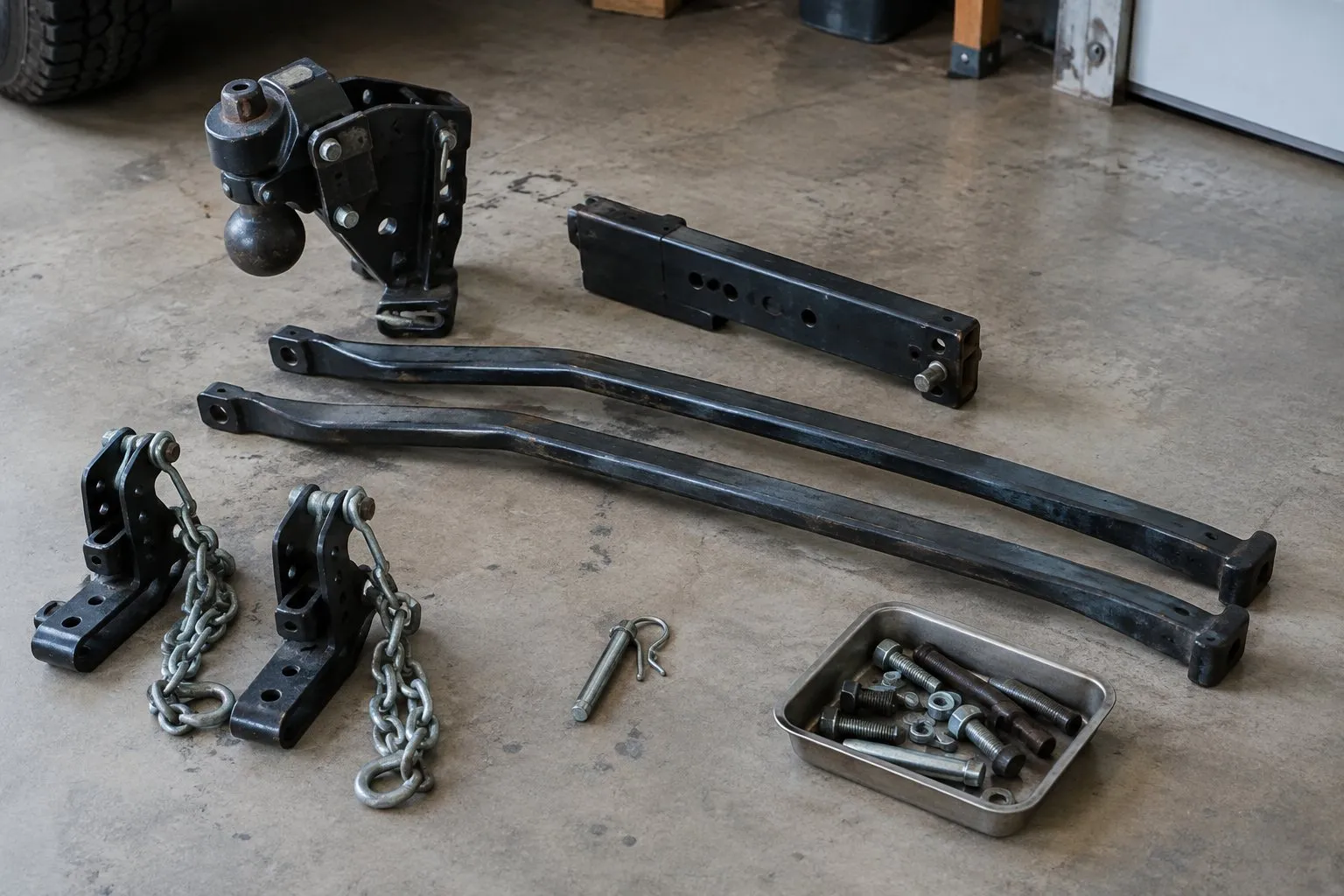
The parts, front to back
Read the hitch the way the load flows: from the truck's receiver, through the head, along the bars and onto the trailer frame. The names below follow Equal-i-zer's 6K–14K parts list and CURT's part pages. Other makers use other words for the same piece, so the common alternatives are in brackets.
| # | Part | What it does | Where you adjust it |
|---|---|---|---|
| 1 | Shank (adjustable shank) | Square bar that slides into the receiver; the head bolts to it | Hole position for height; flip for drop or rise on CURT shanks |
| 2 | Hitch pin and clip | Lock the shank in the receiver | – |
| 3 | Head (hitch head) | Carries the ball and the two sockets for the bars | Tilt, with spacer washers |
| 4 | Hitch ball | Takes the trailer coupler; often 2-5/16 inch | Torque per the manual |
| 5 | Spacer washers and rivet | Set the angle of the head | Add for more tension, remove for less |
| 6 | Spring bars (spring arms, equalizing arms) | Steel levers that carry the tension | Bar rating is chosen at purchase |
| 7 | Frame brackets (L-brackets, snap-up brackets, hookup brackets) | Clamp to the A-frame and hold the bar ends up | Bracket height, or chain link |
| 8 | Chains, or snap L-pins | Hold the bar end at the bracket | Chain kits: as the maker's manual says |
| 9 | Snap-up lever (lift handle) | Lever to lift the bar or chain onto the bracket | – |
| 10 | Sway control | Friction that resists side-to-side movement | Friction bar: adjustment bolt; integrated: by the tension |
At the truck: shank, head and ball
The shank is the part people forget to measure. It decides how high the head sits, and the head has to put the ball at the right height for your coupler. Equal-i-zer's standard shank gives up to 3 inches of drop and 7 inches of rise; CURT's 2 inch shank on the 17062 flips over for drop or rise. Lifted trucks often need a longer drop shank, covered on drop hitch for weight distribution.
The head is where the work happens. It bolts to the shank with two large bolts (3/4 x 5 inch, grade 8 on the Equal-i-zer), and its angle is set by spacer washers and an angle set bolt. More tilt puts more tension on the bars. The sockets on each side take the bars; Equal-i-zer's parts list adds a socket pin and clip for each. CURT's 17062 head has a grease zerk for its round bar sockets.
The ball sits on top of the head. CURT ships the 17062 with a pre-torqued 2-5/16 inch ball. Whatever ball you use, Equal-i-zer's manual says its rating must equal or exceed the trailer's gross weight.
Between them: the spring bars
The spring bars are the reason the hitch exists. Bent upward under load, they push back on the head and move part of the tongue load to the truck's front axle and the trailer axles; Ford's guide describes chains being pulled up and tightened to bend the bars. Each bar set has a rating, and Equal-i-zer prints the model on a sticker on each arm.
Bars come in two shapes. Round bars, like CURT's forged bars on the 17062, enter the head from the underside. Trunnion bars are square and enter from the side, so they sit closer under the head; the CURT TruTrack 4P lets you set them at 30 or 70 degrees. The difference in clearance and hookup is on round bar vs trunnion.
At the trailer: brackets, chains and pins
Two designs hold the bar ends:
- Chain and snap-up bracket. A bracket clamps to each side of the A-frame. A short chain hangs from the bar end, and you lever it up onto the bracket with the lift handle. CURT's 17062 uses this layout, and CURT names the chains and snap-up brackets as the way the kit is set up and adjusted.
- Fixed L-bracket. The bar rests on a bracket and is locked with a snap L-pin, no chain. Equal-i-zer and the CURT TruTrack 4P work this way; CURT says the adjustable brackets give fixed support, unlike chain models.
On the Equal-i-zer, the brackets clamp on with inside and outside link plates and bolts. Their distance from the coupler matters for turning and backing; Equal-i-zer places them 27 to 32 inches from the coupler's center. The bolting is covered on how to install a weight distribution hitch.
Sway control: a separate part, or built in
On a chain kit, sway control is usually a friction bar that bolts between a tab on the head and a ball on the trailer frame. CURT's 17062 has built-in tabs for it and ships its 17200 unit in the box. On an Equal-i-zer, there is no extra part: the friction at the sockets and at the L-brackets is the sway control. Both approaches are compared on integrated vs friction sway control.
The chain-free exception
Andersen's hitch has none of the steel bars. It uses 3/8 inch zinc-plated chains with red urethane springs at their ends, and a friction cone at the ball that Andersen calls a wear item. The other designs side by side are on types of weight distribution hitches.
When a part wears or goes missing
Pins, clips, washers and brackets have their own part numbers, while heads and bars are made for one size: Equal-i-zer lists a separate head and spring arm for each rating. Read the model number off the bar sticker before you order. Replacement shanks, brackets and sway bars you can buy are on weight distribution hitch parts. How all of these pieces work together as a lever is on how a weight distribution hitch works, and what the rig looks like with the bars tensioned is on before and after.
Questions at the scale house
Q01What does a weight distribution hitch look like?
Like a ball mount with a large, heavy head and two steel bars sticking out of it. The head sits on a shank in the receiver and carries the ball. The two spring bars run back along both sides of the trailer's A-frame, where chains on snap-up brackets or fixed L-brackets hold their ends up. Chain-free designs such as Andersen's have short chains with urethane springs and a cone at the ball instead of steel bars.
Q02What are spacer washers for on a weight distribution hitch?
They set the tilt of the head. Equal-i-zer's kit includes eight spacer washers and a spacer rivet. Adding washers tilts the head so the bars take more tension and move more load to the front axle; removing them does the opposite. Equal-i-zer's manual pairs them with the L-bracket height as the two ways to correct under- or over-distribution.
Q03What is the difference between spring bars and spring arms?
Nothing but the name. CURT calls them spring bars, Equal-i-zer calls them spring arms, and Ford's towing guide calls them equalizing arms. In every case they are the steel bars that run from the head to the trailer frame and carry the tension.
Weighed against
Next stop
- How it worksHow it worksHow does a weight distribution hitch work? Spring bars under tension lever part of the tongue load to the front axle and trailer axles.
- Replacement partsBuying sheetWeight distribution hitch parts: which shank, brackets, spring bars, washers, pins and sway bar to buy, and why each part has to match your hitch.
- Hitch typesHow it worksWeight distribution hitch types compared: chain style, fixed bracket, cam, chain-free cone and projection hitches, plus round vs trunnion bars.
- InstallationShop stepsWeight distribution hitch installation in order: coupler height, ball, head on the shank, bars, A-frame brackets, then the torque values.
- Before and afterHow it worksWeight distribution hitch before and after: why the rear squats and the front rises, what a good set-up brings back, and how to measure it.
Who weighs it up
weightdistributionhitch.com Editorial Desk
Towing set-up & hitch picks
We are the editorial desk at weightdistributionhitch.com. For every hitch we pull the tongue weight and trailer weight ratings, the shank and ball size, the bracket spacing and the torque values out of the maker's install sheet, then set them against the receiver label and the tow vehicle's own towing guide.
- — Ratings copied from the install sheet or part page, with document name
- — Set-up targets taken from the truck maker's towing guide, not a rule of thumb
- — "Not stated by maker" wherever a rating, surge-brake note or warranty term is missing