Weight distribution hitch vs airbags and helper springs
Side by sideReading span: 4 minchecked November 28, 2026by the editorial desk
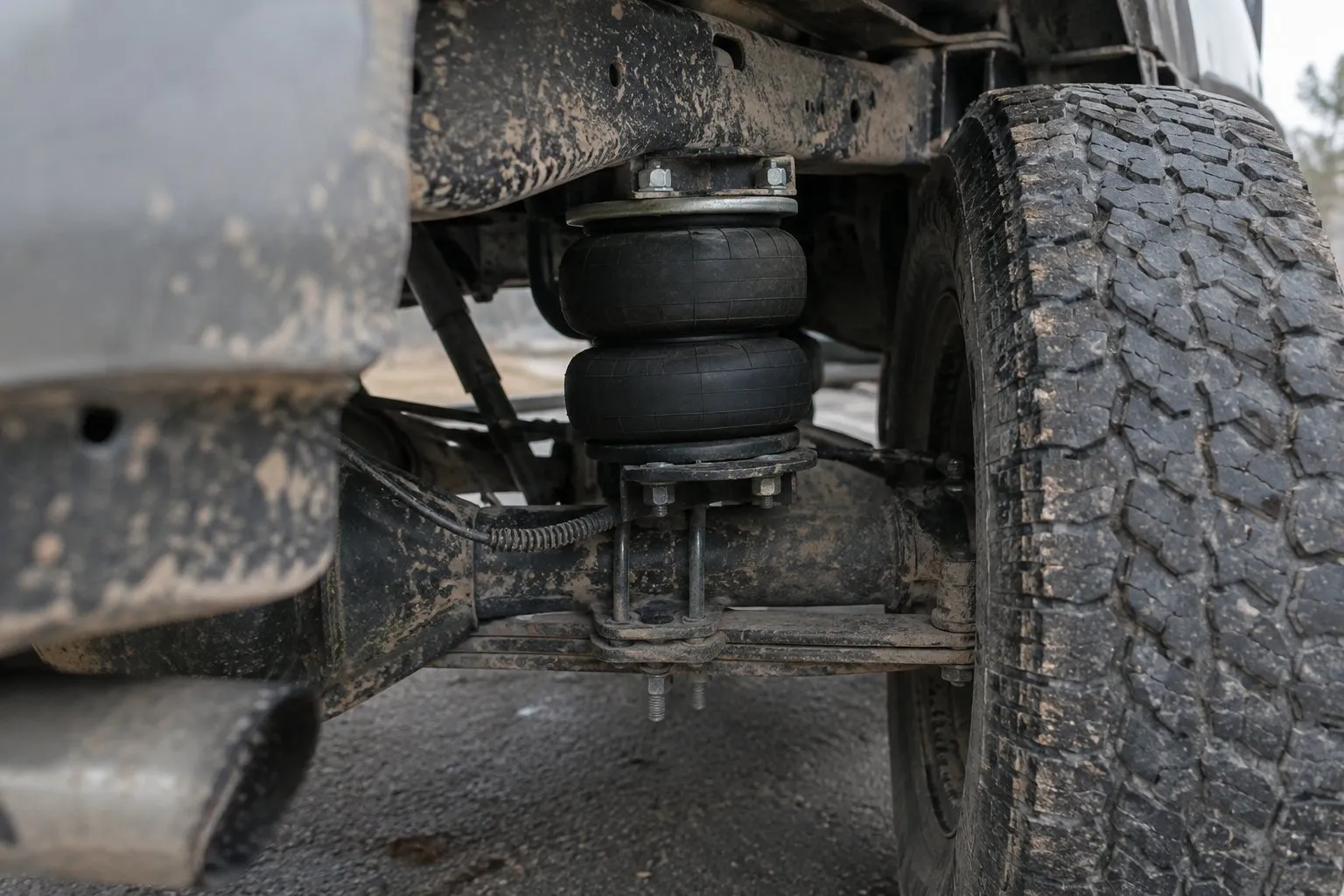
Weight distribution hitch vs airbags is not an either-or. The hitch levers part of the tongue load off your truck's rear axle and puts it back on the front axle and the trailer axles. Airbags, also called air springs or helper springs, hold the rear of the truck up under a load it already carries. One moves weight, the other supports it. Neither raises a weight rating.
On the ticket
They solve different problems. A weight distribution hitch moves part of the tongue load forward, so the front wheels get their steering and braking grip back. Airbags only lift a sagging rear; they do not move load to the front axle, and Air Lift says they do not change GVWR or GAWR. If your vehicle guide calls for weight distribution, airbags do not replace it.
The decision in one sentence
If the front of your truck lifts when the trailer goes on the ball, you need weight moved forward, and only the hitch does that; if the rear still sits low once the hitch is set right, airbags can help hold it up.
What each one does, point by point
| Weight distribution hitch | Airbags / air helper springs | |
|---|---|---|
| What it is | Spring bars between the hitch head and the trailer frame | Air springs added to the truck's rear suspension |
| What it changes | Moves part of the tongue load from the rear axle to the front axle and the trailer axles | Supports the rear and restores ride height |
| Front axle | Gets load back, so steering and braking grip return | No change in load |
| Weight ratings | Does not raise the truck's tow rating; lets the receiver use its weight-distributing limit | Air Lift: do not change GVWR, GCWR or GAWR |
| Sway | Correct tension helps; many kits add sway control | No sway claim in Air Lift's article |
| Adjusted with | Washers, brackets, chains, ball height | Air pressure |
| Interaction | Its setting drops if the rear is lifted afterward | Inflating after set-up reduces the hitch's distribution (Equal-i-zer) |
Ford describes the hitch side plainly: chains bend the spring bars upward, which lifts some of the weight off the rear wheels and transfers it to the other wheels of the truck and trailer. Air Lift describes its own product just as plainly: air springs provide load assistance for a sagging vehicle. Neither maker claims the other's job.
Why "the rear is level now" is not the goal
The danger of a heavy tongue is at the front, not the back. Ford's guide warns that too much tongue load presses the truck down in back until the front wheels lift and traction, steering response and braking drop sharply. An airbag that pushes the rear up makes the truck look level, but the tongue still rests on the hitch behind the rear axle, and Air Lift gives the credit for spreading that load to both axles to the weight distribution bars. A level-looking truck with light front wheels is the trap. What the front end does with and without bars is shown on weight distribution hitch before and after, and the lever behind it on how a weight distribution hitch works.
Using both on one truck
Air Lift presents its air springs and weight distribution bars as a pair for stability and control. The order matters more than the parts:
- Load the rig for the trip. Air pressure set the way you will tow.
- Set the hitch first. Use your truck maker's target for the front fender. Ford, for example, uses 50 % front axle load restoration on the F-150. Air Lift's article also starts with the bars and adds air only where the bars cannot reach the right height.
- Add air after, then re-measure. Equal-i-zer's appendix says air bag suspension and auto-leveling decrease the hitch's weight distribution after set-up. Measure the front fender again with the final pressure and add bar tension if the reading dropped below your target.
- More cargo later? Air Lift suggests more air pressure rather than tighter bars or re-adjusting them. If the fender reading moves out of your target, the bars still need adjusting.
Equal-i-zer's appendix also asks you to follow your vehicle owner's manual or the air bag instructions when you tow. Andersen adds a reminder in its FAQ: worn suspension on truck or trailer can keep a weight distribution hitch from evening out the load, so fix that before adding parts.
Factory air suspension is a different case
Trucks that leave the factory with air suspension or auto-leveling follow their own manual. Ram's 2500/3500 manual has its own hitch set-up for air-suspension trucks, and Equal-i-zer's appendix gives separate rules for 4-corner and rear-only systems, including a 20 to 25 % loss of distribution with 4-corner leveling. That case has its own page: weight distribution hitch with air suspension. Truck-specific limits for the Ford F-150 are listed separately.
Pick by the problem you see
- Front end rises when you hitch up: set up or adjust a weight distribution hitch. The buying side is on best weight distribution hitch.
- Rear sags even with the hitch at its target: airbags can support the rear; set the air, then re-measure.
- You hope for a higher tow rating: neither part changes it, as explained on does a weight distribution hitch increase towing capacity.
Questions at the scale house
Q01Do I need airbags if I have a weight distribution hitch?
Not as a rule. A hitch set to your truck maker's target already brings load back to the front axle. Andersen writes that some owners add airbags or other suspension upgrades to further assist with leveling, and stresses that worn suspension can keep the hitch from evening out the load. Add airbags when the rear still sags with a correct set-up, not to cover a wrong one.
Q02How do I use airbags with a weight distribution hitch?
Set the hitch first, then the air. Air Lift's set-up article tensions the bars first and adds air only if the bars cannot bring the truck to the right height. For extra cargo later, Air Lift suggests more air pressure rather than tighter bars. Equal-i-zer adds that inflating airbags after set-up reduces the weight distribution, so re-measure the front fender afterward.
Q03Should the airbags be deflated when I set up the hitch?
Equal-i-zer's manual says to turn off or disable air bag suspension and auto-leveling for the hitch set-up, after letting the suspension settle at its normal position, and to follow your vehicle or air bag instructions. Air Lift's own article takes the reference heights with the truck unloaded. Use one method from start to finish and measure with the air pressure you will tow at.
Weighed against
- [1]Air Lift, weight distribution bars and air springs
- [2]Air Lift, air suspension myths
- [3]Equal-i-zer 4K owner's manual (PDF), appendix on auto-leveling and air bag suspensions
- [4]Andersen, weight distribution hitch FAQ
- [5]Ford, 2026 RV & Trailer Towing Guide (hitch styles p. 5, tongue load p. 7)
- [6]Ram 2022 2500/3500 owner's manual, recommended distribution hitch adjustment
Next stop
- Air suspensionWill it fit?Air suspension towing with a weight distribution hitch works, but the set-up changes: what Ram, Equal-i-zer and CURT say for auto-leveling.
- How it worksHow it worksHow does a weight distribution hitch work? Spring bars under tension lever part of the tongue load to the front axle and trailer axles.
- Before and afterHow it worksWeight distribution hitch before and after: why the rear squats and the front rises, what a good set-up brings back, and how to measure it.
- Does a weight distribution hitch increase towing capacity?Straight answerDoes a weight distribution hitch increase towing capacity? No. It unlocks the receiver's higher rating, while your truck's tow rating stays the same.
- Do I need a weight distribution hitch?Straight answerDo I need a weight distribution hitch? Your vehicle guide and receiver label decide. Ford sets the F-150 line at 5,000 lb; here is how to find yours.
Who weighs it up
weightdistributionhitch.com Editorial Desk
Towing set-up & hitch picks
We are the editorial desk at weightdistributionhitch.com. For every hitch we pull the tongue weight and trailer weight ratings, the shank and ball size, the bracket spacing and the torque values out of the maker's install sheet, then set them against the receiver label and the tow vehicle's own towing guide.
- — Ratings copied from the install sheet or part page, with document name
- — Set-up targets taken from the truck maker's towing guide, not a rule of thumb
- — "Not stated by maker" wherever a rating, surge-brake note or warranty term is missing