Weight distribution hitch before and after: what the fender tape shows
How it worksReading span: 4 minchecked November 28, 2026by the editorial desk
Weight distribution hitch before and after, in numbers: before, the tongue load squats the truck's rear and lifts the front fender. After the bars are tensioned, the front comes back down part of the way, to the target your truck maker sets. Ford's own example: fender at 37 inches unhitched, 38 inches hitched without bars, 37.5 inches with the bars.
On the ticket
Before: the trailer tongue pushes the truck's rear down and the front rises, so the front tires carry less load. After: the spring bars push the front back down. In Ford's F-150 example the fender goes from 37 to 38 inches on hitching, and the bars bring it to 37.5. Equal-i-zer's example gets to 75 %. Neither aims to put the fender back to its unhitched height.
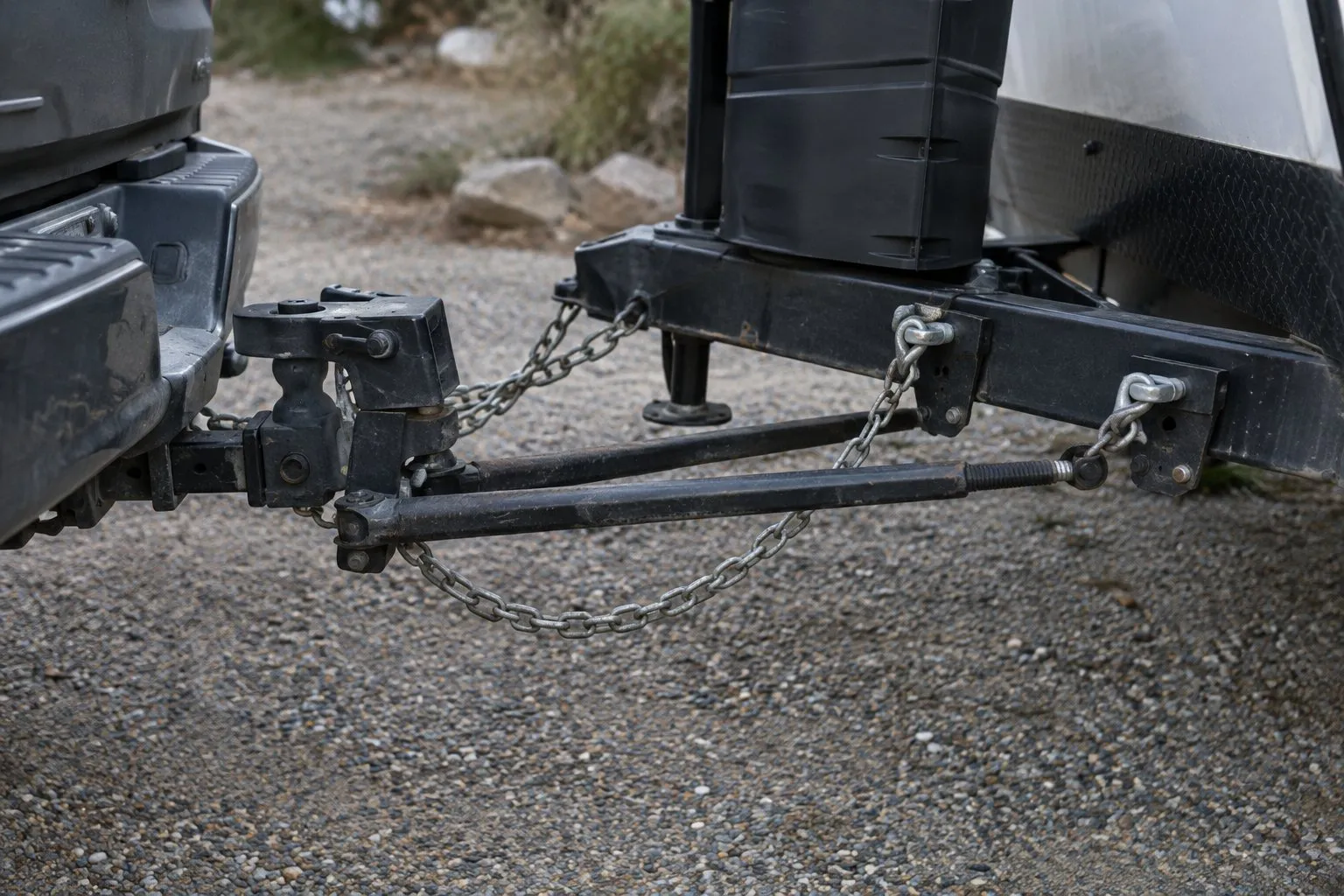
Before: what a bare ball mount does to the truck
Hitch a loaded travel trailer to a plain ball mount and the truck tips over its rear axle. Equal-i-zer calls it a teeter-totter effect: weight behind the rear axle weighs down the back and lifts the front of the tow vehicle. You see it as a rear that sits low and a front fender that has moved up.
What you feel matters more than what you see. Ford's guide warns that too much tongue load can press the vehicle down in back until the front wheels lift to the point where traction, steering response and braking are severely decreased. The front tires are the ones that steer and do much of the braking, and before the bars go on, they carry less than they did with the truck alone.
After: the bars push the front back down
Tensioned spring bars lever part of the tongue load forward to the front axle and back to the trailer's axles. The tongue weight itself stays the same; only where it ends up changes. That point is on does a weight distribution hitch reduce tongue weight, and the lever is drawn out on how a weight distribution hitch works.
The change shows up on a tape measure at the front fender. Two makers publish worked examples:
| Ford F-150 example | Equal-i-zer manual example | |
|---|---|---|
| Before hitching (H1 / A) | 37 inches | 30 inches |
| Hitched, no bars (H2 / B) | 38 inches | 31 inches |
| Hitched, bars on (target / C) | 37.5 inches | 30-1/4 inches |
| Share of the rise brought back | 50 % (Ford's correction factor) | 75 % (Equal-i-zer's calculation) |
Both "after" values sit between the unhitched and the hitched height. Neither example puts the fender back to where it was before hitching, and Equal-i-zer's manual warns against going past that point: over 100 % is over-distributed and can remove too much weight from the rear axle, with a loss of traction that can end in a jack-knife on slick roads.
- 1H1 · unhitched
- 2H2 · hitched, bars off
- 3target · bars on
- 4Ford: 50 % front axle load restoration
- 5Ram 2500/3500: (H2 − H1) ÷ 2 + H1
- 6Equal-i-zer: 50–100 %, never over 100 %
Measure the front fender height from the ground to the top of the wheel opening. Targets from the 2026 Ford towing guide, the 2022 Ram 2500/3500 owner's manual and the Equal-i-zer manual.
What changes in the driver's seat
The table moves in fractions of an inch; the driving difference is about load on the front tires. Equal-i-zer's manual describes the under-distributed rig, the "before" side of the picture: too much weight on the rear axle and not enough on the front, with a loss of steering and braking control and reduced resistance to trailer sway. Its closing page describes the "after" side: tongue weight transferred to all axles, improving steering and stopping and giving a level ride.
The trailer has a before and after too
The trailer should ride level once the hitch is set up. Ford starts the set-up with the trailer level or just slightly nose down. After the weight distribution is right, Equal-i-zer has you measure the trailer frame from the ground at the front and the rear, and move the hitch head up or down on the shank if the two differ by more than 1-1/4 inches. Each change in ball height means a new fender measurement. The ball height itself is set first, on how to measure hitch drop.
Measure your own before and after
You need a tape measure, a level spot and the rig loaded for the trip. Measure the front fender lip above the center of the wheel unhitched, hitched without bars, and hitched with bars. Ford calls the first two H1 and H2; Equal-i-zer calls the three A, B and C and works out the result as 100 × (B − C) ÷ (B − A). The full procedure, with every vehicle maker's target, is on how to set up a weight distribution hitch. If your result is off, weight distribution hitch adjustment covers washers and brackets.
Air bags and helper springs change the rear stance too, and auto-leveling suspension cuts into what the bars do: Equal-i-zer's manual puts the loss at 20 to 25 % for 4-corner systems. How the two approaches compare is on weight distribution hitch vs airbags.
Questions at the scale house
Q01How much should the front fender come down after hooking up the bars?
As far as your truck maker's target, not all the way. Ford uses a correction factor of 50 % for the F-150 and most Super Duty trucks, so the fender comes back half of the rise. Equal-i-zer's manual calls 50 to 100 % good and never more than 100 %. Measure before and after; the difference is your answer.
Q02Should the truck sit level after a weight distribution hitch is set up?
Closer to level, but the target is a number, not a look. Ford sets its fender target between the unhitched and the hitched height. What should sit level is the trailer: Equal-i-zer asks you to measure its frame front and rear and move the hitch head if the two differ by more than 1-1/4 inches.
Q03Why does the truck still squat a little with the bars on?
Because a good set-up leaves some load on the rear axle. Ford's 50 % target brings back only half of the front rise. Andersen says its chain-free hitch is designed to leave a portion of the tongue weight on the rear axle for traction. If the rear sags more than your target allows, add tension.
Weighed against
Next stop
- How it worksHow it worksHow does a weight distribution hitch work? Spring bars under tension lever part of the tongue load to the front axle and trailer axles.
- Set-upShop stepsHow to set up a weight distribution hitch: measure H1 and H2 at the front fender, find your truck maker's target, then tension the bars.
- WD hitch vs airbagsSide by sideWeight distribution hitch vs airbags: the hitch moves tongue load to the front axle, airbags lift a sagging rear. Different jobs, one team.
- AdjustmentShop stepsWeight distribution hitch adjustment: which washer, bracket or ball change adds or removes tension, and how to spot over- and under-distribution.
- Does a weight distribution hitch reduce tongue weight?Straight answerDoes a weight distribution hitch reduce tongue weight? No. The trailer still puts the same load on the ball; the spring bars move where it ends up.
Who weighs it up
weightdistributionhitch.com Editorial Desk
Towing set-up & hitch picks
We are the editorial desk at weightdistributionhitch.com. For every hitch we pull the tongue weight and trailer weight ratings, the shank and ball size, the bracket spacing and the torque values out of the maker's install sheet, then set them against the receiver label and the tow vehicle's own towing guide.
- — Ratings copied from the install sheet or part page, with document name
- — Set-up targets taken from the truck maker's towing guide, not a rule of thumb
- — "Not stated by maker" wherever a rating, surge-brake note or warranty term is missing