Weight distribution hitch storage: bars, head and chains between trips
Shop stepsReading span: 4 minchecked November 28, 2026by the editorial desk
Good weight distribution hitch storage is simple: take the head and shank off the receiver when you are not towing, clean the friction surfaces, touch up bare steel, and keep the parts dry and out of the weather. The makers' manuals ask for exactly that, and for a check of every bolt before the next trip.
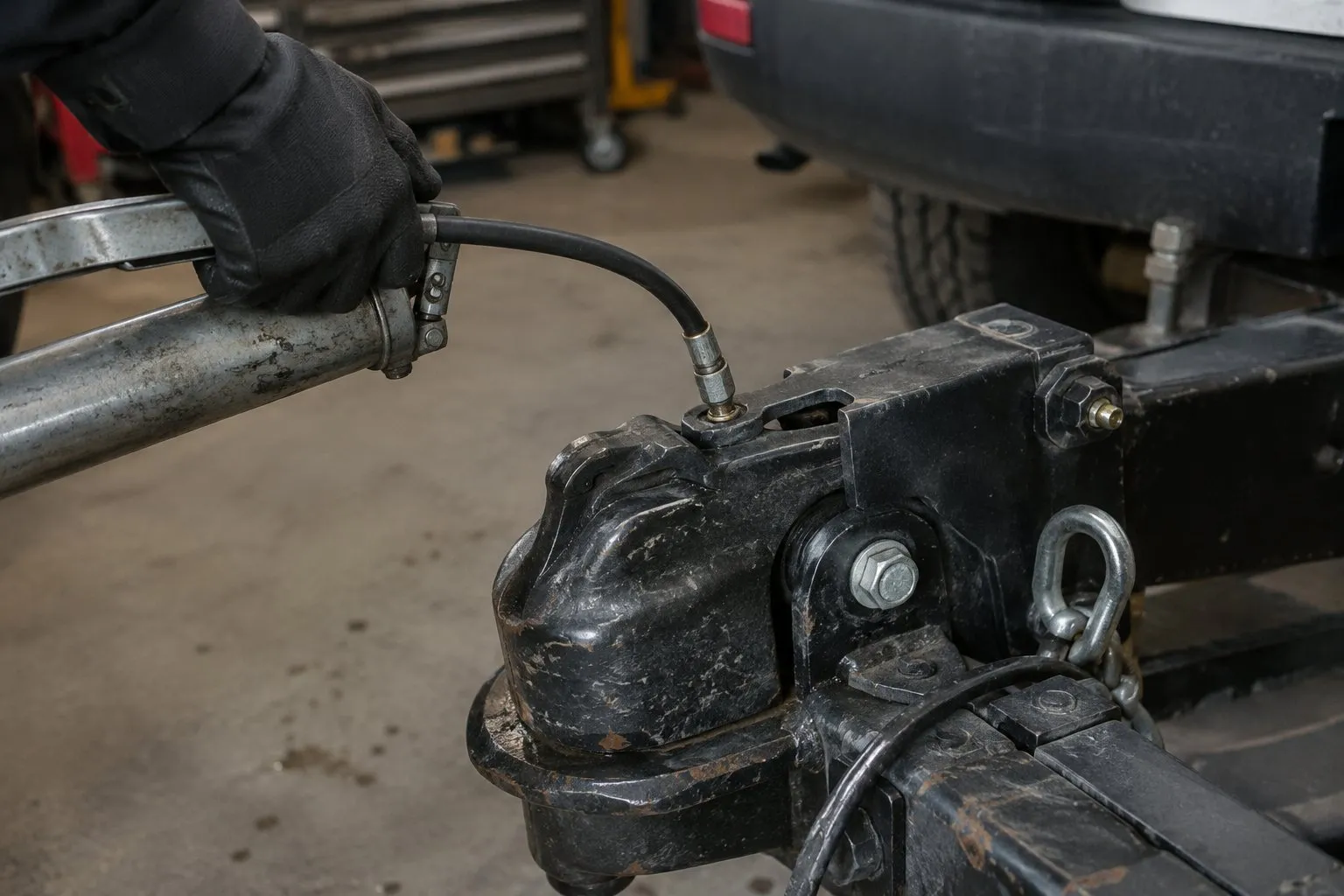
Why the hitch comes off the truck
A weight distribution head left in the receiver is a heavy steel block hanging off the back of the truck. Husky gives three reasons to remove it whenever you are not towing: dirt gets into the spring bar sockets, the head can strike a driveway or other objects, and loose parts are easy to steal. The Center Line TS Plus manual goes one step further and asks you to store the ball mount and shank in a clean, dry place. Equal-i-zer's wording is short: store your hitch out of the weather when not in use.
Plan for the weight. CURT lists its 17422 trunnion hitch at 105 lb. That is a two-person lift or a job for a hand cart, not something to juggle above a tailgate.
What to do on the day you unhitch
Take the tension off before you unhook
Chock the trailer and raise the tongue with the jack until the bars go slack. Equal-i-zer's rule: never loosen or remove any part of the hitch while it is under load. Then pull the L-pins or open the lift brackets.Pull the bars, then the head and shank
Take the spring bars out of the head, unhitch the trailer, and slide the head and shank out of the receiver. The hook-up guide shows the same steps in the order you use them at the campsite.Clean the sockets and friction surfaces
Husky asks you to keep the round bar ends and the sockets free of dirt, and not to let stones lodge around the spring bar retainer. Equal-i-zer asks for dirt to come off all friction surfaces regularly. A clean hitch also makes less noise.Touch up bare steel, not the labels
Equal-i-zer and Husky both ask you to keep the parts painted against rust, with a good spray paint on chips. Neither wants paint on the rating labels or warning stickers. Equal-i-zer sends a free replacement if its stickers become unreadable.Unload any sway clamp
Camco asks for the ReCurve R3 to be stored with the preload removed from its sway control, which means loosening the activation bolt. More on that kit is on the Eaz-Lift page.Store the set dry and together
Head, shank, both bars, pins and clips go into one dry spot. Equal-i-zer's spring arms only fit a head of the same rating, so a mixed-up set can leave you with bars that do not fit.Check everything before the next trip
Re-grease, tighten and inspect, as the next sections explain.
Grease, or no grease: it depends on the design
Storage is the time to clean, not to guess at lubricant. The makers disagree because their hitches work differently:
| Hitch | What the maker asks |
|---|---|
| Equal-i-zer | Clean and grease the friction surfaces of the head and the ball before each trip; no grease on the swing arms or L-brackets |
| Husky round bar | Marine-grade wheel bearing grease on the round bar ends and the ball at the start of every towing day; keep lift brackets clean and lubricated |
| Husky Center Line TS | No grease on the friction plates or trunnion surfaces, because it weakens the built-in sway control |
| Husky Center Line TS Plus | A light lubricant such as petroleum jelly on the lift bracket support surfaces, against wear and rust |
| Camco Eaz-Lift ReCurve R3 | Wheel bearing grease on the trunnion spindle through its fitting before each use |
| Andersen | No grease; a trailer and hitch lubricant on the rub points if the chains squeak |
So grease that suits one hitch can work against another. If you own a hitch not listed here, its manual decides. The parts of a weight distribution hitch page shows where sockets, trunnions and brackets sit.
Before the first trip of the season
A hitch that sat for months gets the same check as one used yesterday, and a little more:
- Bolts and nuts. Equal-i-zer asks for all hardware to be checked and tightened if needed before each trip. Husky asks you to check that all hitch bolts are tight at the start of every towing day, and to check every fastener on the TS Plus once a year.
- Wear. Look at the bar ends, sockets, chains and U-bolts. Husky reads heavy wear at the bar ends as a sign of overload or too little grease, and asks you to replace chains before they wear out.
- Grease. Apply it where your manual asks, then hook up.
- Set-up. If you changed truck, trailer or how you load over the winter, measure again. The weight distribution hitch set-up has the routine.
The rest of the care schedule, from grease intervals to torque values, is on weight distribution hitch maintenance.
Questions at the scale house
Q01Can I leave the weight distribution hitch in the receiver when I am not towing?
The makers say take it out. Husky's manuals ask you to remove the hitch from the receiver when you are not towing, to keep dirt out of the spring bar sockets, to avoid striking it on a driveway or other objects, and to lower the chance of parts being stolen. Equal-i-zer asks you to store the hitch out of the weather when it is not in use.
Q02Do the spring bars have to stay with the same hitch head?
Keep them together as a set. Equal-i-zer says its spring arms are sized for a hitch head of the same rating and will not fit a head of a different rating. Husky asks you to always use a pair of bars of the same rating and size. Store the two bars with their head so they never get mixed with another kit.
Q03Should the hitch be greased before it goes into storage?
Clean it first, then follow your model's manual. Equal-i-zer has you clean and grease the friction surfaces of the head before each trip, and Camco asks for grease on the R3 trunnion spindle before each use. Husky's Center Line TS is the exception: its manual says not to grease the friction plates, because that weakens the built-in sway control.
Weighed against
- [1]Equal-i-zer 4K owner's manual (PDF): maintenance and care, how to unhitch
- [2]Husky Towing, round bar kits 31421 to 31425 instructions, REV. 10 (PDF on SEMA Data)
- [3]Husky Towing, Center Line TS Plus 33300 instructions, Rev3 2025 (PDF on SEMA Data)
- [4]Camco Eaz-Lift, ReCurve R3 installation instructions (PDF)
- [5]Andersen, weight distribution hitch FAQ
- [6]CURT, part 17422 trunnion bar weight distribution hitch
Next stop
- MaintenanceShop stepsWeight distribution hitch maintenance in ten minutes: where the grease goes and where it never goes, which bolts to check and what wear to look for.
- Hook-up routineShop stepsHow to use a weight distribution hitch on every trip: couple, lift with the jack, hook the bars, lower, connect chains and wiring. Unhooking too.
- Parts explainedHow it worksParts of a weight distribution hitch, from shank and head to spring bars, brackets, pins and sway control: what each one does and where you adjust it.
- Hitch noiseFault and fixWeight distribution hitch noise usually means dry friction points or binding chains. Where each squeak comes from and what to grease, or never grease.
- Eaz-LiftMaker fileEaz-Lift weight distribution hitch from Camco: how the Elite and the ReCurve R3 differ, what the R3 ratings mean, and how to grease and store it.
Who weighs it up
weightdistributionhitch.com Editorial Desk
Towing set-up & hitch picks
We are the editorial desk at weightdistributionhitch.com. For every hitch we pull the tongue weight and trailer weight ratings, the shank and ball size, the bracket spacing and the torque values out of the maker's install sheet, then set them against the receiver label and the tow vehicle's own towing guide.
- — Ratings copied from the install sheet or part page, with document name
- — Set-up targets taken from the truck maker's towing guide, not a rule of thumb
- — "Not stated by maker" wherever a rating, surge-brake note or warranty term is missing